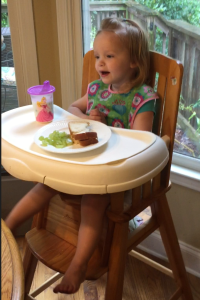
 I don’t know about you, but there are times when I’m truly confounded by the things small children quibble over. For example, my dear grandchildren, ages 2, 4 and 7, will argue about whose turn it is to say the blessing. In fact, they’ll talk over said blessing should one of them start praying before we’ve fully sorted out whose turn it is. Although I’d like to think their bickering arises because they realize how important it is to thank God, I’m afraid it is due instead to a desire for the honor of saying it.
Ah, teachable moments around the table for sure. I’ve tried telling them they can each say a blessing or we can all pray together because God delights in hearing from us and receiving our praises, all to no avail. And so I’m often left silently raising a petition of my own, “Lord, please help them to always have this much enthusiasm when it comes to wanting to thank You!”
Several weeks ago, I was helping daughter, Mary tuck the children in. 7-year-old Joshua selected the recounting of Jesus healing the 10 lepers from his children’s Bible as his bedtime story. In my ESV[1] Bible, the narrative in the Gospel of Luke appears as follows:
On the way to Jerusalem he was passing along between Samaria and Galilee. And as he entered a village, he was met by ten lepers, who stood at a distance and lifted up their voices, saying, “Jesus, Master, have mercy on us.” When he saw them he said to them, “Go and show yourselves to the priests.” And as they went they were cleansed. Then one of them, when he saw that he was healed, turned back, praising God with a loud voice; and he fell on his face at Jesus’ feet, giving him thanks. Now he was a Samaritan. Then Jesus answered, “Were not ten cleansed? Where are the nine? Was no one found to return and give praise to God except this foreigner?” And he said to him, “Rise and go your way; your faith has made you well.” (Luke 17:11-19)
All ten of the lepers cried out to Jesus to heal them. All ten had faith He could do so and followed His command to present themselves to the priest even though the healing didn’t occur immediately in Jesus’ presence. Yet only one took the time to come back and thank Him. And this was no weak, afterthought of a “thanks”. Look again. The passage states the man was praising God with a loud voice and fell on his face at Jesus’ feet in gratitude.
When’s the last time we’ve acknowledged God’s good gifts with such exuberant praise? Not only do we rarely demonstrate such gratitude, but too often we behave like the nine who didn’t return to thank Jesus at all, overlooking or taking for granted His many blessings. Scripture is clear that God is worthy of all praise and thanks. David’s prayer after the Israelites made their offerings for the construction of the Temple is exemplary in acknowledging God’s ownership and benevolence:
Therefore David blessed the Lord in the presence of all the assembly. And David said: “Blessed are you, O Lord, the God of Israel our father, forever and ever. Yours, O Lord, is the greatness and the power and the glory and the victory and the majesty, for all that is in the heavens and in the earth is yours. Yours is the kingdom, O Lord, and you are exalted as head above all. Both riches and honor come from you, and you rule over all. In your hand are power and might, and in your hand it is to make great and to give strength to all. And now we thank you, our God, and praise your glorious name. But who am I, and what is my people, that we should be able thus to offer willingly? For all things come from you, and of your own have we given you.” (1Chronicles 29:10-14)
Jesus himself set an example for us by thanking the Father for sustenance (Matthew 15:36; John 6:11), as well as for hearing His prayers. (John 11:41) And the Apostle Paul repeatedly thanked God for the faith of his fellow believers (see, for example, Romans 1:8, 1 Corinthians 1:4, and Ephesians 1:15-16) and for the inexpressible gift of salvation itself (1 Corinthians 15:57; 2 Corinthians 9:15), reminding us of Jesus’ teaching regarding the superiority of imperishable spiritual treasure. (Matthew 6:19-20)
Furthermore, in his letter to the Colossians, Paul instructed his readers three times in as many sentences to be thankful:
And let the peace of Christ rule in your hearts, to which indeed you were called in one body. And be thankful. Let the word of Christ dwell in you richly, teaching and admonishing one another in all wisdom, singing psalms and hymns and spiritual songs, with thankfulness in your hearts to God. And whatever you do, in word or deed, do everything in the name of the Lord Jesus, giving thanks to God the Father through him. (Colossians 3:15-17)
From the priceless gift of salvation to daily bread, from the beauty of creation to the warmth of friendship, from answered prayer to our very breath and every heartbeat, the reasons to thank God are infinite. Let us avail ourselves of myriad opportunities to praise Him. In so doing, may we model for our little ones how important it is to thank Him with happy hearts and joyful voices for His gracious gifts – not for our glory, but for His.
[1] English Standard Version
 Yet the most sobering examples are times when I haven’t asked God. Years ago, I realized I was praying to God about BIG things, but I didn’t want to bother Him with matters I thought were too trivial. After all, He’s a BIG God, Sovereign over everything. He spoke the world into existence (Genesis 1:1-25), makes the sun rise and set (Jeremiah 31:35), and sustains all of creation. (Matthew 6:25-34)
 I gazed in wonder at the rings and bittersweet tears filled my eyes. Gratitude for having my precious rings restored as close as possible to the originals mingled with sorrow. It took a little time and money, but I was able to replace my rings. Yet I knew if I sold all my belongings and scraped together every cent of the proceeds, I couldn’t ever pay anyone enough to get Ray back. One day, I will go to him. But he will never return to me. (2 Samuel 12:23)
 2 Samuel 11 recounts the whole sordid scenario. David’s first mistake? He didn’t lead his troops into battle against the Ammonites. (v. 1) He chose to stay home instead, which meant he was available to take an afternoon stroll on his rooftop. As he gazed about, he spied a beautiful woman, mid-bath. Instead of respectfully averting his eyes, he inquired as to who she was. Even when informed that she was a married woman, he had her brought to the palace so he could lay with her. (vs. 2-4) When this dalliance led to Bathsheba becoming pregnant, King David concocted a scheme to bring her husband back from the front lines so he could spend time with his wife. But Uriah was an honorable man and refused the conjugal visit while his fellow soldiers and the ark remained camped in an open field. Instead, he slept at the door of the king’s house. The next day, David encouraged him to go to Bathsheba, even making him drunk. Still Uriah refused. (vs. 5-13)
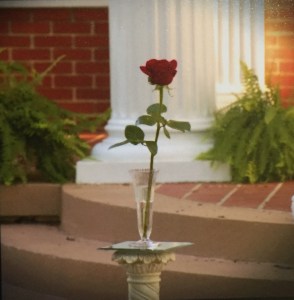 25 years later, Mary and Justin chose to wed in the warmest month of the year too, but by then, there was no dad to walk Mary down the aisle. Instead, she bravely trod the runner-clad distance herself, since no one could take the place of the man who first captured her little-girl heart. I linked arms with her to walk the last few steps to the altar, then gave her away, without reservation, to a young man I knew her dad would not only approve of, but would have been good friends with. A single red rose
 My grandchildren are getting old enough to understand the man by my side in the wedding photo on Mary’s wall is their grandpa in heaven. My heart leapt yesterday when 2-year-old Emma mentioned Grandpa Kuipers for the first time. I love telling them about Ray, sharing his love for God and people and plants and assuring them they’ll get to meet him one day.
 crape myrtle, sights and sounds of early-morning re-awakening greeted me. Two glistening gold finches balanced atop gently-swaying stalks of verbena, expertly extracting the tasty seed. All kinds of busy pollinators buzzed in and out of colorful blossoms. A bejeweled hummingbird hovered near the lantana. Butterflies zig-zagged lazily in the breeze. Birds chirped and frolicked in the sprinkler spray. My heart exulted.

 I was barely halfway down the stairs, looking forward to a day at home to do a few chores, maybe some writing and a little weeding, when I saw it. Instead of facing outward toward the sun like its fellow flowers, one beautiful blossom on the althea on my front porch was peeking in the left sidelight. A joyful, irrepressible exclamation escaped my lips, “Good morning, Lord! Thank You!!” I knew, without a doubt, Who was responsible for the perfectly-placed greeting.
 Our pastor has been preaching through the book of Exodus. The events recorded in the second book of the Bible – the burning bush, the plagues, the parting of the Red Sea, the giving of the Ten Commandments – have been part of my Biblical knowledge for as long as I can remember, dating back to my childhood Sunday school classes. Nevertheless, this ongoing sermon series has yielded a number of thought-provoking insights for now-grown-up me to ponder.
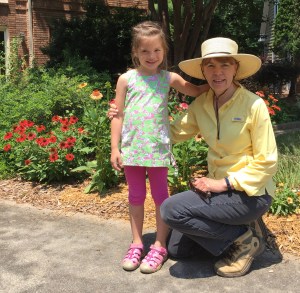 I was working in my garden one recent afternoon, when my youngest neighbor, sweet-spirited Sadie, paid me a visit. We were chatting about flowers and butterflies and bumblebees when she suddenly asked, “Do you have a husband?” I replied, “I used to, but he’s already in heaven. He planted a lot of my trees. That’s why I love them so much.” As I watched, belatedly realizing I’d given a much-too-detailed reply to her simple question, her countenance was overshadowed by a pensive consternation. Nonetheless, before I had a chance to offer up something more appropriate, Sadie’s expression brightened once again as she assured me, “But you’re not alone! You have lots of people around you!” I immediately followed up with, “You’re right! I have such good neighbors.”
 Back 2 the Garden