Groaning

For we know that the whole creation has been groaning together in the pains of childbirth until now.
Romans 8:22

Intruders

I heard a noise above me and looked up. The sound was coming from the gutter and was accompanied by the shuffling of leaves. I could see a few stems and tips moving along the edge.

Well, great. (Insert eye roll.) Something else for the wildlife guys to deal with. They’d already been working on ridding my attic of rats. Maybe the varmints were using the gutter to gain access to their new digs.

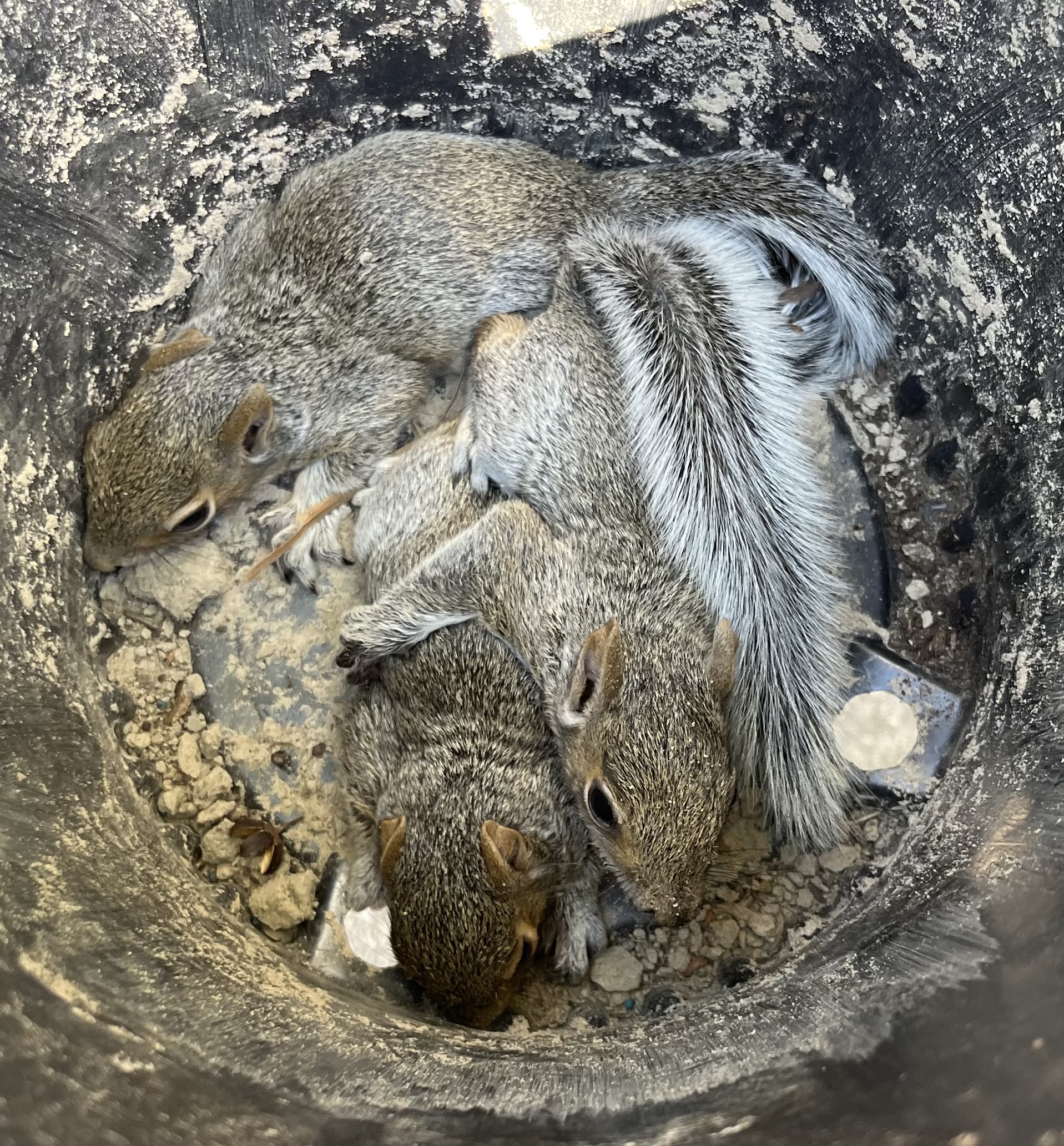
My grandson Joshua was with me when the fellows showed up the next day. One climbed the ladder they brought while the other one steadied it. Elmer lifted the gutter cover just enough to see a tail. But it wasn’t a long, skinny, hairless one. It was fluffy and belonged to a half-grown squirrel, one of three inhabiting a nest the mother squirrel had managed to construct in the narrow confines of the gutter.

As Joshua and I watched the eviction process, I lamented as I often do when some critter or another takes up residence in an off-limits part of my house, “I left plenty of trees for them to live in! Why do they choose to get in/on my house?”

Joshua piped up, “It’s like the garden of Eden, Grammie! There was only one tree Adam and Eve weren’t supposed to eat from, and that’s the one they wanted!” (Genesis 2:16-17)

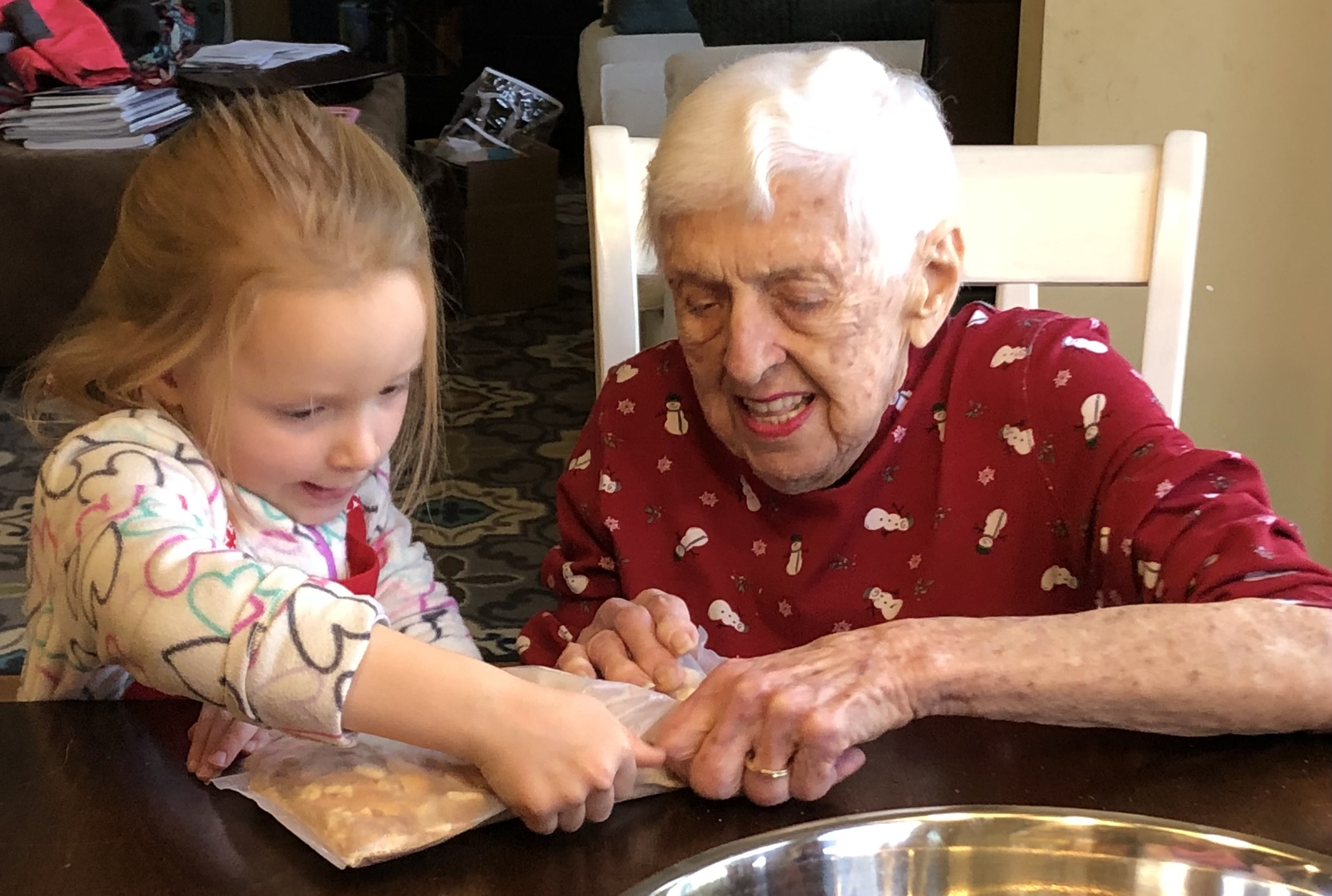
Delighted that Joshua had made that spiritual connection, I asked him if he wanted to expand on his observation like he’d done earlier this year with the parable of the bulbs.[1] However, he was more interested in accompanying Elmer into the attic to check the rat traps after he and his helper gently removed the baby squirrels from the gutter. 

But, once Joshua had planted that thought, I just had to ponder it!

Forbidden Attractions

What is it that’s so attractive about things that are off-limits? Regardless of our age, humans have an inborn desire for the forbidden. Sadly, original sin resides deep inside us, making us vulnerable to the enemy’s whispered, doubt-producing innuendos and causing us to question God’s goodness as Adam and Eve did (Genesis 3:1-6). What if He’s holding out on us, keeping the best to Himself?

Nope! We can squelch any doubts about God’s goodness by looking to the Cross. God gave us the very best He could have given us in Jesus, and Scripture assures us that if He gave us the most priceless gift, He won’t withhold any lesser thing (Romans 8:32).

Then there are the sinful tendencies passed on from more recent generations – frailties and misconceptions that continue to affect decisions and behavior until someone recognizes the familial brokenness and says, “Enough! This stops with me!”

Jesus’ sinless life, atoning death, and triumphant resurrection made the ultimate declaration. Praise God, our enslavement to sin ended with His selfless sacrifice on our behalf (Ephesians 2:4-7)! Though we will continue to battle the remnants of our sinful nature until Jesus calls us Home, the Spirit is transforming us more and more into the image of Christ (2 Corinthians 3:18).

Repeat Offender

The day after Elmer took the juvenile squirrels to their new home in a nearby state park, the noise-from-above scenario replayed. I was watering plants in front of my house when a snippet of sound and motion got my attention. I looked up and saw the mama squirrel with a mouth full of leaves heading to the end of the gutter. Sigh.

By the time Elmer and his helper returned the following week, she had crammed twice as many leaves into the gutter as before. Now that we knew how she was getting in, they closed the hole she’d made at the end of the gutter; however, she or one of her relatives has found a way into the attic and has spent several nights cavorting with the rats.

Such is life in a broken world.

Longing for Home

I suppose the mother squirrel thought the gutter offered excellent protection from predators, but a hollow in a tree would have been more appropriate as the babies grew. They didn’t get a say in their mother’s choice, but they suffered the consequences, first from being cramped and then evicted.

I felt some remorse the first night they were taken away, wondering what their mother thought when she returned and found them gone. Then again, I knew they couldn’t stay. Given the chance when grown, the baby squirrels might have set up housekeeping in the gutter since that was the example they’d been given. Or maybe they would have gnawed a hole in my deck railing, dug up my plants, or knocked one of the birdfeeders off its hook, all things prior generations of their family have done.

All creation is groaning because things aren’t as God intended them to be. There are days when I join in the groaning, longing for Jesus to return and set all things right. From misplaced critters and weeds in my garden to the ravages of cancer and a swath of destruction left by a powerful hurricane, the vestiges of sin are all around us. But evidence of God’s love surrounds us as well. We can rest in the assurance that Jesus is preparing a Home for us where we’ll dwell with Him forever, never to be evicted again (John 14:2-3)

For I consider that the sufferings of this present time are not worth comparing with the glory that is to be revealed to us. For the creation waits with eager longing for the revealing of the sons of God. For the creation was subjected to futility, not willingly, but because of him who subjected it, in hope that the creation itself will be set free from its bondage to corruption and obtain the freedom of the glory of the children of God. For we know that the whole creation has been groaning together in the pains of childbirth until now. And not only the creation, but we ourselves, who have the firstfruits of the Spirit, groan inwardly as we wait eagerly for adoption as sons, the redemption of our bodies. For in this hope we were saved. Now hope that is seen is not hope. For who hopes for what he sees? But if we hope for what we do not see, we wait for it with patience (Romans 8:18-25).


[1][1] You may find Joshua’s parable in “Faith Connections,” Archives, August 2023.

Have We Forgotten?

Yet the number of the children of Israel shall be like the sand of the sea, which cannot be measured or numbered. And in the place where it was said to them, “You are not my people,” it shall be said to them, “Children of the living God.”
Hosea 1:10

A Challenging Message

This fall, we’re using Paula Miles’ “No Empty Word: Relentless Pursuit a Study on Hosea” for our Women’s Bible study. We’ve agreed that Hosea is a challenging book, not the first one we think of when in need of a comforting verse to put on a counted cross stitch. God didn’t hold back when proclaiming what would happen if His people refused to forsake their wicked ways and return to Him. Some of us have even found it difficult to read parts of Hosea aloud since it contains words we wouldn’t dare utter in conversation.

However, as the study has progressed, we’ve realized there is much comfort in Hosea because it recounts God’s unending love and compassion for His wayward people. Time and again, Hosea depicts the tension between God’s judgment and mercy, between His righteousness and covenant fidelity. Despite our faithlessness, He remains faithful (2 Timothy 2:13).

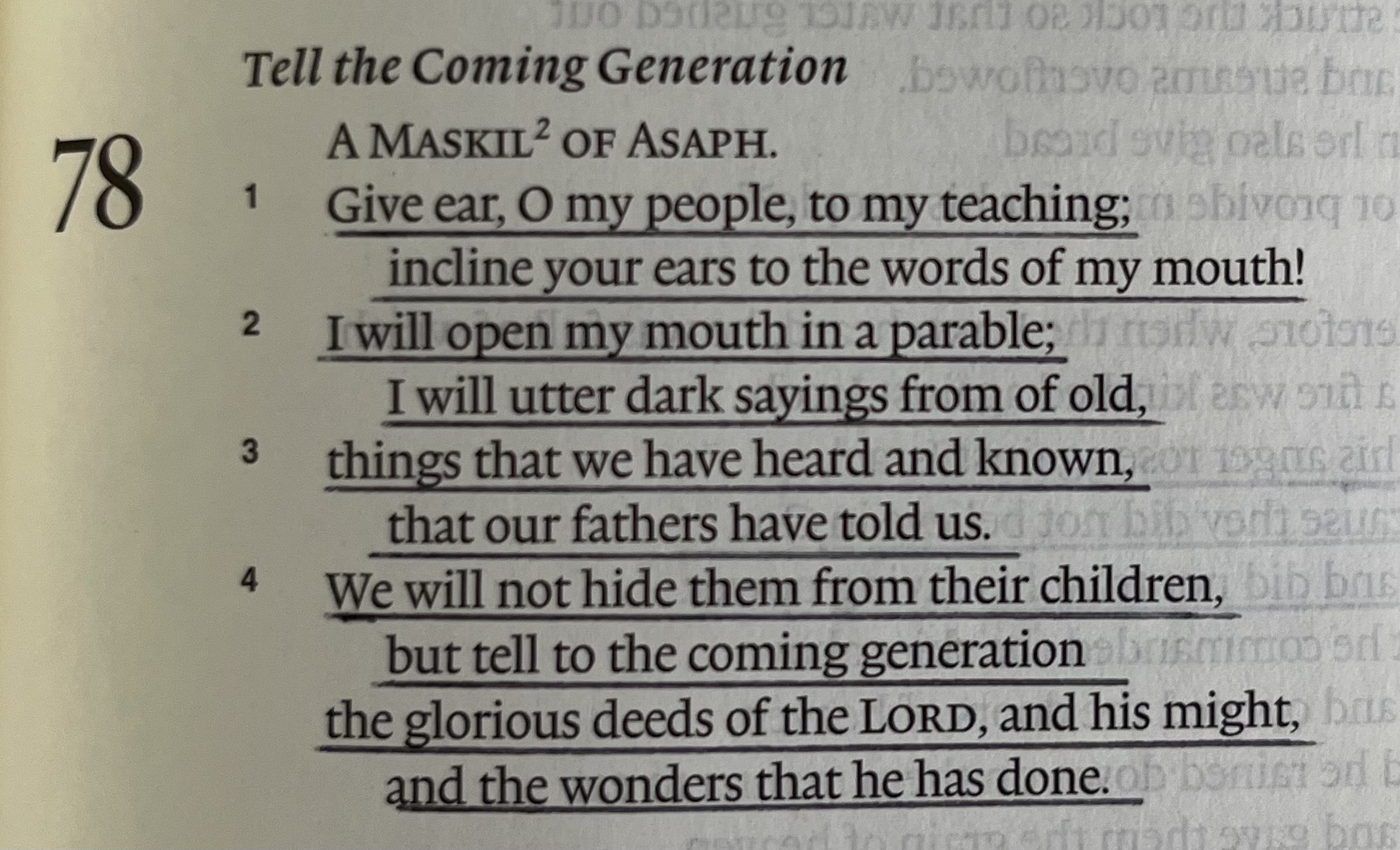
One recent Tuesday morning, we were working our way through chapter 8 of Hosea. In verse 13, we read that God told His people He would remember their iniquity, punish their sins, and send them back to Egypt, which was a foretelling of their captivity under Assyria. By this point in their history, the book of the Law, which the king was supposed to keep by his side and read every day (Deuteronomy 17:18-20), had been misplaced, and the priests were greedy and unfaithful. Thus, it was unlikely God’s people had consistently passed on the story of His miracle-filled deliverance from generation to generation as He’d commanded (Psalm 78:4-6). Given all that, I suggested that the threat of being returned to Egypt might not have meant much to them or carried much weight. Perhaps no one had told them how dreadful it was to be a slave or how marvelous God’s rescue was.

Although Hosea 8:2 says the people still “knew” the Lord and called on His name, simply knowing about God and crying out to Him in times of desperation isn’t the same as having a relationship with Him and a heart that wants to please Him.

Sobering Questions

As our discussion moved on, a whisper arose in my spirit: How about you? Do you remember how bad it was to be enslaved by sin? The thought convicted me. After walking with the Lord for nearly 50 years, have I forgotten how hopeless my situation was before He rescued me? Dead in my trespasses, unable to contribute anything to my salvation. Left to my own devices, I would have perished. Eternally.

But God, in His mercy, chose to redeem a people for Himself (Ephesians 2:4-5). May we never forget how remarkable and costly His rescue was! Redeemed by the Son’s precious blood, none of God’s children will ever be lost. Like a loving Father, He disciplines us (Hebrews 12:5-11), but He won’t ever forsake us (Deuteronomy 31:6).

Throughout No Empty Word, the study questionshave challenged us to identify our idols, those things we allow to usurp God’s rightful place in our hearts and lives, things we look to for security instead of depending on the One who is our Provider, Rock, and Refuge, the One who is sovereign over every detail. Self-reliance, autonomy, self-glory, peace, wealth, fame – we’ve mentioned all of these in our discussions. Several times,  those discussions have reminded me of God’s warning in Deuteronomy 8:

Take care lest you forget the Lord your God by not keeping his commandments and his rules and his statutes, which I command you today, lest, when you have eaten and are full and have built good houses and live in them, and when your herds and flocks multiply and your silver and gold is multiplied and all that you have is multiplied, then your heart be lifted up, and you forget the Lord your God, who brought you out of the land of Egypt, out of the house of slavery, who led you through the great and terrifying wilderness, with its fiery serpents and scorpions and thirsty ground where there was no water, who brought you water out of the flinty rock, who fed you in the wilderness with manna that your fathers did not know, that he might humble you and test you, to do you good in the end. Beware lest you say in your heart, ‘My power and the might of my hand have gotten me this wealth.’ You shall remember the Lord your God, for it is he who gives you power to get wealth, that he may confirm his covenant that he swore to your fathers, as it is this day (Deuteronomy 8:11-18).

It’s a warning that applies every bit as much to God’s children today.

O Lord, please help us never to neglect the reading and hearing of Your Word or tire of telling the coming generations about Your glorious deeds so that they, too, will know how awful it is to be a slave to sin and how awesome it is to be a child of God. And may we never forget that everything we have and are, from our salvation to our daily bread, is a gift from You.

Epilog

You may be wondering about the photo I selected to accompany this post. Years ago, I saw a short video of a guy sitting behind a table in a cemetery. He’d posted a sign with the message along the lines of, “Anyone interested in eternal life step right up!” No surprise, but not a single person exited one of the graves and took him up on his offer. I often think of that clip when I contemplate what it means to be dead in our trespasses, unable to contribute anything toward our salvation!

Exfoliation, Reprise

Do not be conformed to this world, but be transformed by the renewal of your mind, that by testing you may discern what is the will of God, what is good and acceptable and perfect.
Romans 12:2

Color Harmony

Throughout most of the years I worked for a large corporation, I held the role of colorist. As such, I developed, named, and presented new carpet color options to our customers. After all the time spent honing my skills at work, I relished the opportunity to choose the interior and exterior colors when we built our home in Georgia.

My late husband’s specialty was horticulture, a no-less creative endeavor. When I picked a terra cotta color scheme for the bricks and shutters, I didn’t realize how challenging I’d made it for him to select plants. This was especially true when choosing the must-have southern plant on our list – a crape myrtle.

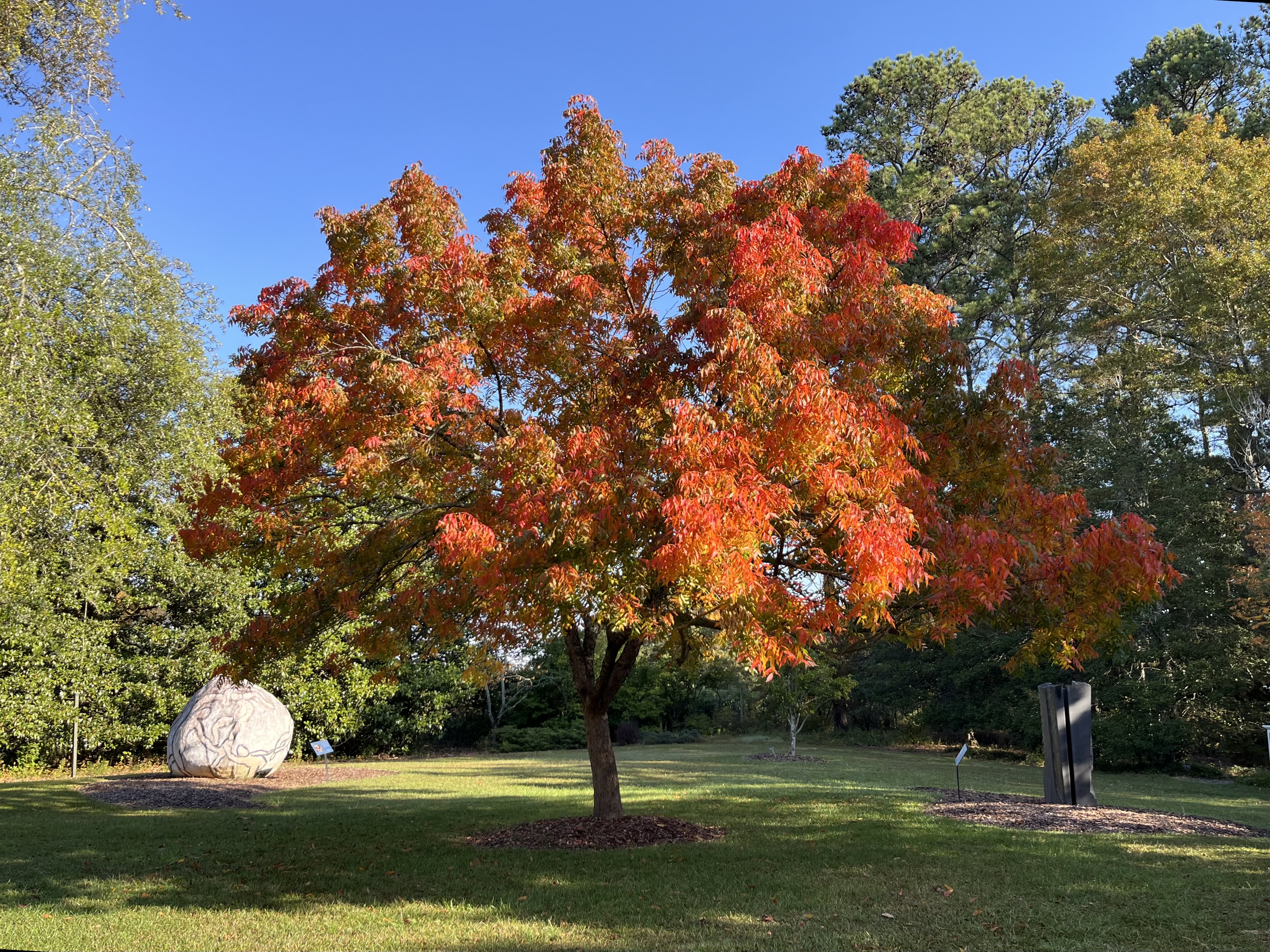
Nonetheless, being a skilled horticulturalist, Ray made an excellent choice. Unlike other cultivars whose pink or purple flowers would have clashed with our cinnamon-colored exterior and offended my color sensibilities, the creamy-white blossoms of the now-stately Natchez create a harmoniously floriferous cascade each summer. But the brilliance of Ray’s choice is most apparent in the fall, for it is then that the annual process of exfoliation occurs.

As summer wanes, cracks appear in the bark along the mighty trunk, signaling the coming changes. Soon, the cracks become fissures as the old skin lifts away from the tree before finally letting go entirely, falling to the ground in long, jagged shards. To the uninitiated observer, this series of events may be unsettling. How could such an extreme shedding of bark possibly benefit the plant? Yet that very act allows the trunk to increase its girth and grow stronger. Best of all, it reveals the most magnificent cinnamon-colored covering.

Ray saw the potential in the sapling he planted so long ago. He knew what it could become.

Putting Off, Putting On

There are several concepts that I consider to be spiritual touchstones. One such idea is that of putting off and putting on. In His analogy of an unclean spirit leaving a man only to return to its neat but empty former abode, Jesus made it clear it’s not enough to make a show of getting rid of sinful thoughts and behavior (Matthew 12:43-45). Instead, our repentance must be true, the kind that produces fruit in keeping with our profession of faith (Matthew 3:8), as we put on right thinking and conduct pleasing to God.

The Apostle Paul affirms this teaching in his letter to the Romans, where he encourages his readers not to conform to the world but to be transformed by renewing their minds. In his letter to the Ephesians, he goes even further. After admonishing them to “put off your old self, which belongs to your former manner of life and is corrupt through deceitful desires and to be renewed in the spirit of your minds, and to put on the new self, created after the likeness of God in true righteousness and holiness” (Ephesians 4:22-24), Paul goes on to provide specific examples of behavior to put off as well as corresponding replacements:

  • Put away falsehood and speak the truth. (vs. 25)
  • Let the thief no longer steal but perform honest labor. (vs. 28)
  • Do not use unwholesome language, but that which benefits and builds up those who listen. (vs.29)
  • Put away all bitterness, wrath, anger, and every form of malice. Be kind to one another, forgiving one another as God in Christ forgave you. (vs. 31-32)

Refined By the Spirit

Because of Jesus’ sacrifice on our behalf, God already counts us as righteous (2 Corinthians 5:21), but there is much refining left to be done. We are not yet holy as He is Holy, nor will our makeover be complete until Jesus returns. Nonetheless, the Spirit is at work in us, transforming us with the same mighty power that raised Jesus from the dead (Ephesians 1:18-20).

At times, our refinement is painful as God strips away bits of our old nature. Our Savior suffered much (Isaiah 53:3-6). How better to know Him than to endure loss, sorrow, and persecution as He did (Romans 8:17)? Such challenges may cause outside observers or even believers themselves to question God’s methods, but we can trust the One who made us has a perfect plan to work all things together for our good and His glory (Jeremiah 29:11; Romans 8:28).

Just as Ray knew what the crape myrtle could become, given sufficient time and proper care, God knows who He created us to be (Ephesians 2:10). Furthermore, He’s promised to complete the work He’s begun in us (Ephesians 1:6) and never to leave or forsake us at any point in the process (Deuteronomy 31:8). The Helper will be with us to remind us of His promises, empower us to do His will, and enable us persevere to the end (John 14:16-17, 26). On that glorious day, our transformation will be complete, and all vestiges of our former selves will disappear. We will gather around the throne, our new selves robed in white, to forever praise our Redeemer King (Revelation 7:9-17).

Scars, Epilog

I will hope continually
    and will praise you yet more and more.
My mouth will tell of your righteous acts,
    of your deeds of salvation all the day,
    for their number is past my knowledge.

Psalm 71:14-15

Secrets?

A longtime friend texted me after she read my last post to tell me she’d suffered an injury almost identical to one of the ones I described. It happened years ago, as did mine, but I never knew of our common experience until now. Admittedly, decades have passed since we lived near each other, and talking about such minor injuries isn’t at the top of our conversation topics when we schedule phone dates. But the fact that I didn’t know got me thinking about more serious things we intentionally hide, even sometimes from those closest to us.

I’m not implying that this particular friend has deep, dark secrets she’s never told me despite our five decades of friendship. No, I’m thinking about how reticent I’ve been to share things from my past for fear of rejection or condemnation. Yet, when situations arose that made it fitting to do so, I’ve not only been freed from my self-imposed isolation, but I’ve also made it safer for others to share their hard things. There is wonder and relief in knowing, “I’m not the only one!”

When someone further down the road assures us that God can redeem our brokenness and bring beauty from ashes (Isaiah 61:3), relief and hope unite as the Light leads us out of darkness.

Credentials

My dear friend Sharon Betters refers to the hard things the Lord brings us through as our credentials. As we call back to others, our experiences make us credible witnesses of God’s steadfast love, goodness, and faithfulness.

On a recent episode of her Daily Treasure podcast[1], Sharon included a quote from Oswald Chambers, which contained the following:

“There is no such thing as a private life . . . for a man or woman who is brought into fellowship with Jesus Christ’s sufferings . . . We are not sanctified for ourselves, we are called into the fellowhip of the Gospel, and things happen which have nothing to do with us . . . Why shouldn’t we go through heartbreaks? Through those doorways God is opening up ways of fellowship with His Son . . . If through a broken heart God can bring His purposes to pass in the world, then thank Him for breaking your heart.”[2]

Thank Him for breaking your heart? That’s unthinkable apart from our eternal security in Christ (2 Corinthians 16-18) and believing that God is working all things together for the good of those who love Him, those called according to His purpose (Romans 8:28). We can find great comfort in knowing that our little stories are part of God’s great big story. He’s weaving the plot lines together in ways we may not understand in the moment or possibly not even this side of Heaven, but we can always trust His character.

For the Lord will not
    cast off forever,
but, though he cause grief, he will have compassion
    according to the abundance of his steadfast love;
for he does not afflict from his heart
    or grieve the children of men.
(Lamentations 3:31-33)

Propriety

There are appropriate times and places to share how the Lord has brought us through challenging circumstances. Not all the stories He’s entrusted to us are meant to be broadcast from a public platform. Some are best processed with wise counselors and trusted friends. Even so, we need to be willing to share when God sovereignly places someone in our lives who would benefit from hearing how He’s worked in and through even our darkest places.

There are some things I’ll probably never write a blog post about. However, I pray for discernment to know when God has ordained a crossing of paths and is nudging me to bless someone with the assurance others have passed on to me: you are not alone, and God can redeem even this.

Before I close, I also want to remind us to be slow to judge since we don’t know all the experiences that have gone into making a person who they are, much less how far along they are on their journey of restoration (1 Samuel 16:7; John 7:24). I’ve had several instances when a piece or two of information has completely changed my perspective on someone’s behavior. And I’ve had others make similar comments when they’ve learned more about my past.  

There are still tender spots in my soul, scars that will cause me to retreat in situations that evoke painful, long-ago events, but I trust God will use even those lingering scars for His good purposes.

So we do not lose heart. Though our outer self is wasting away, our inner self is being renewed day by day. For this light momentary affliction is preparing for us an eternal weight of glory beyond all comparison, as we look not to the things that are seen but to the things that are unseen. For the things that are seen are transient, but the things that are unseen are eternal (2 Corinthians 4:16-18).


[1] “A Private Life?,” Daily Treasure, August 31, 2024. Daily Treasure is one of many resources available through MARKINC Ministries.

[2] Oswald Chambers, My Utmost for His Highest, November 1 devotion: “Ye Are Not Your Own.” (Grand Rapids, Discovery House.)

Scars

But he was pierced for our transgressions;
    he was crushed for our iniquities;
upon him was the chastisement that brought us peace,
    and with his wounds we are healed.
Isaiah 53:5

My right hand bears several scars, some the result of injuries, others from surgery. They’ve become less visible with time, but I can see them if I look hard enough. Let me tell you about those scars and some spiritual parallels I came up with when I realized the ugliest scar has faded along with the rest.

Pesky Pop-tops

I started drinking diet sodas when I was a teenager. Back then, the pop-tops weren’t attached to the cans. I would wipe the lid, peel off the tab, and drop it into the opening. Mom was horrified. “Someday, you’re going to drink one of those things!” I assured her I’d bent them enough that they wouldn’t come out. But one day, I left a tab on the kitchen counter instead of putting it in the can. When I washed my hands later, I dried them with a paper towel someone had placed on the counter, never thinking the metal tab might be underneath. The sharp edge made a small cut on top of my hand and accounts for my oldest scar.

Mom was right – those tiny tabs belonged in the trash!

Fast forward 50 years. Those little pull tabs are now securely attached to the top of cans, but you can pry them off if you bend them back and forth a few times, which is what my 13-year-old grandson was doing recently. I showed him the scar on the top of my hand and told him the story behind it.

Is there a lesson you’ve learned from a poor decision in your past, something more critical than a small cut, that you can share to help others understand potential consequences and make better choices?

Surgical Relief

Then there’s the scar from carpal tunnel surgery. The surgeon carefully made the incision in one of the creases on my palm, knowing it would help hide it. Sure enough, it’s barely visible.

I’m not a fan of surgery because I don’t like to be put to sleep or deal with the downtime associated with recovery, and I often say “elective surgery” is an oxymoron in my vocabulary. But the carpal tunnel operation was so helpful I didn’t hesitate to have it done on the left side a year later, and I’ve recommended it to others who’ve experienced the pain and numbness associated with carpal tunnel syndrome.

Just as I try to avoid surgery, I’m not one to beg God to send difficult circumstances into my life to grow my faith. Yet I know He often uses hard things to discipline me, draw me closer to Himself, and transform me into the image of His Son. Thus, I pray with the psalmist, “Search me, O God, and know my heart! See if there is any offensive way in me and lead me in the way everlasting,” trusting the Holy Spirit to reveal and carefully excise things from my life that are hindering my walk with the Lord (Psalm 139:23-24).  

Stealth Attack

Next up in the catalog of scar-producing injuries is a cut from an unsheathed razor. I vividly remember the moment. We were on vacation at the beach. I reached into my toiletry bag, not realizing the protective cover was no longer on the razor. The sharp blade sliced a small chunk of skin off the upper knuckle of my pointer finger. I almost passed out from the unexpected injury and the gush of blood that accompanied it. The wound healed but produced a bump of thickened skin, known as a keloid.

The circumstances and raised scar associated with this injury remind me of relationships with people who I took at face value and trusted, only to have their true selves appear later, causing deep hurt and bewilderment. Doubting my ability to judge rightly and not wanting to experience that kind of betrayal again, I overreacted and built walls to keep others at a safe distance.

Graceless Stumble

And then there was the jagged, ugly scar I mentioned in the introduction. It resulted from a tumble I took on my front walk. I went to check the rain gauge, wasn’t being careful on the slippery pavement, and plummeted to the ground. Shocked and embarrassed, I lept up lest anyone see me prostrate. Lightheaded and unsteady, I sought my neighbor’s help to stem the blood flow and apply a bandage. Several weeks later, when I saw how unsightly the scar was, I realized it would have been better if I’d sought medical care and gotten a few stitches. I accepted that it would be there forever, glaring at me, reminding me of the fall.

But then, a few days ago, I realized that it, too, is barely visible.

There have been times when I’ve lost focus and slipped into sin. I never thought I would find myself in such a predicament, and tried my best to minimize the damage and cover my tracks. But my efforts were inadequate, like the bandage that barely staunched the flow of blood from my palm and the fig leaves Adam and Eve used to hide their nakedness (Genesis 3:7).

Redeeming Scars

We won’t pass through this life unscathed by the sin and brokenness inherent in our journey. Some of those injuries will be self-inflicted, others caused by people we encounter along the way, and still others due to generational sins that have simmered for decades.

It takes much more than self-applied treatments to wash away the sin and heal the hurts. Praise God for providing the spotless Lamb who was slain (John 1:29; Revelation 5:12)! Jesus was wounded for our transgressions, all of them. He can commiserate with our weaknesses, yet was without sin (Hebrews 4:15). He heals the brokenhearted and binds up our wounds (Psalm 147:3). Blessed assurances!

The memories of past indiscretions linger, but just like the jagged scar I thought would be there forever, they’ve faded, replaced by the truth of Christ’s sacrificial love for me and my identity in Him.

Jesus still bears the wounds from His crucifixion (John 20:27-28). It saddens me to think about Him carrying those scars forever. But I am oh so grateful those wounds will ever plead for me and other ransomed sinners, as Charles Wesley penned in his hymn, “Arise, My Soul, Arise.”

I’ll close rejoicing with the final stanza and chorus of a more recent hymn, “The Power of the Cross:”[1]

Oh, to see my name
Written in the wounds,
For through Your suffering, I am free.
Death is crushed to death;
Life is mine to live,
Won through Your selfless love

This, the pow’r of the cross:
Son of God – slain for us.
What a love! What a cost!
We stand forgiven at the cross.


[1] Stuart Townsend and Keith Getty, “The Power of the Cross,” Thank You Music, 2005.

Summer Doldrums

Though the fig tree should not blossom,
    nor fruit be on the vines,
the produce of the olive fail
    and the fields yield no food,
the flock be cut off from the fold
    and there be no herd in the stalls,
yet I will rejoice in the Lord;
    I will take joy in the God of my salvation.
Habakkuk 3:17-18

I have so much to be thankful for, so I endeavor to count my blessings instead of being negative and complaining. But, as Mom used to say, I am human, and sometimes things get me down. This summer is one of those times. As long-time readers of my posts know, my garden is usually a source of great joy for me, a place of solace where I love to spend time with the Lord. However, after an incredibly long and beautiful spring, we’ve had a summer of extremes.

June was hot and dry, with above-average temperatures and rainfall way below average. Then July arrived, and we got twice the usual amount of rain, which perked up all the plants and trees languishing from the early summer heat and drought but produced a bumper crop of mosquitos and created unfavorable conditions to do much of anything outside since the soil was too wet to weed, dig, or even stand on. Now August is here and we’ve returned to sweltering heat and humidity, with no rain in the forecast for days.

What’s a gardener to do?! I had such high hopes of tackling several significant projects this summer, but alas, I’ve barely been able to keep up with essential maintenance.

And then there’s the deer. They’ve passed through in previous years, feasted on some of my medium-sized hostas, and nibbled on a few toad lilies and asters, but this year, they’ve decimated even my biggest hostas, left nary a bud on the toad lilies or asters, and sampled all sorts of other things.

Between the weather, munching, and mosquitos, I haven’t experienced the garden joy I’ve come to count on.

Yesterday afternoon, I was picking up branches, big and small, dislodged when a mighty windstorm blew through last week, thankful that none of the towering trees had fallen. I was moving fast, focused on my task, trying to outpace the mosquitos. I turned to head back to my debris pile with another armload of branches when a pop of color caught my eye. I stopped and gazed at the brilliant blossoms covering one of my Encore® azaleas. I’d been so intent on my mission that I’d missed them earlier.

Despite the swarming bloodsuckers, I decided to engage in one of my favorite pastimes, also mostly abandoned this summer, and stroll the property in search of other treasures I may have missed. I wasn’t disappointed. As I spied first one flower and then another, my spirits lifted, and the passage from Habbakuk came to my mind.

Even though I haven’t been able to do much in my yard the past couple of months, God has been sustaining the plants, birds, and pollinators, just like He always does. And, as my compassionate heavenly Father, He remembers I’m dust, vulnerable to the vicissitudes of life (Psalm 103:13-14). Thus, whether joyful or distressed, I can bring it all to Him, knowing that He who graciously provides for the flowers and birds cares immensely more for me (Matthew 6:25-34).  

I’ve lived in Georgia for over thirty years, plenty long enough to know that the summer heat will eventually give way to more moderate weather. Regardless of the season, I will keep my eyes open for the evidence of God’s love all around me, and with Habbakuk, I will rejoice in the Lord and take joy in the God of my salvation.

I hope these photos, a sample of the things I saw yesterday, will bring joy to your heart just as discovering the flowers themselves did to mine.

Don’t Cry! (Reprise)

Jesus wept.
John 11:35

Introduction

A recent conversation with friends began with one of them apologizing for the tears that accompanied her reply to our question, “How are you?” “Not great,” followed by,  “Oh, I’m sorry, I cry too easily!”

My other friend and I assured her there was no need for an apology. After all, we cry easily, too! Thinking back on our exchange reminded me of this blog post I wrote several years ago. I decided it was time to dust it off, make a few edits, and rerun it.

Tears for All Occasions

I suppose I should begin with a confession: I’m an equal-opportunity crier. My eyes are just as likely to well up in moments of joy as in sorrow – while reading sweet sentiments in Hallmark cards, watching heartbreaking news stories, attending weddings or funerals, even when leading Bible study, as the magnitude of God’s grace and mercy floods over me. Yes, from a barely-there trickle to gut-wrenching sobs, I’ve shed my share of tears and expect to shed plenty more.

A quick Google search reveals three different types of tears. Basal tears keep our eyes lubricated, while reflex tears pop up in response to irritants like slicing onions or having a pesky gnat flit into your eye. And then there are psychic tears associated with our emotions, distinct from the other two in that they contain stress hormones.[1] No wonder we often feel better after shedding them. They’re like an overflow valve for the soul.

Biblical Weeping

The Bible has much to say about tears and the circumstances surrounding them. Consider, for example:

  • Loss of a loved one by separation or death
    • David grieved the loss of his closer-than-a-brother friend, Jonathan, first from necessary distancing and then by death (1 Samuel 20:41; 2 Samuel 1:12).
    • Mary and Martha mourned Lazarus’ death. Seeing their distress, Jesus wept too, even though He knew his Father would hear His prayer to raise him. Jesus had compassion for the sisters in their time of loss, and He has compassion for us as well (John 11:31-35).
    • Jesus’ followers were bereft and befuddled after His death despite the many times He’d told them what was to come (Luke 18:31-34; 36:13-49).
  • Disappointments of various sorts
    • Esau wept over losing his birthright when he realized his brother had tricked their father (Genesis 27:30-38).
    • Hannah’s unfulfilled desire for a child, exacerbated by her rival’s provocation and her husband’s lack of understanding, led to her fervent, tear-stained prayer for relief (1 Samuel 1:1-10).
  • Sorrow for sin
    • Three of the four Gospels recount Peter’s tear-punctuated dismay when Jesus’ statement that he’d betray Him came to pass (Matthew 26:75; Mark 14:72; Luke 22:62).
    • James says we should be wretched, mourn, and weep over our transgressions, humbly drawing near to God for forgiveness and restoration (James 4:8-10).
  • Worship and Gratitude
    • The penitent woman who wet Jesus’ feet with her tears, wiped them with her hair, and anointed them with ointment was motivated by her love for her Savior (Luke 7:36-38).
  • Joyous reunion
    • Though bitterness marked their estrangement and Jacob feared the worst from Esau, the brothers’ reunion was accompanied by joyful tears (Genesis 33:4).
    •  I’m taking some liberty here because none of the translations I consulted mention crying, but I’ve got to believe the prodigal son’s compassionate father had tears of elation streaming down his face as he ran to greet his returning son (Luke 15:20).

To Grieve or Not to Grieve?

Even though these passages and others make it clear psychic tears are part of our God-given emotions, we’re quick to admonish, “Don’t cry!” Could it be that others’ tears make us uncomfortable or tearful ourselves? Or worse, might we believe God’s children aren’t supposed to cry because we know the end of the story?

I distinctly remember a visit from the mother of one of my daughter’s friends, though it occurred 27 years ago. She, too, was widowed at a young age, losing her husband a few months after I lost mine. Being a wee bit further along the path of single parenting, I hoped to console her, but when she arrived, she was surprisingly joyful and radiant. I’ll never forget her statement, “The elders and my church family have been praying I won’t grieve, and it’s working!”

Not grieve the loss of your life partner and father of your children? I was speechless. Granted, we don’t grieve as those who have no hope, but we do grieve.

Man of Sorrows

The women who witnessed Jesus’ crucifixion no doubt wailed at the sight of their beloved Teacher and Friend, bloodied and beaten, being nailed to a Roman cross – the innocent One put to death for the sins of others. Isaiah 53 is one of my most cherished passages, but also one which I can rarely get through without tears. Man of sorrows, acquainted with grief. Despised. Rejected. Wounded for our transgressions, crushed for our iniquities. My transgressions. My iniquities.

A conversation with my pastor regarding our propensity to rush to the good news of Christ’s victory over death without allowing ourselves or others to grieve reminded me of my daughter Jessie’s comment as we stood by Mom’s grave following her funeral three years ago. After watching Mom endure horrible pain the last ten days of her life, I said I was thankful she wasn’t suffering anymore. Jessie replied, “That’s true, but don’t miss out on the mourning, Mom.”

Don’t miss out on the mourning.

If we ever doubt we have permission to grieve, we have only to look to Jesus. He experienced what it’s like to walk through this sin-scarred world. Even though He knew He would defeat death and not one of those entrusted to Him would be lost, Jesus wept because death was never part of God’s good plan. It stings. It always will this side of heaven.

As we go through difficulties in this life, we know the One who keeps track of every tear (Psalm 56:8) is seated at the right hand of God, interceding for us. Nothing can separate us from His love (Romans 8:31-39). He has promised to return, to usher in a new heaven and a new earth, to wipe every tear from our eyes (Revelation 21:1-4). Until then, let us rejoice with those who rejoice and weep with those who weep, unafraid of our tears.

O Lord, thank You for hearing our cries for help. Though weeping may last through the night, joy comes with the morning (Psalm 30). You have shown great mercy in sending Jesus to die for our sins and will turn our mourning into gladness. For we know this momentary affliction is preparing an eternal weight of glory beyond all comparison (2 Corinthians 4:17). 

Note: A blend of joy that my granddaughter Lyla Ray arrived safely and sorrow that her Grandpa (Ray) Kuipers wasn’t with us to greet his namesake produced the barely visible tear on my cheek in the accompanying photo.


[1] “What are the three different types of tears found in our eyes?”, http://www.sharecare.com

Swords Into Plowshares

They shall beat their swords into plowshares, and their spears into pruning hooks; nation shall not lift up sword against nation, neither shall they learn war anymore.
Micah 4:3

Recently, my daughter Jessie and I had the opportunity to visit England. A tour of Windsor Castle was high on my wish list of stops. When we entered the immense structure, threatening clouds filled the sky. Jessie and I agreed it made a fitting backdrop for the formidable fortress.

Many things about the massive compound impressed me, but one element reminded me of a Bible passage. When I saw a lush garden thriving in the gulley formerly occupied by the moat, I immediately thought of the phrase, “swords into plowshares.”

The phrase appears in Micah 4, a chapter brimming with future hope for the people of God. Take a look at the first four verses:

It shall come to pass in the latter days
    that the mountain of the house of the Lord
shall be established as the highest of the mountains,
    and it shall be lifted up above the hills;
and peoples shall flow to it,
    and many nations shall come, and say:
“Come, let us go up to the mountain of the Lord,
    to the house of the God of Jacob,
that he may teach us his ways
    and that we may walk in his paths.”
For out of Zion shall go forth the law,
    and the word of the Lord from Jerusalem.
He shall judge between many peoples,
    and shall decide disputes for strong nations far away;
and they shall beat their swords into plowshares,
    and their spears into pruning hooks;
nation shall not lift up sword against nation,
    neither shall they learn war anymore;
but they shall sit every man under his vine and under his fig tree,
    and no one shall make them afraid,
    for the mouth of the Lord of hosts has spoken.

Like swords becoming plowshares and spears turning into pruning hooks, the once-menacing moat, long associated with intruders and fierce battles, is now a serene site. However, it is not accessible to visitors. I longed to stroll the flower-lined paths, but I could only admire the beauty from a distance as I peered over the stone wall erected centuries ago.

I rarely watch the news since doing so can leave me feeling anxious and overwhelmed. Yet even a glance at the headlines informs me of ongoing wars and uprisings around the world. Closer to home, I have friends waging battles of a different kind as they or loved ones fight to overcome cancer, depression, financial hardships, or myriad other challenges.

And then there are days like yesterday when events command my attention, when the brokenness that permeates our world takes center stage, making me wonder what will happen next. Seasons of upheaval and uncertainty, whether personal, within my church family, or in the public realm, drive me to remember and rehearse what I know to be true.

We’re not Home yet, and we will face hardships in this life. But we belong to the One who promised never to leave or forsake us (Deuteronomy 31:8), the One who told us to take heart because He’s overcome the world (John 16:33), the One who will return to do away with the former things and establish His eternal kingdom (Revelation 21:1-5).

Though there are times when the waiting seems interminable, we wait in confident assurance of Jesus’ return. And while we wait, He graciously gives us glimpses of what it will be like when He makes all things new, like a once-ominous moat turned into a beautiful garden, even if we need to make the effort to peer over a wall to see them.

Epilog

By the time Jessie and I completed our tour of the magnificent state apartments in the Upper Ward, the sun had appeared. The blue sky and radiant light took the edge off the castle’s sinister side.

Jesus, the Light of the World, commands His followers to be light (John 8:12; Matthew 5:14-16). We have the hope of the Gospel (John 3:16) and the assurance of God’s promises to His people. May we endeavor to shine as beacons pointing others to the hope we have in Christ, making this dark world a bit brighter and less scary for all those God places along our paths.

For the mountains may depart and the hills be removed, but my steadfast love shall not depart from you, and my covenant of peace shall not be removed, says the Lord, who has compassion on you (Isaiah 54:10).

And I heard a loud voice from the throne saying, “Behold, the dwelling place of God is with man. He will dwell with them, and they will be his people, and God himself will be with them” (Revelation 21:3).

A Decade of Blogging

As each has received a gift, use it to serve one another, as good stewards of God’s varied grace: whoever speaks, as one who speaks oracles of God; whoever serves, as one who serves by the strength that God supplies—in order that in everything God may be glorified through Jesus Christ. To him belong glory and dominion forever and ever. Amen.
1 Peter 4:10-11

Dear Readers,

July 1st marks the 10th anniversary of my first post. When I launched Back 2 the Garden in the summer of 2014, I didn’t know what to expect. Would anyone read what I wrote or care about what I had to say? All I knew was that I wanted to glorify God and encourage others by recounting examples of His faithfulness in my life. Two hundred seventy-two posts later, that continues to be my goal.

There have been times when the silence was deafening, as the old saying goes. Those times tempted me to quit, as I wondered if my stories heartened those who read them and whether or not God was pleased with my efforts. Inevitably, when those moments arose, someone would comment something along the lines of, “Thanks for sharing. I needed to read this today!”

I took those comments as God’s nudge to keep writing, to use the gift He’s given me, and to trust Him to use my words as He sees fit, to direct them to the right person in His perfect timing.

Over the years, my posts have tended to fall into one of three broad categories: those inspired by my passion for gardening, those based on insights gleaned from being a mother and grandmother, and those borne from working through deep grief after times of significant loss. I loosely refer to them as lessons learned in my garden, from my grandchildren, and from being a widow – the foundations for a trilogy of books. So far, only one has come to fruition. In fact, my first post, “Consider it Pure Joy,” became the basis for the prologue of Be Still, Quiet Moments With God in My Garden, which I published in November 2020.

Lord willing, I’ll eventually compile and edit posts to create the other books. For now, I will strive to continue to share stories of God’s steadfast love, mercy, and faithfulness.

As I’ve done on the previous anniversaries, I want to thank all of you who have taken the time to read my posts and helped nurture my writing endeavors. Some of you have followed along from the beginning, while others have found your way to this site more recently. Regardless of the tenure of your readership, my prayer continues to be that my words will encourage you and point you to the hope we have in Jesus. God is faithful, and we can trust Him through all the joys and sorrows of our lives. Our stories are part of His eternal, overarching story. I’m grateful that you’ve allowed me to share some of mine with you.

Blessings to you, dear readers.

A Father’s Hugs

See what kind of love the Father has given to us, that we should be called children of God; and so we are.
1 John 3:1

When my daughter and I started planning our long-awaited trip to England and France earlier this year, I gave her a short wish list of places I would like to visit and left the planning up to her. I thought it would be fun, but in hindsight, I realize it was a tremendous amount of work. Not only did she research the places on my list, but she also scheduled many other adventures, lodging options, and special meals.

As dedicated fans of Downton Abbey, Highclere Castle was near the top of the must-see list for both of us; however, Jessie didn’t secure reservations for us before we left. Instead, we hoped to get tickets when we showed up.

Our hopes were dashed when Jessie checked the castle’s website the night before we planned to visit. Bold letters proclaimed, “ALL TOURS SOLD OUT.”

Jessie lamented, “I’m sorry I didn’t reserve the tickets earlier, Mom!”

“It’s ok, Jess, you worked so hard arranging so many other details for our trip.”

I was disappointed about not getting to visit the castle, but I was more concerned that Jessie would focus on this perceived misstep and forget about all the other things she set up for us. We’re cut from the same cloth when it comes to focusing on the one thing we missed instead of giving ourselves credit for the many things we’ve accomplished.

I prayed as I drifted off to sleep, “Lord, nothing is impossible for You, and You know how much we would like to visit Highclere tomorrow, but if it’s not to be, then please help us to accept that and enjoy all the other things You’ve got in store for us on this trip. And please help Jessie not to be upset with herself.”

It was pouring rain when we got up the following morning.

Jessie asked, “What do you want to do, Mom? Should we just forget about it and move on?”

“Nope! When we get home, we’ll be over 4000 miles from here. Right now, we’re five miles from the castle. Let’s drive over and see how far we get. Eventually, we’ll meet up with someone at a checkpoint, and we can explain our situation. All they can say is no, but at least we will have tried, and maybe we’ll get to see it from the outside.”

We ate breakfast, donned our rain jackets, and set off. We traversed the winding drive, drawing ever closer to our destination. Sure enough, someone was minding the entrance to the parking area. But it wasn’t an armed guard. It was a delightful lady in a yellow slicker and rain boots. She listened as Jessie described our plight, then cheerfully replied, “The morning group has already entered the house, but if you come back at 2:30, you’ll be able to get in.”

Jessie and I could barely believe our ears.

“Should we be here earlier to make sure?”

“No need. Be here by 2:30, and you will get in.”

Happily astounded by this turn of events, we had lunch in a nearby village and made sure to return by the appointed time. The same cheerful lady was there to welcome us back when we approached at 2:15.

She checked her watch, “You’re early!”

Jessie and I replied in unison, “We didn’t want to miss our chance!”

“You won’t. Go ahead and park, and then go over to the ticket booth. Once you get your tickets, you can queue up in front of the house.”

We purchased our tickets and strode toward the mansion. A jumble of emotions welled up as we approached the stately manor we’d seen countless times across six seasons of Downton Abbey. It was all I could do to keep from sobbing. Not only would we get to tour the grand house, but even more importantly, I knew we’d received a bear hug from our heavenly Father.

In the ranking of responsibilities, enabling a visit to Highclere Castle barely registers when compared to keeping the universe going. But the One who hung the stars and spoke everything into existence also knows every detail of His children’s lives, and He graciously gives us good gifts that leave no doubt that He knows and loves us.

The heavenly hug I received on that damp, chilly day was specially tailored and multi-layered, as they often are:

  • I’ve been walking with the Lord for nearly 50 years, but I sometimes act like I’ve forgotten Truth that He’s repeatedly affirmed in my life. I genuinely believe I’m never out of His sight (Psalm 139). However, when I travel, I sometimes feel vulnerable, and the further I venture from my home base, the more uneasy I become. An ocean stood between home and me, providing ample fodder for concern, but the Highclere experience was a beautiful reminder that God hadn’t lost sight of us just because we were overseas. That reminder stayed with me for the rest of our twelve-day trip, a touchstone when some circumstance or another tempted me to worry.
  • If we’d reserved tickets for the morning entry time, we would have been soaked waiting to enter the castle. As it was, the rain had stopped by the time we queued up in the afternoon. No soggy jeans to deal with!
  • Perhaps most importantly, Jessie didn’t have to feel bad about not getting the tickets. I didn’t want a perceived failure to overshadow all the hard work my caring, capable, conscientious daughter put into planning our trip. Neither did her Father.

Today is Father’s Day. It may be a joyous occasion for many of you as you celebrate with your dad. For others, it may be a sad day. It is for me because it’s my first Father’s Day without my dad. Though our relationship was rocky at times, I knew Dad always had my back, and there were plenty of instances when his hugs calmed my fears. From childhood scrapes and booboos to life-changing losses in adulthood, he was there. I’m thankful for the love that accompanied those consoling embraces.

I pray those of you who, like me, no longer have your earthly fathers will take comfort in knowing you’re never out of sight or reach of your Heavenly Father. Look for His affectionate hugs – those little reminders that He sees, He knows, and He loves you more than you can imagine (Isaiah 49:15-16).