Even though I’ve faithfully stretched and exercised throughout my adult years, I have stiff muscles. Various stressors, both physical and emotional, have no doubt contributed to my tightly-wound state. The tension increases and decreases, often without a clearly-discernible cause and effect, but it never disappears completely.
Earlier this year, a prolonged period of tender-to-the-touch joints and knotty muscles left me feeling dejected. Thankful a series of medical tests ruled out several serious possibilities, but being no closer to a solution, I procured a referral for physical therapy.
When I went for the initial evaluation, I told the therapist she was my last hope. She maintained a professional demeanor, but I’m almost certain she thought, “Just great! How did this woman end up on my schedule?” Nonetheless, she proceeded with the assessment, asking questions and directing me to bend first one way, then another.
In summarizing her findings, she stated, “Your overall strength is good and your range of motion is somewhat greater than normal. Your joints are loose.”
Attempting to interject some humor, I replied, “Then I guess it’s a good thing my muscles are tight so they can hold me together.”
The therapist didn’t laugh. Instead, she provided the missing piece that allowed me to solve the years-long mystery: “Oh, your muscles really are working over-time to provide the stability your joints and ligaments would normally provide.”
And what did I do with this critical bit of information? I turned to Google, of course! A search of “loose joints, tight muscles” yielded a name for my condition: joint hypermobility syndrome. As I read article after article, years of confounding experiences began to make sense. In trying to help myself, I’d unknowingly inflicted more harm, specifically by over-stretching and requesting too much pressure during my periodic massage therapy sessions. Sadly, my body interpreted these efforts as an assault on the alternative stabilization method it had established. The outcome: more tightness, more trigger points, more tenderness around my joints.
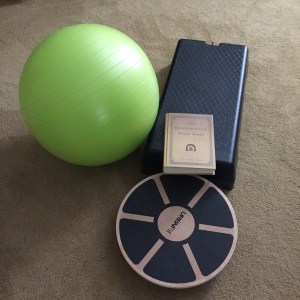
Physical and spiritual training require the proper equipment.
The relief of finally understanding what I’d been battling for so long mingled with deep disappointment at the realization I can’t fix it. It’s the way I’m put together. At best, I can learn how to manage it. Now enlightened, I’m focusing on strength and balance, paying more attention to posture, and being vigilant when it comes to adding pressure (physical and emotional) to an already-stressed system. I’m hopeful consistent implementation of these changes over time will be beneficial. Even so, I’m finding it difficult to be patient while my body adjusts to this new approach.
The spiritual parallels are hard to ignore. Before God calls us to himself, we lack a proper diagnosis. We sense something’s awry, something’s missing. Our attempts to feel better frequently result in the opposite or are short-lived. Because we’re created in God’s image (Genesis 1:27), made to glorify Him (Psalm 86:8-10) and enjoy fellowship with Him, nothing else can satisfy our souls’ deepest longings.*
At the appointed time, He replaces our hearts of stone with hearts of flesh. (Ezekiel 36:26) We begin to understand our condition and the sin that separates us from our Father. There’s nothing we can do to repair our brokenness. (Ephesians 2:8-9) Fortunately, He doesn’t leave us in our helpless state. He sent his only begotten Son to heal our souls and restore the family bonds broken at the fall. (Genesis 3; John 3:16) Jesus, the Great Physician, took our infirmities on himself and bore our iniquities. His wounds brought about our healing. (Isaiah 53:4-5) His righteousness, graciously granted to we who were once lost, ensures our eternal inheritance. (1Peter 1:3-5)
Even though Jesus’ perfect obedience has been credited to our accounts, fully paying the debt we owe our Holy God, we will struggle with the effects of sin, ours and others’, as long as we’re in the this world. Like my impatience with my physical progress, there are times when, with the Apostle Paul, I bewail my inability to consistently obey my Father. (Romans 7:18-20) Nevertheless, with the help of the Spirit, we’re being conformed more and more to the likeness of our elder Brother. (Romans 8:29) Bit by bit, we shed the old and put on the new. (Romans 12:2)The transformation will continue until Jesus’ promised return, when all will be made new and perfect – no more sickness, no more sin, no more tears. (Revelation 21:4)
Until then, may we abide in the One who is able to do immeasurably more than all we ask or imagine according to his power at work within us. (Ephesians 3:20)
* Several well-known quotes alluding to our “God-shaped void”:
“What else does this craving, and this helplessness, proclaim but that there was once in man a true happiness, of which all that now remains is the empty print and trace? This he tries in vain to fill with everything around him, seeking in things that are not there the help he cannot find in those that are, though none can help, since this infinite abyss can be filled only with an infinite and immutable object; in other words by God himself.” Blaise Pascal, Pensées, 1692
“You have made us for yourself, O Lord, and our hearts are restless until they rest in you.” St. Augustine, Confessions, c. AD 400.
“If I find in myself a desire which no experience in this world can satisfy, the most probable explanation is that I was made for another world.” C.S. Lewis, Mere Christianity, 1952.
 Brown thrashers are among those who want to partake of the high-calorie goodness. To say they have trouble steadying themselves on the suet basket would be a significant understatement. Inevitably, when one lands on the suet, it starts to wobble. This in turn causes the bird to flap frantically which results in the basket spinning around, bringing about another flurry of desperate flapping. It’s a rather comical sight, but also somewhat sad because the thrasher’s behavior keeps him from the nourishment he’s seeking .

