For no good tree bears bad fruit, nor again does a bad tree bear good fruit, for each tree is known by its own fruit. For figs are not gathered from thornbushes, nor are grapes picked from a bramble bush. The good person out of the good treasure of his heart produces good, and the evil person out of his evil treasure produces evil, for out of the abundance of the heart his mouth speaks.
Luke 6:43-45
Identifying Features
Before I studied horticulture, I tried to identify trees by their leaves. Don’t get me wrong, leaves are important identifiers for many species, but they can be misleading in others. When botanists classify plants, they look instead at their reproductive structures – flowers, fruit, and seeds.
Although oak leaves come in different shapes, all oaks sprout from acorns. Likewise, there are numerous forms of maple leaves, not just the classic silhouette that appears on the Canadian flag. But all maple seeds are borne in samaras, those little winged carriers that float to the ground like tiny helicopters.
Once I learned this, it became a fun game to see if I could spot similarities between plants at the botanical garden where I volunteered. I first noted the flowers on Abutilon with their crepe paper-like petals resemble dwarf hibiscus blossoms. Despite the shape of its leaves, which leads to one of its common names, flowering maple, Abutilon is part of the Malvaceae family, as are hibiscus and okra.
-
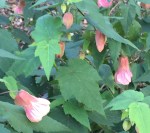
- Abutilon
-

- Hibiscus
-
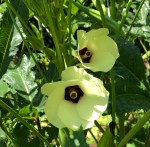
- Okra
Next, I noticed the tiny white bell-shaped flowers on Pieris japonica look like those on a small tree, known as farkleberry, and both resemble those on blueberry bushes. Those three belong to the Ericaceae family.
The more I studied, the easier it became to see the distinguishing characteristics and successfully match plants with their relatives. I wondered why I found it to be so gratifying, musing that it must be because family, both biological and spiritual, is so important to me.
Family Resemblance
Just like we can recognize plants by their fruit, Jesus taught that members of His family would bear distinguishing fruit as well, and He made it clear the only way to bear abundant spiritual fruit was to abide in Him:
Abide in me, and I in you. As the branch cannot bear fruit by itself, unless it abides in the vine, neither can you, unless you abide in me. I am the vine; you are the branches. Whoever abides in me and I in him, he it is that bears much fruit, for apart from me you can do nothing. John 15:4-5
I’m frequently reminded of His statement when I’m pruning. I sometimes leave piles of discarded branches on the ground and then go back to collect them after I finish cutting. Inevitably, the leaves on the severed limbs are already beginning to wilt. The longer the time apart from their source of nourishment and the hotter the day, the quicker their demise. They can no longer live, much less produce fruit.
When I think of abiding, I think of peace – no striving or struggling. The word appears ten times in verses 4 to 10 of John 15, emphasizing the permanence of our relationship with Christ as well as the eternal significance of the fruit we bear. Securely connected to the Giver of Life, His life flows through us to bless and benefit others, all to the praise of His glory.
Distinctive Fruit
And what kind of distinct fruit do we produce when we abide in Him? Love, joy, peace, patience, goodness, kindness, gentleness, faithfulness, self-control (Galatians 5:22-23). All are marks of God’s children, but one outshines them all – love. Jesus prayed that the love He and the Father shared would dwell richly in His followers (John 17:26). That singular mark of distinction would allow all people to identify them as being part of God’s family (John 13:35).
He also warned against false prophets, those seeking to deceive. Like leaves that mimic those of other plants, their outward appearance may initially camouflage their deceit. But closer inspection of the fruit borne of the evil intent in their hearts will give them away, ultimately leading to their destruction (Matthew 7:15-20).
Not so the children of God who bear fruit in keeping with repentance and shine as lights in this dark world (Ephesians 5:8-11).
O Lord, what a privilege it is to be a branch on Your family tree. We bear the imprint of the true Vine, Whose life in us allows us to bear abundant fruit of eternal value.
 Last year, my daughter, Mary, helped start an American Heritage Girls troop at her church and serves as one of the leaders. Each week, Mary and my granddaughters, Lyla and Emma, look forward to meeting with their friends. They engage in a variety of activities as they work toward the organization’s goal of developing Christ-like character and leadership skills.
 After a long period of separation related to coronavirus restrictions, the troop began meeting again last month. Though always vital, the skills they’re learning to earn their Emergency Preparedness badge seem especially appropriate during this time of uncertainty. They’ve talked about stranger danger, paid a virtual visit to a local fire station, and got an up-close look at an ambulance, all while discussing how to help themselves and others during emergency situations.
 My curiosity piqued, I had to look. After all, I hadn’t officially settled into my quiet time. The glance confirmed my hunch. Daughter Jessie sent a photo to me and her older sister, Mary, with the comment, “Fun game! Let me know when you spot it.”
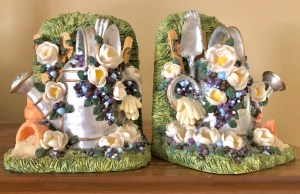 Her statement piqued my curiosity and nudged a long-ago, gift-related memory from the recesses of my mind. The recollection tempered my enthusiasm as I wondered which traits I’d projected to inspire this perfect gift. Much to my relief, the beautiful bookends my friend joyfully presented after the worship service reflected my love of gardening and reading.
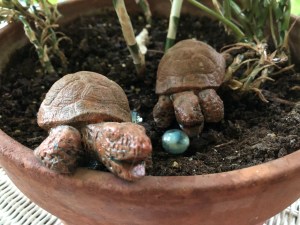 So what about the memory? Two small, resin snapping turtles, a Mother’s Day gift from my then-elementary-aged daughters. Snapping turtles! To this day, some 25 years later, my daughters declare they thought the scary critters were cute. Cute?! Maybe it was my late husband’s barely-suppressed grin or my insecurities as a busy, often-tired mom, but no amount of explaining could convince me the turtles weren’t a commentary on my character flaws.
 I never would have imagined all the times I’d reach for my trusty Pink Pearl eraser the past several weeks. One by one, activities came off my calendar – appointments of various kinds, lunch with friends, 5k races, garden tours, even Grammie days
 I suppose I should begin with a confession: I’m an equal-opportunity crier. My eyes are just as likely to well up in moments of joy as in sorrow – while reading sweet sentiments in Hallmark cards, watching heartbreaking news stories, attending weddings or funerals, even when leading Bible study as the magnitude of God’s grace and mercy floods over me. Yes, from a barely-there trickle to gut-wrenching sobs, I’ve shed my share of tears and expect to shed plenty more.
 While Grammie Mondays and Wednesdays are temporarily suspended, FaceTime allows me to visit with my grandchildren, though I’m just as likely to see a knee or the floor as they wiggle and giggle in and out of view. Mom and I logged on to Facebook Live for last night’s church service. I start most of my days listening to a podcast or two. Phone calls, e-mails, texts throughout the day keep me attached.
 I awoke to brilliant sunshine this morning, with one of the hymns we sang yesterday playing in my mind. I’ve hummed snippets of “Because He Lives” sporadically ever since, thankful to belong to the Lord of all, thankful to be sheltering in place surrounded by fellow believers. So I dedicate this post, a slightly-modified version of one I first published in June 2018, to them. I pray it will encourage you to look up and reach out during these unprecedented times.
 I was working in my garden one recent afternoon, when my youngest neighbor, sweet-spirited Sadie, paid me a visit. We were chatting about flowers and butterflies and bumblebees when she suddenly asked, “Do you have a husband?” I replied, “I used to, but he’s already in heaven. He planted a lot of my trees. That’s why I love them so much.” As I watched, belatedly realizing I’d given a much-too-detailed reply to her simple question, her countenance was overshadowed by pensive consternation. Nonetheless, before I had a chance to offer up something more appropriate, Sadie’s expression brightened once again as she assured me, “But you’re not alone! You have lots of people around you!” I immediately followed up with, “You’re right! I have such good neighbors.”
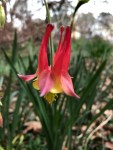 Similar thoughts accompanied me as I strolled my woods exclaiming over the latest plant finds. Jesus’ declaration that we need not worry because the God who cares for the birds and the lilies will watch over His beloved children, who are much more precious, is among my most cherished (Matthew 6:25-34). It’s also one of the reasons I find so much solace in my garden since I see the truth of His statement played out repeatedly.
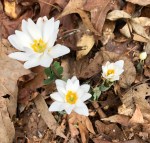 You may argue that the birds and flowers aren’t capable of worrying since they don’t know what we know or reason as we reason. But God says the same about us. Even though we’re created in His image, His ways and His thoughts are higher than ours, beyond our finite minds (Isaiah 55:8-9). He is Sovereign. We aren’t. And it often takes events that are obviously out of our control to remind us, even though every breath we take is a gift from God.
 I’m thankful for the time Ray and I spent together. I’d rather have been married to him for 13 years than not at all. The last card he gave me was a Valentine card. Unlike other memorabilia tucked away in various boxes and file folders, it resides in a special spot on my bookshelf. Lost in my reverie, I retrieved it from its slot and reverently removed it from its well-worn envelope. After savoring the sentiments within, I placed it on the edge of my dining room table which also serves as my desk. There, alongside other tangible reminders of loved ones, it radiated a message of glowing encouragement.
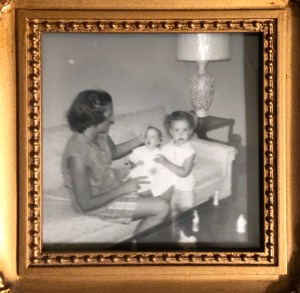 My baby sister barely reached 8 months of age, hence I grew up an only child with no sibling rivalry and no one to bicker with. But I saw plenty of both as I raised my daughters and now witness more of the same as I spend time with my grandchildren.
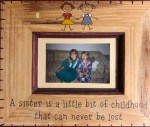 My sister’s death left an empty spot, a life-long yearning to have been able to grow up and grow old with her. In spite of my daughters’ and grandchildren’s childhood squabbling, they’re family, forever part of each other. And so it is in God’s family as He knits our hearts and lives together in love.
 Back 2 the Garden