Her children rise up and call her blessed.
Proverbs 31:28a
Ok, you probably think I’ve gotten my holidays mixed up. No, I know it’s not Mother’s Day. But it is the season of Thanksgiving and today is my dear mom’s 87th birthday. Thus, I want to thank God for the blessing of a godly mother as well as celebrate this very special woman by documenting some of the nuggets of wisdom she’s shared with me for as long as I can remember.
People will let you down, but God never will. Mom and I have been through numerous trials together in the nearly-60 years since she gave birth to me. Lies, disappointments, job loss, broken relationships, deaths. Through it all, Mom has taught me to depend on the One who says He’ll never leave or forsake us (Deuteronomy 31:6); who faithfully keeps His promises (Hebrews 10:23) and speaks only truth. (Hebrews 6:18) We will have troubles in this world, but Jesus has overcome the world. We can find peace in Him. (John 16:33)
When faced with a list of tasks, do whatever’s bothering you the most first and get it behind you. When I feel overwhelmed, which is more often than I like to admit, Mom encourages me with this time-tested advice bestowed upon her by one of her grade-school teachers. Though it may not have been inspired by scripture originally, there’s certainly a Biblical tie-in. Usually when my to-do list becomes over-loaded, it’s filled with chores associated with temporal concerns. Cooking, cleaning, weeding, mulching, paying bills and the like are necessary. But Jesus makes it clear we’re to seek eternal things first, trusting Him to provide all we need (Matthew 6:25-33) and spending time at His feet to learn of Him. (Luke 10:38-42)
We can’t change anyone else, much as we’d like to sometimes. We can only give an account of ourselves. My reply when Mom tells me this? “You’re right. I have a hard enough time keeping myself in line!” Once again, there’s Biblical truth in Mom’s statement. As part of His magnificent Sermon on the Mount, Jesus warned against judging others, especially since we have sin in our own lives to deal with. (Matthew 7:1-5) Praise God for giving us His Spirit, which is at work in us to bring about the transformation we’re incapable of accomplishing on our own. (2 Corinthians 3:17-18) Furthermore, we’re called to pray for others, but only He can soften hardened hearts. (Ezekiel 36:25-27)
We can’t give up. We’ve got to hold on to our faith and keep going. Throughout her life, Mom’s faced challenges that may have led some to quit or become bitter. In the last decade alone, she:
- shattered the bones in her right shoulder, an injury that required surgery to install a plate and multiple screws and left her with limited range of motion in that arm.
- suffered a heart attack that led to the discovery of three severely-blocked arteries resulting in emergency open-heart surgery.
- fractured a vertebra in her back and had a procedure known as kyphoplasty to repair it.
Mom endures daily pain due to the ravages of arthritis that have led to enlarged joints in her fingers and cartilage deterioration in her now-bone-on-bone right knee. Yet she rarely mentions her constant aches. Instead, she clings to God’s mercies which are new every morning (Lamentations 3:22-24) and encourages those in her inner circle to do the same. Though she’s never declared a favorite verse, I expect Philippians 4:13, “I can do all things through Christ who strengthens me”, would be a front-runner.
That’s a Gulf song. Granted, this statement isn’t advice, but I include it because it alludes to my heritage of faith. Mom grew up in the tiny town of Gulf, NC, where she attended a small Presbyterian church established in the 1800’s. When the strains of a familiar hymn from her childhood begin to play at our current church, Mom’s face brightens and one of us will usually lean toward the other and whisper, “That’s a Gulf song.” I don’t know how many generations my heritage of faith encompasses, but I know there are at least two behind me and two in front. I pray that legacy of faith will be passed continually from generation to generation until Christ returns. (Deuteronomy 6:4-9)
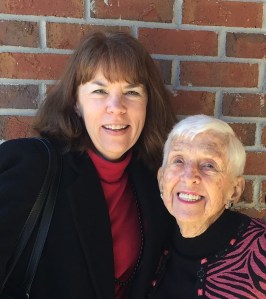 Though petite in stature, Mom’s my biggest cheerleader and most dependable defender. We all need someone who’s unconditionally, unreservedly in our corner. I’m so thankful Mom’s in mine. She’s my rock because she consistently points me to the Rock and reminds me His everlasting arms are securely holding all who belong to Him in an eternal embrace. (Deuteronomy 33:26-27a) O LORD, please help me to do the same for my precious children and grandchildren. Thank You for the priceless blessing of a godly mother!
Give ear, O my people, to my teaching; incline your ears to the words of my mouth! I will open my mouth in a parable; I will utter dark sayings from of old, things that we have heard and known, that our fathers have told us. We will not hide them from their children, but tell to the coming generation the glorious deeds of the Lord, and his might, and the wonders that he has done. (Psalm 78:1-4)
Make a joyful noise to the Lord, all the earth! Serve the Lord with gladness! Come into his presence with singing! Know that the Lord, he is God! It is he who made us, and we are his; we are his people, and the sheep of his pasture. Enter his gates with thanksgiving and his courts with praise! Give thanks to him; bless his name! For the Lord is good; his steadfast love endures forever, and his faithfulness to all generations. (Psalm 100)
 Our pastor has been preaching through the book of Exodus. The events recorded in the second book of the Bible – the burning bush, the plagues, the parting of the Red Sea, the giving of the Ten Commandments – have been part of my Biblical knowledge for as long as I can remember, dating back to my childhood Sunday school classes. Nevertheless, this ongoing sermon series has yielded a number of thought-provoking insights for now-grown-up me to ponder.
 Faced with the orange-ball debacle, I decided no one would get to play with it. This, of course, resulted in more sobbing and anguished pleas. Eventually my three charges turned their attention to other things and peace prevailed, at least for a while. Mustering all her 2-year-old earnestness, Emma confided something to me. A smile accompanied my comprehension of what I’d missed the first time when she repeated, “No fit pitchin’, Gammie.” “That’s right, Emma. We don’t pitch fits when we don’t get what we want!”


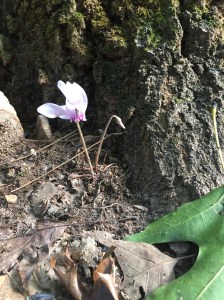 The Lord deals with us in much the same way, remembering we are dust, frail creatures who sometimes lose sight of Him amidst our storms. As our compassionate Father, He often sends personally-prepared reassurances of his watchful care. On the day Irma blew through, my reminder came via the unruffled presence of the birds as they fed contentedly. When I strolled my woods several days later, I discovered another special gift. Nestled safely at the base of a towering oak bloomed a tiny cyclamen, unfazed by events earlier in the week.
 A spikey orange and black gulf fritillary caterpillar munched methodically on a passionflower bud while butterflies flitted around the vine ready to lay the next generation of eggs. Japanese anemone and wood asters displayed the first of their late-summer blooms. Peace began to return to my soul. The One who spoke everything into existence created me in his image.
 I’ve since contemplated the statement in Revelation regarding the new order of things. “There will be no more night. They will not need the light of a lamp or the light of the sun, for the Lord God will give them light.”
 But my story was far from over. On January 28th, a mere two days after that fateful meeting, I contacted the admissions office at a local technical college and started the enrollment process to study horticulture. Six months later, my first grandchild was born. Joshua was present when I received my Environmental Horticulture diploma in December 2012. Two more grandchildren, Lyla and Emma, have joined our family. My days are full and my interests are many. I am blessed to have meaningful relationships. I am thankful.
 disappeared into the back playroom while 5-year old Joshua launched into his first imaginative scenario of the day. As he spread a flowered quilt on the floor, he explained it was a bee garden. He went on to describe several activities, such as bee races and honey tasting, and asked me to visit his garden. As Joshua was concluding his description, Lyla re-emerged in full Minnie Mouse regalia, including distinctive slippers and ears. In addition to donning her special attire, she had been setting up a picnic to which we were also invited.
 I love to feed the birds. I consider my feathered friends to be outdoor pets of sorts. Now that the weather has turned colder and there are fewer natural food sources, the activity around the feeders has escalated. In fact, I added a second feeder to accommodate the increased traffic. Tufted titmice and cardinals, chickadees and nuthatches, wrens and woodpeckers are regular visitors, eagerly partaking of the sunflower seeds and suet. The feeding generally proceeds in a harmonious manner, with birds flitting from feeder to tree branch to deck railing, taking turns as it were. But occasionally one of the diners becomes impatient. A ruckus ensues as the bird brusquely flaps his way to the feeder, scattering his equally-hungry companions. Nonetheless,whether patient or pushy, the birds have done nothing to earn the savory seeds. They are a gift, freely given.
 Back 2 the Garden