Lost and Found

For the Son of Man came to seek and to save the lost.
Luke 19:10

Futile Search

I got a Fitbit several years ago and have been wearing it daily ever since to keep track of my steps, resting heart rate, and sleep quality. Recently, I spent an intense couple of hours working outside, clearing one of my overgrown garden beds and racking up plenty of zone minutes. After toiling in the afternoon sun, I was ready for a cool shower, followed by a refreshing salad.

While preparing dinner, I realized I didn’t have my Fitbit. I went upstairs, expecting to find it on the bathroom counter. When it wasn’t there, I returned to the kitchen and searched. No sign of it there either. Realizing I would have to conduct a more extensive search, I turned my attention back to garnishing my salad.

I could barely focus on my dinner companion, a novel I’d been engrossed in the previous dinnertime when my mind wasn’t concerned about the whereabouts of my Fitbit. After more futile searching inside, I headed outside. Not finding my Fitbit in the garage, I crept outside to poke around in the soil and among the plants where I’d been working. By then, it was dark, and I was in my PJs, hoping my neighbors wouldn’t see the light from my phone bobbing around and come over to check on me. Nothing.

In a last desperate attempt, I texted myself in hopes the tracker would light up or buzz. Still nothing. Dejected and wondering if I’d ever see it again, I gave up and went to bed. Despite the exhaustion produced by the afternoon’s labor, restful sleep eluded me. I’d doze off only to wake up with another idea of where my Fitbit might be and how to find it.

Success!

Morning dawned, bringing with it renewed hope and another plan, albeit one tied to a concerning possibility. What if my Fitbit had fallen into the large brown paper sack where I’d stuffed the weeds? Or, shudder, what if it was in the plastic bag full of poison ivy?

Fortunately, my Fitbit was still connected to my phone. I went to the garage, picked up the paper sack, and walked back and forth a few times. No steps registered on the app. I eyed the bag containing the poison ivy, thoughts teetering between hope and dread, yet knowing I wouldn’t let poison ivy keep me from retrieving my tracker. I donned my gloves, picked up the bag, and started walking, delighted to see the counter recording my steps.
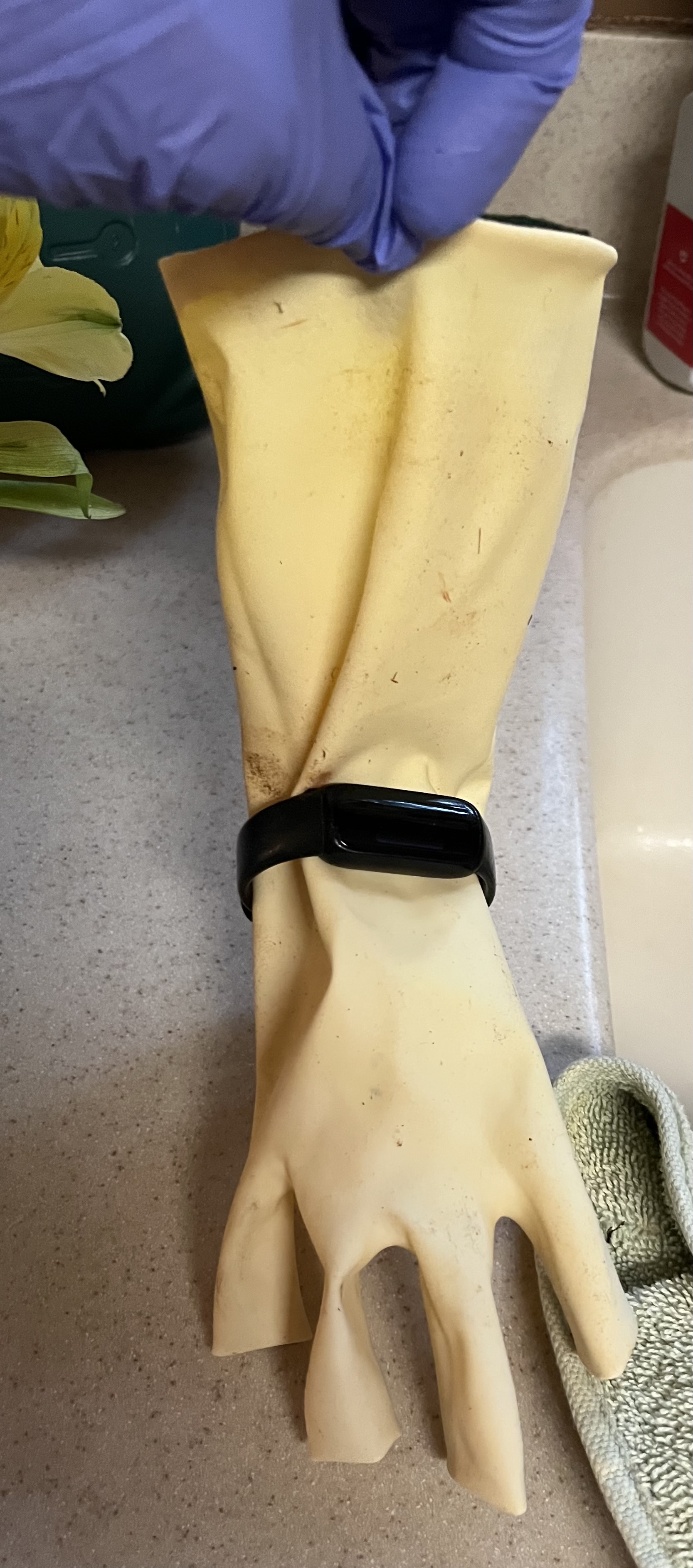
I set the bag down, peered in, and shook my head as I saw my tracker looped around one of the disposable gloves I’d worn the day before. In my haste to discard the glove and the itch-causing oil on its surface, I didn’t notice my poor tracker went into the bag with it.

The Ultimate Seeker

As I scrubbed the band of the Fitbit before returning it to my wrist, I couldn’t help but think about God’s unwavering commitment to seek out the lost. Though I was determined to find my Fitbit, if repeated attempts to do so had failed, I would have eventually given up. Or what if I’d found it, but it was in a bag filled with scorpions or venomous snakes instead of poison ivy? My resolve would have evaporated like the morning mist.

But God never gives up on us. He has been steadfast in seeking out the lost and those hiding in shame ever since He replaced Adam and Eve’s fig leaves with garments of animal skins, foreshadowing the ultimate sacrifice of His beloved Son, the seed of the woman who would crush the head of the serpent (Genesis 3:8-9).

God chose us in Christ before the foundation of the world, that we should be holy and blameless before him (Ephesians 1:4). He would stop at nothing, even the death of His precious Son, to secure His treasured possession, a people for Himself (1 Peter 2:9).

The Good Shepherd

The spotless Lamb is also the Good Shepherd, the One who came to seek and save the lost (Luke 19:10), who will not break a bruised reed or quench a faintly burning wick (Isaiah 42:3). He knows His sheep, each one entrusted to Him by the Father, and none will be lost (John 10:27-29).

Lambs aren’t the only ones that ramble off. Even mature sheep can wander, enticed by greener tufts of grass on the far side of the pasture. It’s comforting to know our watchful Shepherd won’t allow us to roam forever. We’ll hear and recognize His voice and return to His side. When we do, there will be great rejoicing, just like in the parable wherein a man left his 99 sheep to search for the one that went astray (Matthew 18:24-14).

Don’t Despair

I expect many of you reading this have at least one unbelieving friend you’re praying for, or a loved one who once walked with the Lord, but who’s wandered away from the faith. It’s painful for those of us who experience the goodness and mercy of our faithful Father to know some of those we care most about aren’t savoring the sweet fellowship and saving grace we depend on for our very life. At times, we may even despair of their ever joining or returning to the fold. It’s then that we must remember the One who seeks them is the very One who promised, “I myself will be the shepherd of my sheep, and I myself will make them lie down. I will seek the lost, and I will bring back the strayed, and I will bind up the injured, and I will strengthen the weak” (Ezekiel 34:15).

So, dear readers, keep praying, keep believing, knowing that the One who seeks the lost will never give up until all of His sheep are in the fold! Unlike my Fitbit and me, God doesn’t lose sight of any of us. He knows exactly where we and our loved ones are all the time and will stop at nothing to draw us back (Psalm 139:1-12, 23-24).


April, A Month of Contrasts

He will wipe away every tear from their eyes, and death shall be no more, neither shall there be mourning, nor crying, nor pain anymore, for the former things have passed away.
Revelation 21:4

Mourning

Inevitably, when the calendar turns to April, an undercurrent of melancholy seeps into my soul, regardless of what’s going on in my life. The seeds of sorrow were planted in the past and ripen into tears this time of year. I’ve lost several dear relatives in the month of April, including a great-aunt, an uncle, and a sister-in-law.

The most life-changing April losses were the deaths of my husband and mother. On April 19, 1997, Ray, barely 39 years old, left for work on a beautiful spring day, had a fatal heart attack, and never returned home, leaving me to raise our two young daughters on my own. On April 20, 2021, my 89-year-old mother fell, broke her hip, and passed into Glory ten days later after suffering unimaginable pain and frequent delirium.

The day Mom broke her hip was my dad’s 90th birthday. He joined her in the presence of Jesus in the wee hours of July 12, 2023, but no longer being able to celebrate his April birthday or watch the last round of the Masters golf tournament with him, as was our tradition, adds to the angst of this month.  

Never Forsaken

Those direct, just-the-facts descriptions of the bereavements belie the emotional punch each one packs. Every year, I’m intentional in remembering my last days with Ray and my first days without him. The numbness, inability to think clearly, and wondering how I’d ever make it without him colored my days. Now, in looking back, I see that God never left me then or in all the years since (Psalm 68:5).

I don’t spend as much time contemplating Mom’s final days. Being in so much pain was agonizing for her. Seeing her in so much pain was heartbreaking for those of us who kept vigil by her bedside. But I know we weren’t the only ones keeping watch over Mom. Her suffering Savior had endured even more, understood the pain, and never forsook her (Isaiah 53:4; Deuteronomy 31:6).

Joy

Despite the melancholy memories associated with the fourth month, April is also full of hope and joy. Here in Georgia, spring has arrived. The plants have woken up from their winter slumber. Trees are bedecked in fresh leaves, azaleas and dogwoods are blooming, and more flowers are popping up daily. It’s as if all creation is praising the Creator and mirroring the Resurrection story (Psalm 96:11-12).

April is also the month we usually celebrate Easter. Some years, my intentional reminiscences of Ray’s last days and Jesus’ final week overlap. Such is the case this year. As I remember my closing days with Ray, I will be thinking about all Jesus endured for us. A week that began with the Triumphal Entry quickly degenerated into betrayal, unjust trials, condemnation, beatings, mocking, and, ultimately, a gruesome death. The 28th anniversary of Ray’s Homegoing falls on the day before Easter, the glorious day that Jesus rose from the grave and changed everything forever (Matthew 28:6).

This week, as I engage in my annual tradition of remembering departed loved ones, I will rejoice in knowing that death doesn’t get the final say. The separation from God and beloved family members and friends is only temporary because Jesus paid the penalty we deserved so that we might spend eternity with Him.

So, I will shed some tears this week. Some will be borne of sorrow, some of wonder at God’s great love in sending His Son to die for us (John 3:16). I will revel in the beauty all around me, knowing it is but a glimpse of the beauty that awaits. And I will endeavor to add my hallelujahs to the chorus of praise because He is Risen! He is Risen indeed, and we are risen with Him! (Ephesians 2:6)

The Inheritance

Blessed be the God and Father of our Lord Jesus Christ! According to his great mercy, he has caused us to be born again to a living hope through the resurrection of Jesus Christ from the dead, to an inheritance that is imperishable, undefiled, and unfading, kept in heaven for you, who by God’s power are being guarded through faith for a salvation ready to be revealed in the last time.
1 Peter 1:3-5

Bittersweet Blessing

An inheritance is a bittersweet blessing. By definition, you only receive it when someone who loved you is no longer alive (Hebrews 9:16-17). Such was the case when my dad died in the summer of 2023. Engulfed by grief from losing him and grappling with my new orphan status since Mom preceded him in 2021, I was overwhelmed as I contemplated my position as their only child and sole heir. Gratitude and guilt mingled with an intense sense of responsibility.

My parents married young and had little material wealth to their names. Dad served in the Air Force and went to college on the GI Bill after he completed his four years of active duty. Mom worked various jobs to help pay the bills. From these humble beginnings, they labored together over nearly 70 years of marriage to build a comfortable life. They provided for me while I was under their roof and shared graciously with me and my family as the years progressed. Dad invested wisely, always with the goal of having something to leave for future generations.

Unmerited Benefits

I didn’t do anything to deserve the inheritance. If anything, I drained my parents’ finances instead of contributing to their wealth. As grateful as I was to receive it, I also worried I would make poor decisions and somehow waste or misuse what they’d left to me. One day, when I was engaging in just such hand-wringing, the friend listening to my angst said, “Your dad didn’t have to leave his inheritance to you. He could have given it to his alma mater or another charity, but he entrusted it to you. He knew you would handle it well.”

In the nearly two years that have passed since Dad joined Mom in the presence of Jesus, the powerful, mind-numbing grief has subsided to a dull, ever-present ache. Able to think more clearly than in the early days of loss, I’ve taken heart in what my friend said and have endeavored to make decisions that honor my parents’ memory and the values they instilled in me, including generosity, appreciation for education, and planning for the welfare of future generations.

Spiritual Inheritance

Navigating the realities of my material inheritance has provided ample opportunities for me to contemplate the importance of how I steward my spiritual inheritance.

Unlike Mom and Dad, Jesus was wealthy beyond measure, but He became poor for my sake so that by His poverty, I might become rich (2 Corinthians 2:8-9). He didn’t consider equality with God something to grasp. Instead, He left His throne and humbled Himself to the point of death on a cross (Philippians 2:6-8). His death secured an eternal, imperishable inheritance I did nothing to deserve (1 Peter 1:3-5).

Several years ago, our women’s Bible study worked through Entrusted to Be Invested by Karen Hodge. As children of the King, we’ve been entrusted with the greatest treasure of all, the Gospel. Unlike our earthly inheritance, which may become vulnerable to loss regardless of our best efforts, our inheritance in Christ is eternally secure, kept safe for us by the power of His blood.

Just as I strive to steward the earthly treasures my parents entrusted to me, I desire to steward the treasure of Gospel hope in a way that brings honor to my heavenly Father as I live out the values He’s imparted to me through the power of the indwelling Spirit.

Dear readers, in him we have obtained an inheritance, having been predestined according to the purpose of him who works all things according to the counsel of his will, so that we who were the first to hope in Christ might be to the praise of his glory. In him you also, when you heard the word of truth, the Gospel of your salvation, and believed in him, were sealed with the promised Holy Spirit, who is the guarantee of our inheritance until we acquire possession of it, to the praise of his glory . . . I pray that the eyes of your heart may be enlightened, so that you will know what is the hope of His calling, what are the riches of the glory of His inheritance in the saints and what is the immeasurable greatness of his power toward us who believe (Ephesians 1:11-14; 18-19).

May we endeavor to pass this priceless inheritance from one generation to the next until He returns.

Groaning

For we know that the whole creation has been groaning together in the pains of childbirth until now.
Romans 8:22

Intruders

I heard a noise above me and looked up. The sound was coming from the gutter and was accompanied by the shuffling of leaves. I could see a few stems and tips moving along the edge.

Well, great. (Insert eye roll.) Something else for the wildlife guys to deal with. They’d already been working on ridding my attic of rats. Maybe the varmints were using the gutter to gain access to their new digs.

My grandson Joshua was with me when the fellows showed up the next day. One climbed the ladder they brought while the other one steadied it. Elmer lifted the gutter cover just enough to see a tail. But it wasn’t a long, skinny, hairless one. It was fluffy and belonged to a half-grown squirrel, one of three inhabiting a nest the mother squirrel had managed to construct in the narrow confines of the gutter.

As Joshua and I watched the eviction process, I lamented as I often do when some critter or another takes up residence in an off-limits part of my house, “I left plenty of trees for them to live in! Why do they choose to get in/on my house?”

Joshua piped up, “It’s like the garden of Eden, Grammie! There was only one tree Adam and Eve weren’t supposed to eat from, and that’s the one they wanted!” (Genesis 2:16-17)

Delighted that Joshua had made that spiritual connection, I asked him if he wanted to expand on his observation like he’d done earlier this year with the parable of the bulbs.[1] However, he was more interested in accompanying Elmer into the attic to check the rat traps after he and his helper gently removed the baby squirrels from the gutter. 

But, once Joshua had planted that thought, I just had to ponder it!

Forbidden Attractions

What is it that’s so attractive about things that are off-limits? Regardless of our age, humans have an inborn desire for the forbidden. Sadly, original sin resides deep inside us, making us vulnerable to the enemy’s whispered, doubt-producing innuendos and causing us to question God’s goodness as Adam and Eve did (Genesis 3:1-6). What if He’s holding out on us, keeping the best to Himself?

Nope! We can squelch any doubts about God’s goodness by looking to the Cross. God gave us the very best He could have given us in Jesus, and Scripture assures us that if He gave us the most priceless gift, He won’t withhold any lesser thing (Romans 8:32).

Then there are the sinful tendencies passed on from more recent generations – frailties and misconceptions that continue to affect decisions and behavior until someone recognizes the familial brokenness and says, “Enough! This stops with me!”

Jesus’ sinless life, atoning death, and triumphant resurrection made the ultimate declaration. Praise God, our enslavement to sin ended with His selfless sacrifice on our behalf (Ephesians 2:4-7)! Though we will continue to battle the remnants of our sinful nature until Jesus calls us Home, the Spirit is transforming us more and more into the image of Christ (2 Corinthians 3:18).

Repeat Offender

The day after Elmer took the juvenile squirrels to their new home in a nearby state park, the noise-from-above scenario replayed. I was watering plants in front of my house when a snippet of sound and motion got my attention. I looked up and saw the mama squirrel with a mouth full of leaves heading to the end of the gutter. Sigh.

By the time Elmer and his helper returned the following week, she had crammed twice as many leaves into the gutter as before. Now that we knew how she was getting in, they closed the hole she’d made at the end of the gutter; however, she or one of her relatives has found a way into the attic and has spent several nights cavorting with the rats.

Such is life in a broken world.

Longing for Home

I suppose the mother squirrel thought the gutter offered excellent protection from predators, but a hollow in a tree would have been more appropriate as the babies grew. They didn’t get a say in their mother’s choice, but they suffered the consequences, first from being cramped and then evicted.

I felt some remorse the first night they were taken away, wondering what their mother thought when she returned and found them gone. Then again, I knew they couldn’t stay. Given the chance when grown, the baby squirrels might have set up housekeeping in the gutter since that was the example they’d been given. Or maybe they would have gnawed a hole in my deck railing, dug up my plants, or knocked one of the birdfeeders off its hook, all things prior generations of their family have done.

All creation is groaning because things aren’t as God intended them to be. There are days when I join in the groaning, longing for Jesus to return and set all things right. From misplaced critters and weeds in my garden to the ravages of cancer and a swath of destruction left by a powerful hurricane, the vestiges of sin are all around us. But evidence of God’s love surrounds us as well. We can rest in the assurance that Jesus is preparing a Home for us where we’ll dwell with Him forever, never to be evicted again (John 14:2-3)

For I consider that the sufferings of this present time are not worth comparing with the glory that is to be revealed to us. For the creation waits with eager longing for the revealing of the sons of God. For the creation was subjected to futility, not willingly, but because of him who subjected it, in hope that the creation itself will be set free from its bondage to corruption and obtain the freedom of the glory of the children of God. For we know that the whole creation has been groaning together in the pains of childbirth until now. And not only the creation, but we ourselves, who have the firstfruits of the Spirit, groan inwardly as we wait eagerly for adoption as sons, the redemption of our bodies. For in this hope we were saved. Now hope that is seen is not hope. For who hopes for what he sees? But if we hope for what we do not see, we wait for it with patience (Romans 8:18-25).


[1][1] You may find Joshua’s parable in “Faith Connections,” Archives, August 2023.

Have We Forgotten?

Yet the number of the children of Israel shall be like the sand of the sea, which cannot be measured or numbered. And in the place where it was said to them, “You are not my people,” it shall be said to them, “Children of the living God.”
Hosea 1:10

A Challenging Message

This fall, we’re using Paula Miles’ “No Empty Word: Relentless Pursuit a Study on Hosea” for our Women’s Bible study. We’ve agreed that Hosea is a challenging book, not the first one we think of when in need of a comforting verse to put on a counted cross stitch. God didn’t hold back when proclaiming what would happen if His people refused to forsake their wicked ways and return to Him. Some of us have even found it difficult to read parts of Hosea aloud since it contains words we wouldn’t dare utter in conversation.

However, as the study has progressed, we’ve realized there is much comfort in Hosea because it recounts God’s unending love and compassion for His wayward people. Time and again, Hosea depicts the tension between God’s judgment and mercy, between His righteousness and covenant fidelity. Despite our faithlessness, He remains faithful (2 Timothy 2:13).

One recent Tuesday morning, we were working our way through chapter 8 of Hosea. In verse 13, we read that God told His people He would remember their iniquity, punish their sins, and send them back to Egypt, which was a foretelling of their captivity under Assyria. By this point in their history, the book of the Law, which the king was supposed to keep by his side and read every day (Deuteronomy 17:18-20), had been misplaced, and the priests were greedy and unfaithful. Thus, it was unlikely God’s people had consistently passed on the story of His miracle-filled deliverance from generation to generation as He’d commanded (Psalm 78:4-6). Given all that, I suggested that the threat of being returned to Egypt might not have meant much to them or carried much weight. Perhaps no one had told them how dreadful it was to be a slave or how marvelous God’s rescue was.

Although Hosea 8:2 says the people still “knew” the Lord and called on His name, simply knowing about God and crying out to Him in times of desperation isn’t the same as having a relationship with Him and a heart that wants to please Him.

Sobering Questions

As our discussion moved on, a whisper arose in my spirit: How about you? Do you remember how bad it was to be enslaved by sin? The thought convicted me. After walking with the Lord for nearly 50 years, have I forgotten how hopeless my situation was before He rescued me? Dead in my trespasses, unable to contribute anything to my salvation. Left to my own devices, I would have perished. Eternally.

But God, in His mercy, chose to redeem a people for Himself (Ephesians 2:4-5). May we never forget how remarkable and costly His rescue was! Redeemed by the Son’s precious blood, none of God’s children will ever be lost. Like a loving Father, He disciplines us (Hebrews 12:5-11), but He won’t ever forsake us (Deuteronomy 31:6).

Throughout No Empty Word, the study questionshave challenged us to identify our idols, those things we allow to usurp God’s rightful place in our hearts and lives, things we look to for security instead of depending on the One who is our Provider, Rock, and Refuge, the One who is sovereign over every detail. Self-reliance, autonomy, self-glory, peace, wealth, fame – we’ve mentioned all of these in our discussions. Several times,  those discussions have reminded me of God’s warning in Deuteronomy 8:

Take care lest you forget the Lord your God by not keeping his commandments and his rules and his statutes, which I command you today, lest, when you have eaten and are full and have built good houses and live in them, and when your herds and flocks multiply and your silver and gold is multiplied and all that you have is multiplied, then your heart be lifted up, and you forget the Lord your God, who brought you out of the land of Egypt, out of the house of slavery, who led you through the great and terrifying wilderness, with its fiery serpents and scorpions and thirsty ground where there was no water, who brought you water out of the flinty rock, who fed you in the wilderness with manna that your fathers did not know, that he might humble you and test you, to do you good in the end. Beware lest you say in your heart, ‘My power and the might of my hand have gotten me this wealth.’ You shall remember the Lord your God, for it is he who gives you power to get wealth, that he may confirm his covenant that he swore to your fathers, as it is this day (Deuteronomy 8:11-18).

It’s a warning that applies every bit as much to God’s children today.

O Lord, please help us never to neglect the reading and hearing of Your Word or tire of telling the coming generations about Your glorious deeds so that they, too, will know how awful it is to be a slave to sin and how awesome it is to be a child of God. And may we never forget that everything we have and are, from our salvation to our daily bread, is a gift from You.

Epilog

You may be wondering about the photo I selected to accompany this post. Years ago, I saw a short video of a guy sitting behind a table in a cemetery. He’d posted a sign with the message along the lines of, “Anyone interested in eternal life step right up!” No surprise, but not a single person exited one of the graves and took him up on his offer. I often think of that clip when I contemplate what it means to be dead in our trespasses, unable to contribute anything toward our salvation!

Scars

But he was pierced for our transgressions;
    he was crushed for our iniquities;
upon him was the chastisement that brought us peace,
    and with his wounds we are healed.
Isaiah 53:5

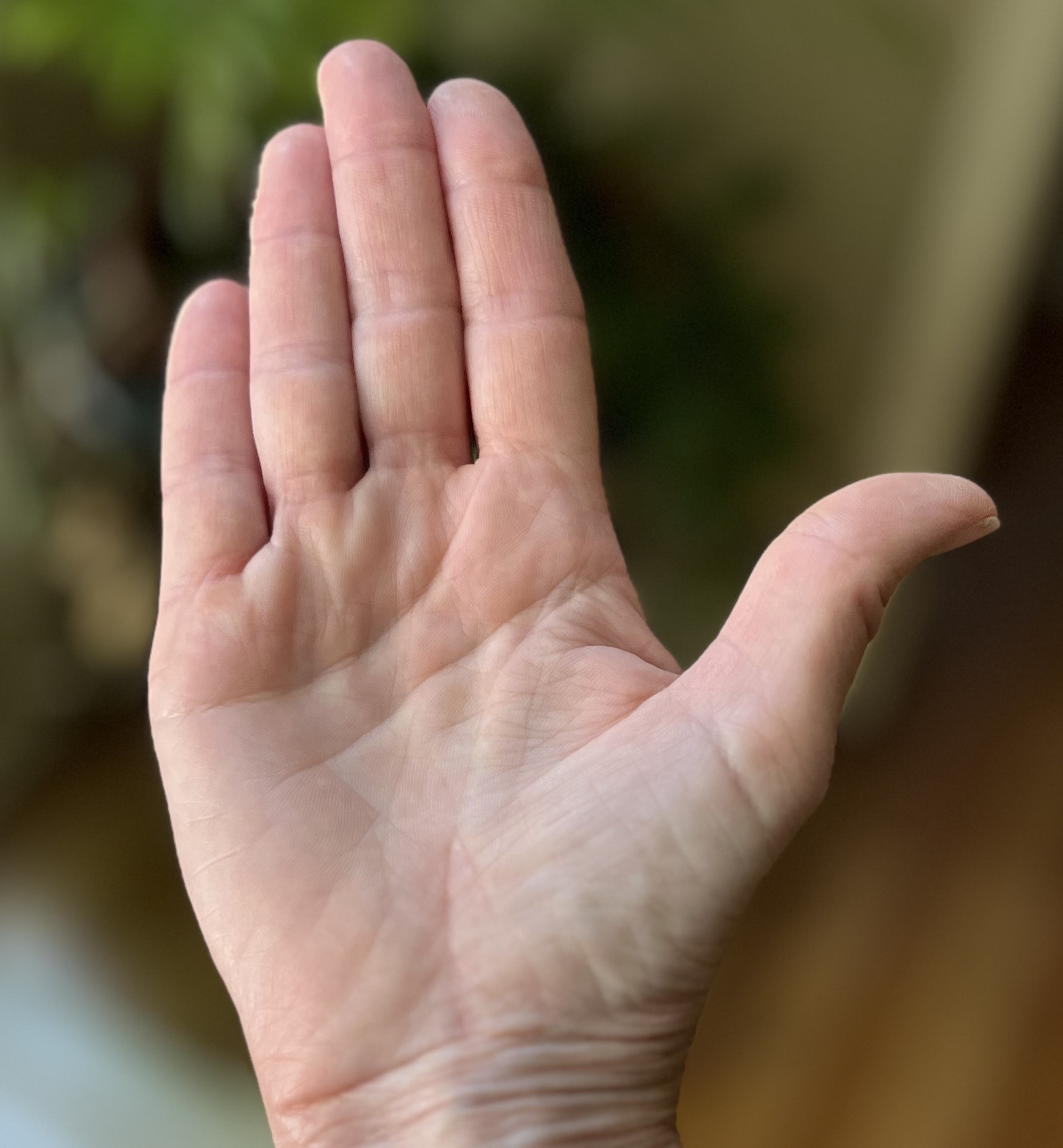
My right hand bears several scars, some the result of injuries, others from surgery. They’ve become less visible with time, but I can see them if I look hard enough. Let me tell you about those scars and some spiritual parallels I came up with when I realized the ugliest scar has faded along with the rest.

Pesky Pop-tops

I started drinking diet sodas when I was a teenager. Back then, the pop-tops weren’t attached to the cans. I would wipe the lid, peel off the tab, and drop it into the opening. Mom was horrified. “Someday, you’re going to drink one of those things!” I assured her I’d bent them enough that they wouldn’t come out. But one day, I left a tab on the kitchen counter instead of putting it in the can. When I washed my hands later, I dried them with a paper towel someone had placed on the counter, never thinking the metal tab might be underneath. The sharp edge made a small cut on top of my hand and accounts for my oldest scar.

Mom was right – those tiny tabs belonged in the trash!

Fast forward 50 years. Those little pull tabs are now securely attached to the top of cans, but you can pry them off if you bend them back and forth a few times, which is what my 13-year-old grandson was doing recently. I showed him the scar on the top of my hand and told him the story behind it.

Is there a lesson you’ve learned from a poor decision in your past, something more critical than a small cut, that you can share to help others understand potential consequences and make better choices?

Surgical Relief

Then there’s the scar from carpal tunnel surgery. The surgeon carefully made the incision in one of the creases on my palm, knowing it would help hide it. Sure enough, it’s barely visible.

I’m not a fan of surgery because I don’t like to be put to sleep or deal with the downtime associated with recovery, and I often say “elective surgery” is an oxymoron in my vocabulary. But the carpal tunnel operation was so helpful I didn’t hesitate to have it done on the left side a year later, and I’ve recommended it to others who’ve experienced the pain and numbness associated with carpal tunnel syndrome.

Just as I try to avoid surgery, I’m not one to beg God to send difficult circumstances into my life to grow my faith. Yet I know He often uses hard things to discipline me, draw me closer to Himself, and transform me into the image of His Son. Thus, I pray with the psalmist, “Search me, O God, and know my heart! See if there is any offensive way in me and lead me in the way everlasting,” trusting the Holy Spirit to reveal and carefully excise things from my life that are hindering my walk with the Lord (Psalm 139:23-24).  

Stealth Attack

Next up in the catalog of scar-producing injuries is a cut from an unsheathed razor. I vividly remember the moment. We were on vacation at the beach. I reached into my toiletry bag, not realizing the protective cover was no longer on the razor. The sharp blade sliced a small chunk of skin off the upper knuckle of my pointer finger. I almost passed out from the unexpected injury and the gush of blood that accompanied it. The wound healed but produced a bump of thickened skin, known as a keloid.

The circumstances and raised scar associated with this injury remind me of relationships with people who I took at face value and trusted, only to have their true selves appear later, causing deep hurt and bewilderment. Doubting my ability to judge rightly and not wanting to experience that kind of betrayal again, I overreacted and built walls to keep others at a safe distance.

Graceless Stumble

And then there was the jagged, ugly scar I mentioned in the introduction. It resulted from a tumble I took on my front walk. I went to check the rain gauge, wasn’t being careful on the slippery pavement, and plummeted to the ground. Shocked and embarrassed, I lept up lest anyone see me prostrate. Lightheaded and unsteady, I sought my neighbor’s help to stem the blood flow and apply a bandage. Several weeks later, when I saw how unsightly the scar was, I realized it would have been better if I’d sought medical care and gotten a few stitches. I accepted that it would be there forever, glaring at me, reminding me of the fall.

But then, a few days ago, I realized that it, too, is barely visible.

There have been times when I’ve lost focus and slipped into sin. I never thought I would find myself in such a predicament, and tried my best to minimize the damage and cover my tracks. But my efforts were inadequate, like the bandage that barely staunched the flow of blood from my palm and the fig leaves Adam and Eve used to hide their nakedness (Genesis 3:7).

Redeeming Scars

We won’t pass through this life unscathed by the sin and brokenness inherent in our journey. Some of those injuries will be self-inflicted, others caused by people we encounter along the way, and still others due to generational sins that have simmered for decades.

It takes much more than self-applied treatments to wash away the sin and heal the hurts. Praise God for providing the spotless Lamb who was slain (John 1:29; Revelation 5:12)! Jesus was wounded for our transgressions, all of them. He can commiserate with our weaknesses, yet was without sin (Hebrews 4:15). He heals the brokenhearted and binds up our wounds (Psalm 147:3). Blessed assurances!

The memories of past indiscretions linger, but just like the jagged scar I thought would be there forever, they’ve faded, replaced by the truth of Christ’s sacrificial love for me and my identity in Him.

Jesus still bears the wounds from His crucifixion (John 20:27-28). It saddens me to think about Him carrying those scars forever. But I am oh so grateful those wounds will ever plead for me and other ransomed sinners, as Charles Wesley penned in his hymn, “Arise, My Soul, Arise.”

I’ll close rejoicing with the final stanza and chorus of a more recent hymn, “The Power of the Cross:”[1]

Oh, to see my name
Written in the wounds,
For through Your suffering, I am free.
Death is crushed to death;
Life is mine to live,
Won through Your selfless love

This, the pow’r of the cross:
Son of God – slain for us.
What a love! What a cost!
We stand forgiven at the cross.


[1] Stuart Townsend and Keith Getty, “The Power of the Cross,” Thank You Music, 2005.

Don’t Cry! (Reprise)

Jesus wept.
John 11:35

Introduction

A recent conversation with friends began with one of them apologizing for the tears that accompanied her reply to our question, “How are you?” “Not great,” followed by,  “Oh, I’m sorry, I cry too easily!”

My other friend and I assured her there was no need for an apology. After all, we cry easily, too! Thinking back on our exchange reminded me of this blog post I wrote several years ago. I decided it was time to dust it off, make a few edits, and rerun it.

Tears for All Occasions

I suppose I should begin with a confession: I’m an equal-opportunity crier. My eyes are just as likely to well up in moments of joy as in sorrow – while reading sweet sentiments in Hallmark cards, watching heartbreaking news stories, attending weddings or funerals, even when leading Bible study, as the magnitude of God’s grace and mercy floods over me. Yes, from a barely-there trickle to gut-wrenching sobs, I’ve shed my share of tears and expect to shed plenty more.

A quick Google search reveals three different types of tears. Basal tears keep our eyes lubricated, while reflex tears pop up in response to irritants like slicing onions or having a pesky gnat flit into your eye. And then there are psychic tears associated with our emotions, distinct from the other two in that they contain stress hormones.[1] No wonder we often feel better after shedding them. They’re like an overflow valve for the soul.

Biblical Weeping

The Bible has much to say about tears and the circumstances surrounding them. Consider, for example:

  • Loss of a loved one by separation or death
    • David grieved the loss of his closer-than-a-brother friend, Jonathan, first from necessary distancing and then by death (1 Samuel 20:41; 2 Samuel 1:12).
    • Mary and Martha mourned Lazarus’ death. Seeing their distress, Jesus wept too, even though He knew his Father would hear His prayer to raise him. Jesus had compassion for the sisters in their time of loss, and He has compassion for us as well (John 11:31-35).
    • Jesus’ followers were bereft and befuddled after His death despite the many times He’d told them what was to come (Luke 18:31-34; 36:13-49).
  • Disappointments of various sorts
    • Esau wept over losing his birthright when he realized his brother had tricked their father (Genesis 27:30-38).
    • Hannah’s unfulfilled desire for a child, exacerbated by her rival’s provocation and her husband’s lack of understanding, led to her fervent, tear-stained prayer for relief (1 Samuel 1:1-10).
  • Sorrow for sin
    • Three of the four Gospels recount Peter’s tear-punctuated dismay when Jesus’ statement that he’d betray Him came to pass (Matthew 26:75; Mark 14:72; Luke 22:62).
    • James says we should be wretched, mourn, and weep over our transgressions, humbly drawing near to God for forgiveness and restoration (James 4:8-10).
  • Worship and Gratitude
    • The penitent woman who wet Jesus’ feet with her tears, wiped them with her hair, and anointed them with ointment was motivated by her love for her Savior (Luke 7:36-38).
  • Joyous reunion
    • Though bitterness marked their estrangement and Jacob feared the worst from Esau, the brothers’ reunion was accompanied by joyful tears (Genesis 33:4).
    •  I’m taking some liberty here because none of the translations I consulted mention crying, but I’ve got to believe the prodigal son’s compassionate father had tears of elation streaming down his face as he ran to greet his returning son (Luke 15:20).

To Grieve or Not to Grieve?

Even though these passages and others make it clear psychic tears are part of our God-given emotions, we’re quick to admonish, “Don’t cry!” Could it be that others’ tears make us uncomfortable or tearful ourselves? Or worse, might we believe God’s children aren’t supposed to cry because we know the end of the story?

I distinctly remember a visit from the mother of one of my daughter’s friends, though it occurred 27 years ago. She, too, was widowed at a young age, losing her husband a few months after I lost mine. Being a wee bit further along the path of single parenting, I hoped to console her, but when she arrived, she was surprisingly joyful and radiant. I’ll never forget her statement, “The elders and my church family have been praying I won’t grieve, and it’s working!”

Not grieve the loss of your life partner and father of your children? I was speechless. Granted, we don’t grieve as those who have no hope, but we do grieve.

Man of Sorrows

The women who witnessed Jesus’ crucifixion no doubt wailed at the sight of their beloved Teacher and Friend, bloodied and beaten, being nailed to a Roman cross – the innocent One put to death for the sins of others. Isaiah 53 is one of my most cherished passages, but also one which I can rarely get through without tears. Man of sorrows, acquainted with grief. Despised. Rejected. Wounded for our transgressions, crushed for our iniquities. My transgressions. My iniquities.

A conversation with my pastor regarding our propensity to rush to the good news of Christ’s victory over death without allowing ourselves or others to grieve reminded me of my daughter Jessie’s comment as we stood by Mom’s grave following her funeral three years ago. After watching Mom endure horrible pain the last ten days of her life, I said I was thankful she wasn’t suffering anymore. Jessie replied, “That’s true, but don’t miss out on the mourning, Mom.”

Don’t miss out on the mourning.

If we ever doubt we have permission to grieve, we have only to look to Jesus. He experienced what it’s like to walk through this sin-scarred world. Even though He knew He would defeat death and not one of those entrusted to Him would be lost, Jesus wept because death was never part of God’s good plan. It stings. It always will this side of heaven.

As we go through difficulties in this life, we know the One who keeps track of every tear (Psalm 56:8) is seated at the right hand of God, interceding for us. Nothing can separate us from His love (Romans 8:31-39). He has promised to return, to usher in a new heaven and a new earth, to wipe every tear from our eyes (Revelation 21:1-4). Until then, let us rejoice with those who rejoice and weep with those who weep, unafraid of our tears.

O Lord, thank You for hearing our cries for help. Though weeping may last through the night, joy comes with the morning (Psalm 30). You have shown great mercy in sending Jesus to die for our sins and will turn our mourning into gladness. For we know this momentary affliction is preparing an eternal weight of glory beyond all comparison (2 Corinthians 4:17). 

Note: A blend of joy that my granddaughter Lyla Ray arrived safely and sorrow that her Grandpa (Ray) Kuipers wasn’t with us to greet his namesake produced the barely visible tear on my cheek in the accompanying photo.


[1] “What are the three different types of tears found in our eyes?”, http://www.sharecare.com

Death Benefits, Revisited

I have been crucified with Christ. It is no longer I who live, but Christ who lives in me. And the life I now live in the flesh I live by faith in the Son of God, who loved me and gave himself for me (Galatians 2:20).

Abram believed the Lord, and he credited it to him as righteousness (Genesis 15:6 (NIV).

I’ve been known to gasp over a post-Christmas credit card bill or cringe when writing my annual property tax check, but this may have been a first – tears filled my eyes as I gazed at a deposit to my account. The deposit was present because my husband no longer is.

After dealing with the aftermath of Ray’s sudden death – notifying family and friends, planning and attending his visitation, funeral, and burial services, traveling back and forth to North Carolina – grief clouded my thinking and slowed my body. Not yet able to fully grasp the finality of the situation, I moved through my days moment-by-moment, piecing thoughts and decisions together, struggling to complete a puzzle missing an essential piece.

My parents’ presence not only comforted me, but their clearer minds filled in some of the gaps in my thinking. And so, some ten days after Ray’s passing, at my dad’s urging, we made our way to the Social Security office. I recorded the following in my journal:

“Gathered things to take to meeting with Social Security after I took Mary and Jessie to school – marriage license, passports, M&J’s birth certificates – happy bits of my life, now gathered for a very unhappy purpose.”

Nonetheless, thankfulness and relief washed over me when I heard my minor daughters qualified to receive monthly benefits, based on their dad’s earnings, until their 18th birthdays. I received a small, one-time widow’s stipend along with the news that I would be eligible to collect Ray’s benefits when I reached age 60, at least if I hadn’t remarried by then. Remarrying seemed highly improbable. Like a swan, I felt I mated once, for life. Regardless, my 60th birthday loomed 22 years in the future, a distant speck on a 21st-century calendar, so I filed that bit of information in the far reaches of my mind.

I dedicated myself to raising my daughters, completed a 30-year career at a large corporation, returned to school to study horticulture, and became “Grammie” to three precious little ones. All the while, the calendar pages kept turning with increasing velocity until that distant speck became an entry on my planner, “me – 60!!” Once again, I gathered important documents and went to the Social Security office. Thoughts of the former trip accompanied me, as did so many similar emotions, which became barely-contained tears as I resolutely recounted my story to the kind agent who entered my claim.

Several months later, the first deposit appeared on the designated date, eliciting the tears mentioned above. Ray’s benefits, based on his years of diligent work, were credited to my account. I had done nothing to earn them other than being his widow and believing that the benefits would be there as promised.

Each year, as the April 19th anniversary of Ray’s death approaches, I intentionally think back to my last week with him and my first one without him. My annual remembrance occurs in the same season as Holy Week, another time of intentional remembrance, though the exact dates of the latter change from year to year. From Palm Sunday to Good Friday, I recall the events of each day of Jesus’ final week, all He endured to save me, a destitute sinner with no hope of saving up any treasure worthy of entering the Father’s presence.

And then comes Resurrection Sunday! What joy and gratitude fill my heart, knowing Jesus’ sacrifice paid my debt and credited His perfect righteousness to my account, an account that now overflows with eternal blessings.

Indeed, Jesus’ sinless life, atoning death, and subsequent resurrection guarantee numerous benefits for those who belong to Him. Consider, for example:

  • Peace with God – Therefore, since we have been justified by faith, we have peace with God through our Lord Jesus Christ (Romans 5:1). (See also Luke 2:14; Romans 15:13)
  • Forgiveness – To him all the prophets bear witness that everyone who believes in him receives forgiveness of sins through his name (Acts 10:43). (See also Ephesians 1:7; Colossians 1:13-14)
  • God’s abiding presence now – And behold, I am with you always, to the end of the age  (Matthew 28:20b). (See also Deuteronomy 31:8)
  • and forever – Then I saw a new heaven and a new earth, for the first heaven and the first earth had passed away, and the sea was no more. And I saw the holy city, new Jerusalem, coming down out of heaven from God, prepared as a bride adorned for her husband. And I heard a loud voice from the throne saying, “Behold, the dwelling place of God is with man. He will dwell with them, and they will be his people, and God himself will be with them as their God (Revelation 21:1-3).
  • An eternal home – In my Father’s house are many rooms. If it were not so, would I have told you that I go to prepare a place for you? And if I go and prepare a place for you, I will come again and will take you to myself, that where I am you may be also (John 14:2-3).
  • An imperishable body – Behold! I tell you a mystery. We shall not all sleep, but we shall all be changed, in a moment, in the twinkling of an eye, at the last trumpet. For the trumpet will sound, and the dead will be raised imperishable, and we shall be changed. For this perishable body must put on the imperishable, and this mortal body must put on immortality (1 Corinthians 15:51-53. (See 1 Corinthians 15:35-58 for the full description of the change we can look forward to.)
  • An eternal inheritance – Blessed be the God and Father of our Lord Jesus Christ! According to his great mercy, he has caused us to be born again to a living hope through the resurrection of Jesus Christ from the dead, to an inheritance that is imperishable, undefiled, and unfading, kept in heaven for you, who by God’s power are being guarded through faith for a salvation ready to be revealed in the last time (1 Peter 1:3-5).

I’m grateful to receive Ray’s Social Security payments. They connect me to him and remind me of his love and care while he was with me. But each month, when I see that deposit on my statement, it also reminds me of the One who is my ultimate and eternal Provider, the Giver of all good gifts (James 1:17), who didn’t spare His only Son, but gave Him up for us all (Romans 8:32) to secure death benefits of the most enduring kind.

The Light

The light shines in the darkness, and the darkness has not overcome it.
John 1:5

I’m tired. And a bit grumpy. The same thing happens every year when I lose an hour of sleep as we spring forward to Daylight Savings Time. I get out of sorts just thinking about it. But then, when evening of the shortened day descends, and it’s still light after dinner, I remember the benefits of those extra hours of light at the end of the day, including more time to work in my garden and go for walks.

I’ve shared a number of times on these pages that one of the things I like best about living in Georgia is the early arrival of spring and the long bloom season. Granted, the weather usually teases us with a few stretches of warm days followed by a return to near-freezing conditions before the last official frost date, sometimes with dire consequences for the plants that thought spring had arrived to stay.

But not so with the light. After the winter solstice, daylight gradually increases until the summer solstice, when it begins to decline again. My aunt used to give Mom an almanac calendar that noted the daily amount of daylight to the minute. By the end of December each year, Mom would happily report, “The days are getting longer!”

All this thinking about light led me to ponder THE Light.

In one of His discourses with the Pharisees, Jesus declared, “I am the light of the world. Whoever follows me will not walk in darkness, but will have the light of life.” (John 8:12)

The Apostle Paul affirmed our status in his letter to the Colossians: (The Father) has delivered us from the domain of darkness and transferred us to the kingdom of his beloved Son,  in whom we have redemption, the forgiveness of sins (Colossians 1:13-14).

Peter also mentioned darkness and light as he described our incredible identity in Christ: But you are a chosen race, a royal priesthood, a holy nation, a people for his own possession, that you may proclaim the excellencies of him who called you out of darkness into his marvelous light. Once you were not a people, but now you are God’s people; once you had not received mercy, but now you have received mercy (1 Peter 2:9-10).

However, we must not overlook the fact that ushering us into the kingdom of light plunged Jesus into the depths of darkness as He took our sins upon Himself and endured the wrath of God on our behalf, thus removing the barrier between us and the Father:

And when the sixth hour had come, there was darkness over the whole land until the ninth hour. And at the ninth hour Jesus cried with a loud voice, “Eloi, Eloi, lema sabachthani?” which means, “My God, my God, why have you forsaken me?” . . . And Jesus uttered a loud cry and breathed his last. And the curtain of the temple was torn in two, from top to bottom (Mark 15:33-34, 37-38).

The lyrics of a song we sing at church depict the painful separation of Father and Son. The words often bring me to tears as I contemplate the darkness Jesus endured for us:

How deep the Father’s love for us,
How vast beyond all measure,
That He should give His only Son
To make a wretch His treasure.
How great the pain of searing loss –
The Father turns His face away,
As wounds which mar the Chosen One
Bring many sons to glory.
[1]

Even though Jesus secured victory over death by His sacrifice on the cross, this world is still marred by sin and brokenness. There are times when we experience darkness, collectively as the Body of Christ and individually – illness, disappointments, broken hearts, and dashed dreams. But, the darkness will never overcome the Light. And, as His representatives, we’re to shine brightly, glorifying God and pointing others to the hope we have in Jesus.

In His Sermon on the Mount, Jesus declared as much:

“You are the light of the world. A city set on a hill cannot be hidden. Nor do people light a lamp and put it under a basket, but on a stand, and it gives light to all in the house. In the same way, let your light shine before others, so that they may see your good works and give glory to your Father who is in heaven.” Matthew 5:14-16

Just as Mom used to get excited about the incremental minutes of daylight, we can rejoice in knowing we’re getting ever closer to Jesus’ promised return. The day is coming when darkness will be defeated once and for all, overcome by the brilliance of the spotless Lamb, surrounded by His followers arrayed in radiant robes of righteousness that have been washed in His blood:

And I saw no temple in the city, for its temple is the Lord God the Almighty and the Lamb. And the city has no need of sun or moon to shine on it, for the glory of God gives it light, and its lamp is the Lamb. By its light will the nations walk, and the kings of the earth will bring their glory into it, and its gates will never be shut by day—and there will be no night there. They will bring into it the glory and the honor of the nations. But nothing unclean will ever enter it, nor anyone who does what is detestable or false, but only those who are written in the Lamb’s book of life (Revelation 21:22-27).

Dear readers, I hope my musings and, more importantly, the passages of Scripture I’ve included in this post will give you some things to consider as we look forward to celebrating Easter later this month. How blessed we are that God loved us so much that He sent His Son to die for us so that we might be welcomed into the kingdom of Light forever!


[1] “How Deep the Father’s Love”, Stuart Townend, 1995
Photo courtesy of Google Images.

Selfless Giving

Do nothing from selfish ambition or conceit, but in humility count others more significant than yourselves. Let each of you look not only to his own interests, but also to the interests of others. Have this mind among yourselves, which is yours in Christ Jesus, who, though he was in the form of God, did not count equality with God a thing to be grasped, but emptied himself, by taking the form of a servant, being born in the likeness of men.
Philippians 2:3-7

Welling

My daughters gave me an early birthday present a couple of weeks ago – dinner followed by Amy Grant and  Michael W. Smith’s Christmas Concert. After listening to their music for over three decades, we sometimes say it’s our Christmas soundtrack, so it was delightful to see them in person.

Several songs into the concert, Michael announced he had released a new Christmas album, his fifth. (How did I not know about this?) He performed several songs from the latest release throughout the evening, but the initial one, “Sometime Every Christmas,” touched me the most. Michael barely made it through the first two stanzas before it evoked in me what the chorus described:

I’m thinking about the holiday
And the sands of time
Years pass like pages of old family
Photos in my mind

Faces and the places
How Decembers used to be
A little loneliness and longing
It rises up in me

Sometime every Christmas
Can’t say where or when or why
But some moment or some memory
Takes me by surprise
And something in the season
Wells up in my eye
Sometime every Christmas
I cry

My “sometime” isn’t confined to a single episode during the Christmas season, which is full of countless traditions associated with loved ones who are no longer here. Usually limited to the momentary welling Michael referred to in this poignant song, there are times when my emotions overtake me and welling quickly gives way to weeping.

Such was the case a few days after the concert when I came across a note from Mom.

Weeping

I’d been working on setting up my Dickens Village, a beloved part of my Christmas celebration ever since my late husband gave me the first few pieces 34 years ago. Ray gifted me a few buildings and accessories each year until he passed away seven years later, and I’ve continued to add to the display ever since.

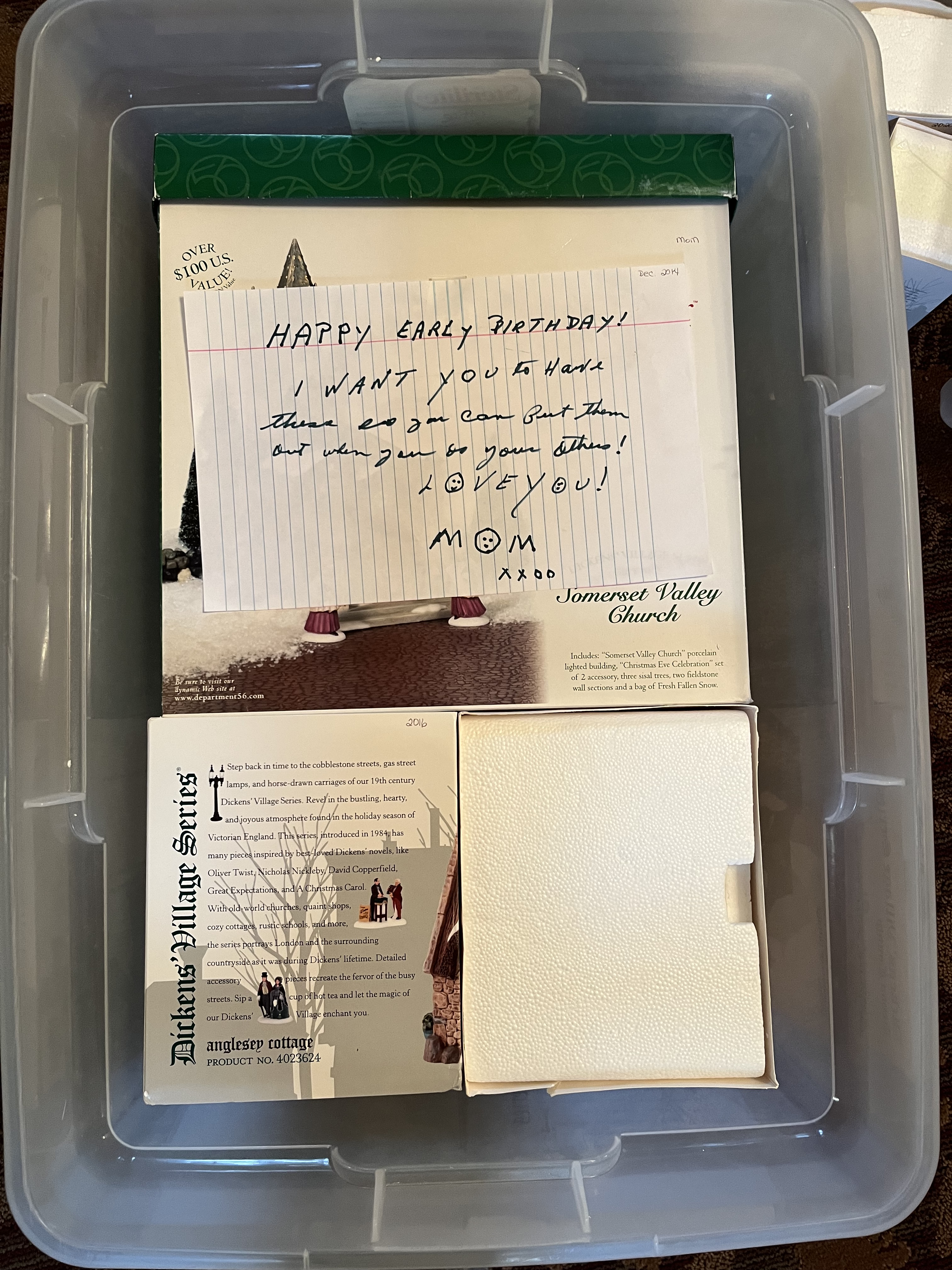
Ray also started a village for Mom. Dad and I added to her collection until it became difficult for her to set up the display. I offered to do it for her. Instead, one early December day, she said, “Come upstairs with me.” I followed along as she slowly trod the stairs and stopped outside the closet where she kept her Christmas decorations. When she opened the door, I saw she’d taped a note on the shelf where the boxes holding her village sat. “HAPPY EARLY BIRTHDAY! I want you to have these so you can put them out when you do your others! Love you! Mom xxoo.”

I keep the buildings and accessories in their original boxes, which I store in multiple plastic tubs. Sentimental me kept Mom’s note. It resides in one of the tubs, but I somehow forget about it from one year to the next. Thus, it caught me off guard when I opened one of the containers the week after the concert. In that moment, I was no longer standing in my living room. Whisked back in time, I was with Mom, outside her closet. Her eyes shone with anticipation as she opened the door to reveal the surprise. Her joy in giving such a special gift radiated through her petite being. The scene replayed in vivid detail, though the event occurred nine years ago.

No welling of tiny tears when I read the note penned in Mom’s familiar handwriting. Full-body sobs overtook me as the note reminded me of all I’d lost when she went Home. Mom was one of the kindest people I’ve ever known. Selfless and generous, she delighted in serving and giving to others. I often think of her when I read Philippians 2:3-8. Mom humbly put others’ interests before her own. Though her humility would never have allowed her to say, “Be imitators of me as I imitate Christ,” as the Apostle Paul did, nor did she hold herself up as a godly role model, she set a beautiful example for me to follow, nonetheless. Though I often fall short, one of the greatest compliments anyone can give me is to say some aspect of my character is like Mom’s.

Rejoicing

I enjoy listening to music while I’m working on my village. In a perfectly timed moment, as my sobs subsided, the Josh Groban song, “Thankful,” heretofore unheeded, arrived at the line, “We have so much to be thankful for.” Though I was by myself, I replied aloud, “So true, Lord! I have so much to be thankful for!” including the blessing of a godly mother, fond memories of Christmases past, and children and grandchildren with whom to share treasured traditions.

Advent is a time to contemplate the greatest gift ever: Jesus, God’s only begotten Son. Utterly undeserved, yet freely given, because God loves us (John 3:16)! Such a marvelous present belongs at the very top of our thankfulness list. The fact that the Word became flesh and dwelt among us makes all the difference, now and for eternity (John 1:14)! Jesus, the spotless Lamb, came to live the perfect life we could never live and died the death that belonged to us so that we can be dressed in His robes of righteousness, to stand in God’s holy presence clean and unafraid. How incredible!

Though we can’t grasp what it cost the Father and Son to bestow this gracious gift, may our hearts swell with gratitude and our eyes well with thankful tears, not just at Christmas but all year long, as we remember what Jesus has done for us. And, like Mom, may we endeavor to follow His example of humble selflessness.