(You) were taught in him, as the truth is in Jesus, to put off your old self, which belongs to your former manner of life and is corrupt through deceitful desires, and to be renewed in the spirit of your minds, and to put on the new self, created after the likeness of God in true righteousness and holiness (Ephesians 4:21b-24).
Throughout most of the years I worked for a large corporation, I held the role of colorist. As such, I developed, named, and presented new carpet color options to our customers. After all the time spent honing my skills at work, I eagerly embraced the opportunity to select the interior and exterior colors when we built our home in Georgia.
Ray’s specialty, horticulture, was an equally creative endeavor. I didn’t realize how I’d narrowed his flowering plant possibilities when I picked a terra cotta color scheme for the bricks and shutters, especially when it came to choosing the requisite southern plant on our list – a crape myrtle.
Nonetheless, being a skilled horticulturist, Ray made an excellent choice. Unlike other cultivars whose pink or purple flowers would have offended my color sensibilities as they clashed with our cinnamon-colored exterior, the creamy-white blossoms of the stately Natchez create a harmoniously floriferous cascade each summer. But the brilliance of Ray’s choice is most apparent in the fall. For it is then that the annual process of exfoliation occurs.
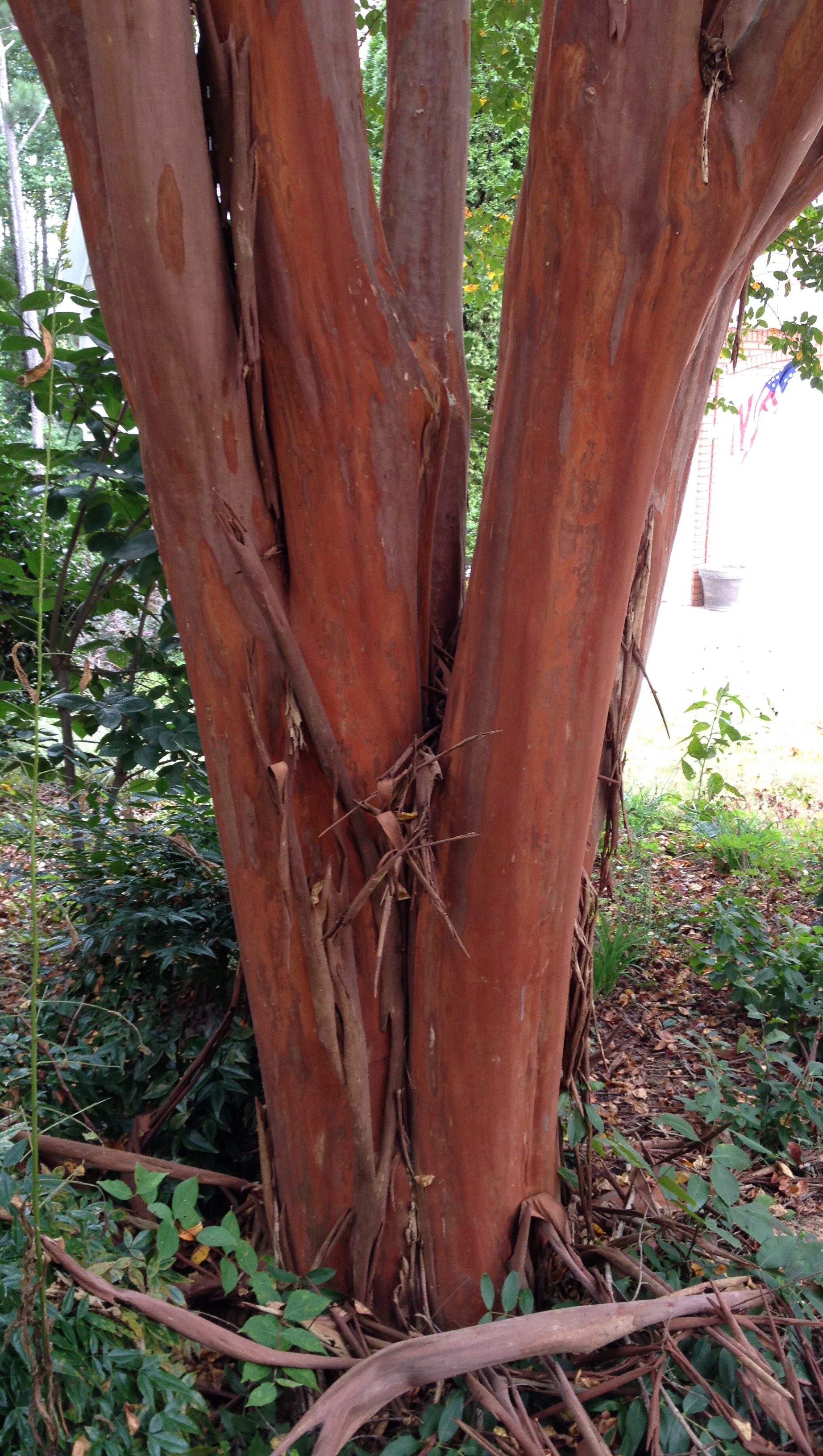 As summer wanes, cracks begin to appear in the bark along the mighty trunk, signaling the coming changes. Soon the cracks turn into fissures, and the old skin lifts away from the tree, before finally letting go completely, falling to the ground in long, jagged shards. To the uninitiated observer, this series of events may be unsettling. How could such a process possibly be beneficial for the plant? Yet that very act allows the trunk to increase its girth and grow stronger. Best of all, it reveals the most magnificent cinnamon-colored covering. Ray saw the potential in the sapling he planted so long ago. He knew what it could become.
There are several concepts that I consider to be spiritual touchstones. One such idea is that of putting off and putting on. In Jesus’ analogy of an unclean spirit leaving a man only to return to its neat but empty former abode, He made it clear it’s not enough to make a show of getting rid of sinful thoughts and behavior (Matthew 12:43-45). Instead, our repentance must be true, the kind that produces fruit in keeping with our profession of faith, as we put on right-thinking and conduct pleasing to God.
The Apostle Paul affirms this teaching in his letter to the Romans. He encourages his readers not to conform to the world but to be transformed by the renewing of their minds (Romans 12:2). And in his letter to the Ephesians, he goes even further. After urging them to put off the old self and to put on the new in the introductory passage above, Paul goes on to provide specific examples of behavior to put off as well as corresponding replacements:
- Put away falsehood and speak the truth (v. 25).
- Let the thief no longer steal but perform honest labor (v. 28).
- Do not use unwholesome language, but that which benefits and builds up those who listen (v.29).
- Put away all bitterness, wrath, anger, and every form of malice. Be kind to one another, forgiving one another as God in Christ forgave you (vv. 31-32).
Because of Jesus’ sacrifice on our behalf, God already sees His righteousness when He looks at us (2 Corinthians 5:21), but there is much refining left to be done. We are not yet holy as He is Holy, nor will our makeover be complete until He returns. Nonetheless, the Spirit is at work in us, transforming us with the same mighty power that raised Jesus from the dead (Ephesians 1:18-20).
At times our refinement is painful as the Helper strips away bits of our old nature. Our Savior suffered much. How better to know Him than to endure loss, sorrow, and persecution as He did (Romans 8:17)? Such challenges may cause outside observers or even believers themselves to question God’s methods, but we can trust the One who made us to have a good and perfect plan and to work all things together for good (Jeremiah 29:11; Romans 8:28).
Just as Ray knew what the crape myrtle could become, given sufficient time and proper care, God knows who He created us to be. Furthermore, He’s promised to complete the work He’s begun in us (Ephesians 1:6) and to never leave or forsake us at any point in the process (Deuteronomy 31:8). The Helper will be with us to empower us to do His will and to persevere to the end (John 14:16-17, 26).
O Lord, how I look forward to Your return! On that glorious day, our transformation will be complete and all vestiges of our former selves will be gone. We will gather around Your throne, our new selves robed in white, to forever praise You, our Redeemer King.

 Back 2 the Garden