Soon after I turned 50, I began noticing a disconcerting trend whenever I mentioned an ailment to my doctor or dentist. Time after time, they prefaced their replies with, “As we age”, and then went on to explain my symptoms were to be expected given my advancing years. (Insert eye roll.)
Well, here I am, having completed another decade with its attendant wear and tear and I’m starting to believe them. But, being my mother’s daughter, I refuse to go down easily or give up my favorite pastimes, even though most of them – gardening, writing[1], needlework – take a toll on my hands and arms. Then, when my hands and arms get tired, other parts try to compensate, particularly my neck and back. They in turn grow weary from assisting in addition to carrying their own loads.
It’s getting easier and easier for me to relate to the Apostle Paul’s assertion that all parts of the body are necessary and the body performs best when each part is functioning as God designed it to. (1 Corinthians 12) Of course, Paul was using that superb analogy to describe how beautifully God equipped His children with varying gifts and graces to build up the church, the body of believers. And, just as I’m increasingly aware of the veracity of my doctor’s statements, serving as Coordinator of our Women’s Ministry Committee is teaching me how appropriate Paul’s comparison is.
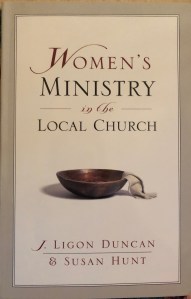 The committee was in transition late last year when I was asked to join. The remaining members were dedicated to the ministry and each other, but tired from trying to do it all, especially when the assigned tasks didn’t fit their gifts. Fortunately, our pastor asked long-time women’s ministry leader and member of our church, Susan Hunt, to mentor us. With Susan’s guidance, and using the five foundational principles outlined in Women’s Ministry in the Local Church[2], we restructured the committee around several areas of service: Compassion, Community, Elder/Deacon Support and Bible Study, with a Coordinator to guide, support and disciple the ministry leaders.[3]
As the time approached to allocate the various roles, each woman on the committee prayerfully considered her giftedness as well as the gifts of her sisters in light of the positions we needed to fill. We prayed for God’s guidance and we prayed for a spirit of unity and harmony when we assigned leaders to the ministry areas.
Nonetheless, we were concerned about the possibility of more than one woman thinking she was best-suited to a given ministry, while another ministry remained unclaimed. We also wanted to avoid the feeling of a hierarchy, where one role was deemed more or less valuable than another. The previously-referenced 12th chapter of 1st Corinthians makes it abundantly clear that there are many different gifts, all valuable and bestowed by God as He sees fit, for the building up of the church. Paul affirms the same in Romans 12:3-8:
For by the grace given to me I say to everyone among you not to think of himself more highly than he ought to think, but to think with sober judgment, each according to the measure of faith that God has assigned. For as in one body we have many members, and the members do not all have the same function, so we, though many, are one body in Christ, and individually members one of another. Having gifts that differ according to the grace given to us, let us use them: if prophecy, in proportion to our faith; if service, in our serving; the one who teaches, in his teaching; the one who exhorts, in his exhortation; the one who contributes, in generosity; the one who leads, with zeal; the one who does acts of mercy, with cheerfulness.
O, us of little faith! As we went ministry by ministry the morning we met, each woman respectfully requested her role, with her sisters gladly affirming the fit. We were relieved. We were energized. And we were so grateful God had graciously gone before us, pre-assembling our team based on the needs of our congregation and how He’s gifted us.
In my 30-year corporate career, the best managers were the ones who matched the talents and abilities of their workers to the available tasks, resulting in a happier and more productive team. I’ve already seen a similar outcome since we apportioned the assignments. Within days of our planning meeting, ministry leaders started sending e-mails to each other, unprompted by me, as the women embraced their responsibilities and enthusiastically shared ideas with other committee members.
Several days before our first event, a Ladies’ Winter Tea, I awoke with a start one morning thinking, “What about the food? I don’t know what we’re serving!” My heart returned to its normal cadence as I reminded myself, “I don’t have to know. Roseann and her team have it covered.” And did they ever! The food was plentiful and delicious, the tables beautifully decorated. The women were joyfully using their gifts to glorify God and bless those in attendance.
We shared the new ministry structure with the women at the tea and encouraged them to consider their God-given gifts and where they can best use them to glorify Him and build up his body. Our prayer is that all of our women will become involved with one or more of the ministry areas this year.
In addition to special events, we have Bible studies and small discipleship groups. We are thankful for the positive momentum since restructuring the committee, however, this is the time we need to stay focused on God’s glory, not self-glory and self-congratulation. We must remember our confidence is in Christ alone, leaving no room for boasting in any aspect of our lives. Only then can we be life-giving leaders who reflect God’s goodness to those we seek to serve.
How about you? Are you doing your part to keep the Body strong?
Lord, You have graciously given each of us gifts and graces, abilities to be used for your glory and for the building up of your church. Please help us to gladly take on our roles, neither coveting the gifts of others nor being prideful about our own, for all we have and are, both spiritual and material, comes from You. (1 Chronicles 29:10-13; Ephesians 2:8-10; James 1:17)
[1] Including pen, typing and texting!
[2] Women’s Ministry in the Local Church, J. Ligon Duncan & Susan Hunt, Crossway Books, Wheaton, IL, 2006.
[3] Discipleship is part of each ministry leader’s role, as she disciples women serving in her area.
 Almost-3-year-old granddaughter Emma was napping peacefully when my daughter Mary arrived home with 7-year-old Joshua in tow. As he headed upstairs to change out of his school clothes, Mary and I both admonished him to be quiet so he wouldn’t wake his sleeping sister. Joshua clumped up the stairs and Mary followed up with a sternly whispered, “Joshua! Quiet!!” But, after a long day at school, Joshua was ready for some sibling interaction. By the time he reached the second floor, he was singing and then, right outside Emma’s door, he let out a spirited whoop. Mary and I barely had time to groan before he called out, “Emma’s awake!” (Really?!)
 From his earliest days, Joshua has enjoyed company and his philosophy is if he’s awake, someone else should be awake to talk to or play with. Unfortunately, there are times when the person on the receiving end of his cheerful, “Wakey, wakey!”, isn’t ready to wake up, much less engage in a conversation. For now, I’m giving him the benefit of the doubt that he’s not being malicious, just thoughtless. But I hope he’ll soon learn to be more considerate and put his sisters’
 Several weeks ago my daughter, Mary, found her not-quite-three-year-old daughter, Emma, peering intently into a mirror. Curious as to the cause of her staring, Mary asked what she was looking at. Stoically, Emma replied she had no eyebrows. It was one of those moments when Mary most likely had to fight to control any laughter that threatened to erupt. After all, Emma was quite serious. Her light-blond brows are barely discernible and that, she realized, set her apart from the rest of her darker-browed family members.
 Little more than a week had passed since Mary’s recounting of the eyebrow incident, when Emma approached me, tape measure in hand, and asked if I would measure her. I obliged, measuring around her tummy, a place or two on her legs, and both little arms. I knew her request was inspired by wanting to be like Mommy, her very favorite person. You see, Mary uses that same pink tape measure to periodically assess her progress since starting a strengthening and conditioning program last fall.
 I’m playing catch-up. December descended, as it always does, with its attendant whirlwind of activities. I’m one of those who revel in the festivities, from sending and receiving cards to plotting gift strategy with family members to savoring special meals with loved ones. But, as I’m enjoying the merriment the season has to offer, day-to-day chores and responsibilities start to pile up and about now, as the celebrations wind down, I realize just how far behind I am. I don’t regret my decision to enjoy the season, since it comes but once a year, while chores persist year-round. But I know I now need to pick up the reins and get the more mundane aspects of life back in order. As much as I relish celebrating, I also look forward to returning to a normal schedule.