The Way the World Works

For we know that the whole creation has been groaning together in the pains of childbirth until now. And not only the creation, but we ourselves, who have the firstfruits of the Spirit, groan inwardly as we wait eagerly for adoption as sons, the redemption of our bodies (Romans 8:22-23).

Gulf fritillary butterflies depend on passionflower for survival. The vigorous vine, native to the southeastern United States, is the only food source for their caterpillars. As part of my efforts to create a pollinator oasis in my suburban neighborhood, I planted a passionflower vine by my mailbox. It took a couple of years to become established, but by the third year, it was flourishing – plenty of foliage for the caterpillars to devour and lots of lovely flowers for me to enjoy.

Except I couldn’t find any caterpillars.

I examined the vine every morning when I went out to collect the newspaper and every evening when I checked for mail. No caterpillars. Then one day, I saw a tiny caterpillar in the clutches of a wasp. What did I do? I turned to Google, of course! “Do wasps eat caterpillars?” Unfortunately, they do.

I kept up my twice-daily vigil, hoping there would eventually be enough caterpillars to satisfy the wasps and still leave some to make it through their life cycle. Days passed with only an occasional sighting. Then I realized there was an army of ants busily traversing the sprawling vines. Back to Google. “Do ants eat caterpillars?” Yes, they do. By this time, my anticipation at getting to watch wave after wave of caterpillars reach maturity on my vine had given way to despair since I doubted it would be possible to get rid of the ants without negatively impacting the caterpillars.

Grandson Joshua, five-years-old at the time, encouraged me to find the ant mound and deal with the pesky marauders at their source. I was somewhat surprised he didn’t say, “That’s the way the world works, Grammie,” as he often does when I mourn the fact some predator has taken down its prey. Being an avid fan of “Wild Kratts,” Joshua is incredibly knowledgeable about a multitude of creatures.  He takes the food chain in stride, knowing some animals get eaten by other animals as God provides for all of his creation.

Yet the world isn’t working the way God originally intended, particularly when it comes to death. Some time ago, I was reading the first chapter of Genesis, a passage I’ve read countless times, when I noticed something. Take a look at verses 29 and 30: Then God said, “I give you every seed-bearing plant on the face of the whole earth and every tree that has fruit with seed in it. They will be yours for food.  And to all the beasts of the earth and all the birds in the sky and all the creatures that move along the ground—everything that has the breath of life in it—I give every green plant for food.” (Emphasis added.)  Do you see it too? In the beginning, when God created everything and it was all good, there was no death, not even animals eating each other.

Death entered in only after the fall, the penalty for disobedience (Genesis 2:16-17). I wonder what Adam and Eve thought when they saw the blood of the innocent animal God killed to provide garments of skin to cover their nakedness. What horror they must have felt when Cain killed Abel. The shedding of blood became commonplace. Sadly, that’s the way the world works now.

But the spotless Lamb of God came to save and restore by shedding His own precious blood. Without the shedding of blood there is no forgiveness. With it, we have the assurance that someday all things will be set right again. The world will work once more as its Creator initially intended. Speaking of Jesus’ return, the prophet Isaiah said,

 Righteousness will be his belt and faithfulness
the sash around his waist.
The wolf will live with the lamb,
the leopard will lie down with the goat,
the calf and the lion and the yearling together;
and a little child will lead them.
The cow will feed with the bear,
their young will lie down together,
and the lion will eat straw like the ox.
The infant will play near the cobra’s den,
and the young child will put its hand into the viper’s nest.
They will neither harm nor destroy on all my holy mountain,
for the earth will be filled with the knowledge of the Lord
as the waters cover the sea”(Isaiah 11:5-9)
(Emphasis added.)

Jesus’ promised return is certain. We can wait confidently and expectantly for the day when death is swallowed up in victory. And while we wait, God graciously sustains his creation.
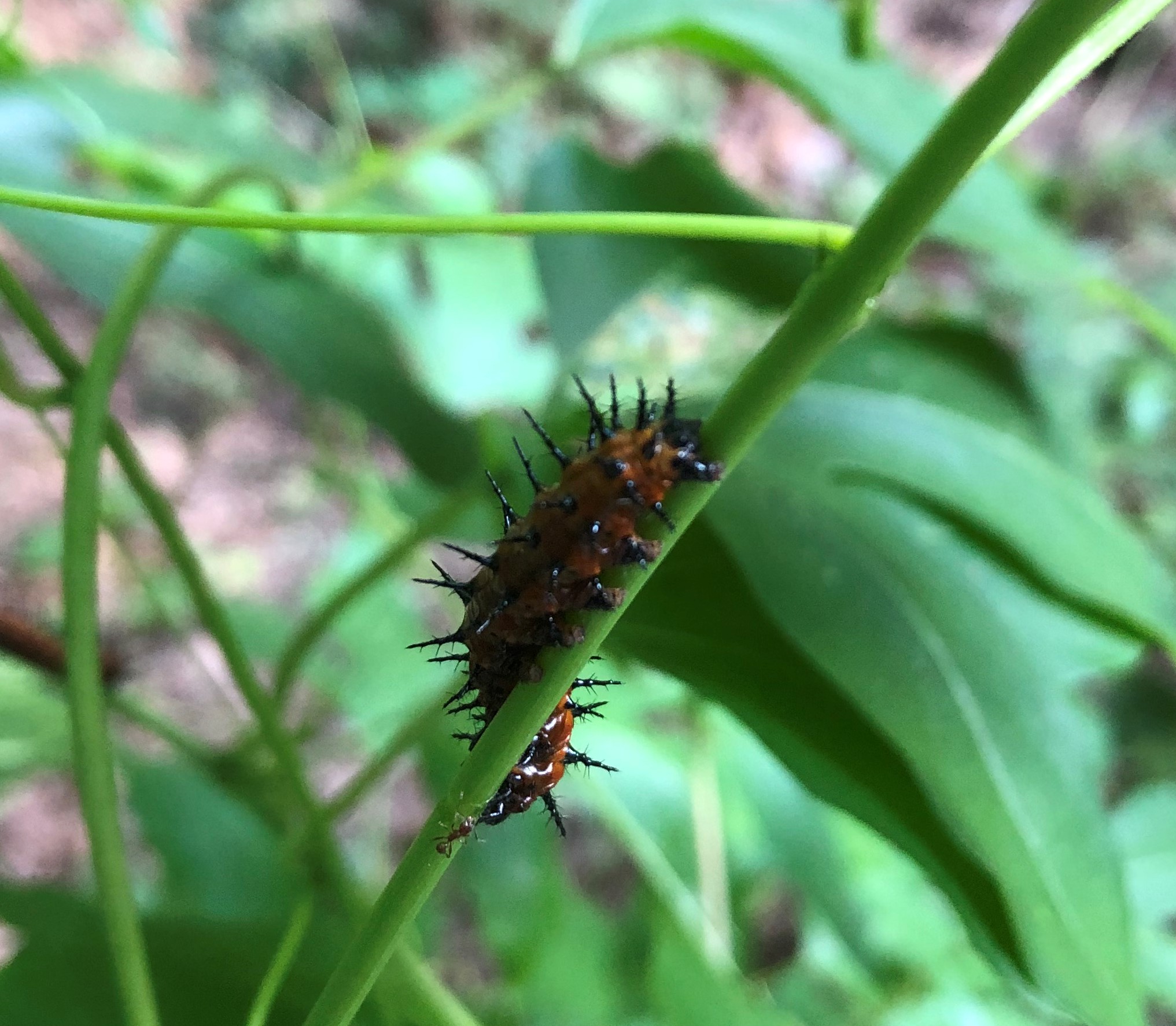
My daily caterpillar search eventually yielded the results I’d been hoping for – a dozen or so voracious nibblers of various sizes. More followed as several generations consumed the vine. I suppose it’s a small thing in the overall scheme of life. But I see it as a gift from the One who knows how much I delight in hosting the Gulf fritillaries and their offspring each year.

O Lord, how I look forward to the day of Jesus’ return when the world will finally work as You’ve intended from the beginning. No more tears, no more death, no more harm on all Your holy mountain.
Twiners and Climbers

Vines, whether ornamental like clematis and honeysuckle or food-producing like squash and beans, are plants whose stems require support – unless they’re left to trail along the ground because they bear more substantial fare like pumpkins and watermelons.  They use a variety of methods to climb and attach themselves to supporting structures, including twining stems, tendrils, aerial roots, and adhesive disks, also known as holdfasts.[1]

I know I’m showing my plant geek side, but please keep reading. Like so much of God’s creation, these details show how fearfully and wonderfully made everything is and how much care God took when He designed it all. They also offer some spiritual parallels, which I describe in the mini-devotions below.

Tenacious Tendrils

According to Britannica.com, tendrils are plant organs specialized to anchor and support vining stems, distinctive because they possess a strong twining tendency causing them to encircle any object encountered. The article goes on to say that tendrils are sensitive to contact and will turn toward objects they brush against. In time, tendrils grow strong enough to support the weight of the plant.[2] Think curly-cue fishing line, slender but sturdy.

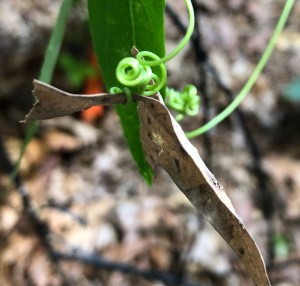
016During a recent reconnaissance walk through my woods, I discovered a patch of passionflower vine. Though it chose to pop up on its own, I was delighted to see it since it’s the food source for caterpillars of Gulf Fritillary butterflies. The petite vine was already sprouting tendrils and reaching out for support. I smiled and shook my head when I found one tiny green appendage wrapped around a leaf lying on the ground. Even though the tendril had a stranglehold on the leaf,  the latter could never help the passionflower rise above the ground.
Tendrils borne on another sprig of vine clutched a more promising, but still less-than-ideal platform, a squat neighboring plant. I fetched a trellis from the garage and returned to the woods, determined to pry the tendril free from the leaf and unwrap those twirled around the unsuspecting coral bells. As I guided them to the trellis, nudging the newly-freed tendrils to grasp the appropriate support, I thought how prone we are to engage in misguided attachments.

Created in the image of the Triune God, we’re relational beings, designed for community. But often, we look to fellow finite sojourners to meet needs only God Himself can fill, overwhelming or alienating them in the process.

Or, worse, we turn to things to sustain us. Though we are meant to worship our Creator, we worship creation instead. At times, our hearts are like tendrils that turn toward whatever they brush against.

Praise God for sending the Spirit, just as Jesus promised (John 14:26). His power raised Jesus from the dead, and that same power is at work within every believer – to change our hearts, to transform us more and more into the image of Christ, and to enable us to walk worthy of our calling (Ephesians 1:19-20; 2 Corinthians 3:18). He is our all-sufficient, strong-enough Support.

Clinging Climbers

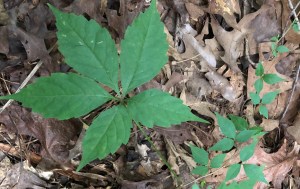
203Virginia creeper, a native vine with 5-leaved adult foliage, is sometimes mistaken for poison ivy, because its juvenile foliage frequently has three leaves, like the pesky purveyor of itch-producing oil. Its ability to scale walls and tree trunks thanks to holdfasts that act like sticky toes, reminds me of the tiny lizards I see scampering up the bricks on the front of my house. Though both plant and critter are capable of ascending considerable heights, they’re easy to dislodge.
Earlier this summer, I yanked a Virginia creeper off the side of my daughter’s house. Nourished by plentiful rainfall, it had clambered all the way to the second story and put down roots in the gutter. Nonetheless, a few tugs brought the entire vine tumbling down as its little feet let go of the wall. Unlike the wayward tendrils in the first story, the vine picked a solid underpinning.  But it didn’t have the strength to hold on when adversity came in the form of my pulling.

In 1997, the year my husband Ray died, Christian artist Geoff Moore released his album “Threads,” which concluded with “The Letter.” The lyrics tell of someone ready to give up but encouraged not to do so by the friend who received the letter.  As I struggled to regain my footing after Ray’s sudden death, these words brought hope and comfort:

And when your hand starts to slip
And when you’re losing your grip
And when you know your hope is gone
You’re not the only one holding on[3]

There were many times I had to remind myself God was holding me and would never let go. Jesus said as much: “My sheep hear my voice, and I know them, and they follow me. I give them eternal life, and they will never perish, and no one will snatch them out of my hand. My Father, who has given them to me, is greater than all, and no one is able to snatch them out of the Father’s hand” (John 10:27-29).

We’ve been learning a new-to-us hymn at church, “He Will Hold Me Fast.” I catch myself humming the tune repeatedly while the lyrics play in my mind, offering the same assurance found in the long-ago Geoff Moore song:

When I fear my faith will fail, Christ will hold me fast;
When the tempter would prevail, He will hold me fast.
I could never keep my hold through life’s fearful path;
For my love is often cold; He must hold me fast.

He will hold me fast, He will hold me fast;
For my Saviour loves me so, He will hold me fast.
[4]

An assurance that will carry us through this life until we’re called Home and our faith is made sight (1 Corinthians 13:12).

Lord, how I thank You for sending Your Spirit to guide and sustain us, to be our Support as we seek to grow according to your will for us. And I praise You for the precious promise that though our strength may fail, You’ll never let us go. We’re forever safe in Your mighty grasp.


[1] https://web.extension.illinois.edu/vines/attachment.cfm:

[2] https://www.britannica.com/science/tendril

[3] “The Letter” lyrics © 1997 Universal Music Publishing Group. Songwriters: Lisa Kainde Diaz / Maya Dagnino / Naomi Diaz / Paula Moore

[4] Ada R. Habersham, “He Will Hold Me Fast,” 1906

Garden Stories

I’m a member of the “Play in the Dirt Club”, a frequent-shopper program at a local nursery. I adopted their phrase years ago to describe my gardening ventures. Weeding, mowing, mulching, planting – I love playing in the dirt!

To use one of Mom’s old expressions, I suppose I come by it honest. My grandfathers supported their families by farming in central North Carolina. My grandmothers canned, preserved, or froze the excess fruits of their husbands’ labors, those not consumed or shared right after harvesting.

Memories of summertime Sunday dinners around their tables are vibrant even though decades have passed since I last sat elbow-to-elbow with relatives of multiple generations: plates of juicy red tomato slices and steaming corn on the cob; bowls full of fried okra, green beans, and lima beans; freshly-made biscuits and gravy. Laughter seasoned the conversation as family stories mingled with good-natured ribbing.

Other recollections are equally vivid – flowers edging the fields; straw hats perched on hooks by the door, ready to be grasped on the way out to the garden; a metal dipper hung on a nail above the back-porch sink for a refreshing sip of water upon returning to the house.

In My Genes?

My mom was one of eight siblings, my dad one of ten. They, along with most of my aunts and uncles, gardened. Their efforts ranged from plots to grow a few vegetables to a commercial tomato farm, from fruit trees to flower-filled beds surrounding suburban homes.

179Multiple members of my generation love tending plants, as do a number of our children and grandchildren. Recognizing our shared passion, I smile when cousins post pictures of their gardens, sometimes with young offspring sampling produce fresh from the vine.042
My gardening efforts are aimed at ornamentals since I don’t have a spot sunny enough to grow veggies. Nonetheless, the delight I feel in caring for my flowers and shrubs is enhanced by the connection to generations of loved ones.

Sometimes I muse that gardening is in my genes.

In the Beginning

Maybe that notion isn’t so far-fetched, at least when you consider where God placed our very first ancestors – in an idyllic garden, where all sorts of plants thrived, and God strolled in the cool of the evening. He entrusted them with the responsibility of maintaining the garden and gave them all the plants as food, save one, the tree of the knowledge of good and evil (Genesis 2:8, 15-17).

One exception amidst abundance we can’t imagine, yet Adam and Eve didn’t obey. Satan cunningly twisted God’s command and Eve ate, believing his lie that God was withholding something pleasant and necessary. She offered Adam a bite and he ate. In a moment, everything changed (Genesis 3:1-7).

But God came to the garden, as always, even though He knew of their disobedience. He drew them out of their hiding place. In the midst of declaring the penalties they’d incur, He planted a kernel of hope, a promise they could count on. One day the Seed of the woman would bruise the head of the serpent, dealing death itself a fatal blow. (Genesis 3:8-19).

Centuries passed and the time came for God to send His beloved Son, that whoever believes in Him would not perish, but have everlasting life (John 3:16). Jesus left His place at the Father’s right hand and dwelt among us for a while (John 1:1-5, 14). On the night of His betrayal, He retreated with His disciples to the Garden of Gethsemane. With sorrow weighing heavily on His soul, He fervently prayed that the cup might pass from Him (Matthew 26:36-44). But it was the Father’s will to crush Him for our sake (Isaiah 53:10).

Jesus remained perfectly obedient to His Father’s will, even to the point of death on a cross (Philippians 2:5-8). There was a new tomb in the garden near the place of  Jesus’ crucifixion (John 19:41). Joseph of Arimathea placed His body in that tomb, but death couldn’t hold Him there. On the third day, God raised Him by the power of the Spirit. According to the Apostle John, the resurrected Christ first appeared to Mary Magdalene in the garden. In her grief, she even mistook Him for the gardener (John 20:14-16).

The New Earth

So many momentous garden moments in His-story, with more to come. Jesus promised to return. When He does, heaven and earth will pass away, making way for the new heaven and new earth where God will dwell with His people forever (Revelation 21:1-4). Creation will be redeemed right along with the children of God (Romans 8:19-22).

One continuous story from beginning to end. Could it be the sweet connections woven through generations of gardeners in my family are rooted in echoes of Eden? Our hearts harbor a deep-seated longing for perfect communion with God in a world unmarred by sin. No more thistles and thorns. No more pain or tears or death.

As we wait for Jesus’ return, God gifts us with hints of heaven, in blue skies and gentle breezes, in fruits and flowers and fresh-from-the-field vegetables, in gatherings with friends and family around food-laden tables. Let us give thanks, remembering even the most splendid day here is a mere shadow of the beauty that awaits in the restored garden (1 Corinthians 13:12).