 Several weeks ago my daughter, Mary, found her not-quite-three-year-old daughter, Emma, peering intently into a mirror. Curious as to the cause of her staring, Mary asked what she was looking at. Stoically, Emma replied she had no eyebrows. It was one of those moments when Mary most likely had to fight to control any laughter that threatened to erupt. After all, Emma was quite serious. Her light-blond brows are barely discernible and that, she realized, set her apart from the rest of her darker-browed family members.
 Little more than a week had passed since Mary’s recounting of the eyebrow incident, when Emma approached me, tape measure in hand, and asked if I would measure her. I obliged, measuring around her tummy, a place or two on her legs, and both little arms. I knew her request was inspired by wanting to be like Mommy, her very favorite person. You see, Mary uses that same pink tape measure to periodically assess her progress since starting a strengthening and conditioning program last fall.
The occurrence of these two incidents in such proximity to one another impressed upon me, yet again, that much of what our children (and grandchildren) learn from us is caught rather than taught. And, ever-observant, they easily detect discrepancies between what we say and what we do. Consistency between verbal and behavioral lessons is crucial. But, when such consistency is lacking, our deeds supersede our admonitions as the old adage, “actions speak louder than words”, attests.
Most of us truly want to be good examples, to live lives of integrity. Yet, in spite of our best intentions, we frequently struggle to do what we know is right, what we yearn to do. The Apostle Paul described this tension between giving into the flesh and obeying the Spirit in his letter to the Romans (Romans 7:15) and to the Galatians. (Galatians 5:17) In fact, he described himself as the chief of sinners not withstanding all he did and sacrificed for the early church. Instead, he focused on the great grace that had been shown him by the only perfect One. (1 Timothy 1:15)
Oh that we would do likewise. Instead we too often compare ourselves to our fellow sinners, thinking, “I’m not that bad.” (Luke 18:9-14) But the thoughts and behavior of our fellow sinners are not our standard. Jesus’ perfect righteousness and sinless life are. We are to be holy as He is Holy. (Leviticus 11:45; Matthew 5:48; 1 Peter 1:14-16) Furthermore, Jesus made it clear that keeping the Law begins in our hearts and encompasses more than our actions:
“You have heard that it was said to those of old, ‘You shall not murder; and whoever murders will be liable to judgment.’ But I say to you that everyone who is angry with his brother will be liable to judgment; whoever insults his brother will be liable to the council; and whoever says, ‘You fool!’ will be liable to the hell of fire.” (Matthew 5:21-22)
“You have heard that it was said, ‘You shall not commit adultery.’ But I say to you that everyone who looks at a woman with lustful intent has already committed adultery with her in his heart.” (Matthew 5:27-28)
The longer we walk with Jesus and the closer we get to Him, the more easily we recognize our flaws and failings. There are times when a thought pops into my mind, uncensored, appalling. I’m shocked and saddened at the darkness that still dwells in me. Yet I know my dismay is evidence my heart of stone was replaced with a heart of flesh that desires to obey God. (Ezekiel 36:26-27) It also reminds me that the One who began a good work in me is faithfully transforming me into the image of his Son and will finish what He started. (Philippians 1:6; Romans 8:29; 2 Corinthians 3:18)
I long to be a good role model for my children and grandchildren, someone worthy of emulation. But, even more, I want to point them to Jesus, the author and perfecter of our faith (Hebrews 12:1-2); the Servant Leader who set us an example in all things (John 13:14-15); the One who died that we might be clothed in His perfect righteousness. (Isaiah 61:10; 2 Corinthians 5:21) He alone is our flawless standard.
O Lord, please help us to remember that all we have and are is a gift from you, leaving no room for boasting or comparing. (Romans 12:3; 2 Corinthians 10:17-18; Ephesians 2:8-9) And may we grow to resemble our elder Brother more and more, by the power of your Spirit at work within us.
But when the goodness and loving kindness of God our Savior appeared, he saved us, not because of works done by us in righteousness, but according to his own mercy, by the washing of regeneration and renewal of the Holy Spirit, whom he poured out on us richly through Jesus Christ our Savior, so that being justified by his grace we might become heirs according to the hope of eternal life. (Titus 3:4-7)
 One recent Grammie day
 Now that I’ve finally resurfaced, I’ve skimmed some of the articles and reviewed “Royalty” in light of them. Fortunately, the analogy in my previous post remains pertinent. In fact, coverage of the duchesses’ squabbles amplified one of my key points: people are always watching, evaluating, commenting. Sadly, some prefer drama over harmony. Some may even be looking for a reason to criticize or reject.
 I’m playing catch-up. December descended, as it always does, with its attendant whirlwind of activities. I’m one of those who revel in the festivities, from sending and receiving cards to plotting gift strategy with family members to savoring special meals with loved ones. But, as I’m enjoying the merriment the season has to offer, day-to-day chores and responsibilities start to pile up and about now, as the celebrations wind down, I realize just how far behind I am. I don’t regret my decision to enjoy the season, since it comes but once a year, while chores persist year-round. But I know I now need to pick up the reins and get the more mundane aspects of life back in order. As much as I relish celebrating, I also look forward to returning to a normal schedule.
 hands have made it clear they’re not happy with the repeated gripping and lifting required to set up my beloved Dickens Village – and the final enemy, death, which paid an unexpected visit to one of our church families. The weight has grown heavy indeed.
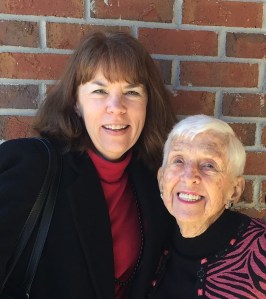 Though petite in stature, Mom’s my biggest cheerleader and most dependable defender. We all need someone who’s unconditionally, unreservedly in our corner. I’m so thankful Mom’s in mine. She’s my rock because she consistently points me to the Rock and reminds me His everlasting arms are securely holding all who belong to Him in an eternal embrace. (Deuteronomy 33:26-27a) O LORD, please help me to do the same for my precious children and grandchildren. Thank You for the priceless blessing of a godly mother!
 Just as I benefitted greatly from learning Spanish in a Spanish-speaking country, Christians thrive best when we’re part of God’s visible church. Scripture is clear that each of us has an important, God-ordained place in His body (1Corinthians 12:12-30) and that we should not neglect meeting together. (Hebrews 10:24-25) Furthermore, God’s family is composed of members of varying ages, abilities and spiritual maturities, just like biological families. We are called to do life together in compassionate covenant communities, where we rejoice with those who rejoice, mourn with those who mourn and come alongside each other to teach, support and encourage according to the gifts we’ve been given. (Romans 12:3-21)
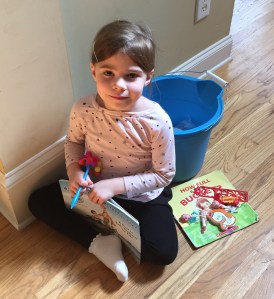 Joshua read the books to us after lunch. They were all about how we fill or empty each other’s imaginary buckets by being kind or being mean. Furthermore, the books pointed out we’re doing one or the other all the time. The narrative went on to say that by filling up others’ buckets, we’re filling up our own as well since being helpful, obedient and thoughtful makes situations better for everyone involved. Bucket-fillers, buoyed by the results of their good deeds, are much happier than bucket-dumpers, whose actions contribute to continued strife.
 My mom was the baby of her family, the youngest of eight siblings and her father’s darling. He called her “Babe” and warmed her clothes by the fire for her before she went off to school on cold mornings. Occasionally my grandmother, a bit more stern in her demeanor, would delegate the task of disciplining a wayward child to my grandfather. He would take the offending party outside beyond her view and tell the child to cry out while he used the switch on some inanimate object instead of their legs.
 “Mr. Jim”, as the people around town knew him, was a man of faith, a deacon in the tiny country church where he worshiped. He embodied the fruits of the Spirit – love, joy, peace, patience, goodness, kindness, faithfulness, gentleness, self-control. (Galatians 5:22-23) When he suffered a heart attack a few months before he died, the doctor told him he had to limit his physical activities. For a man who loved his garden and was used to being outside, it was like a death sentence. He’d sit in the kitchen of the home he shared with my grandmother, his wife of 55 years, turn his gaze toward the little church and comment he’d rather be in the cemetery than just sitting around.
 Back 2 the Garden