Thrashing about

I suppose I should preface this post by saying I don’t consider myself to be particularly punny – that’s the province of my daughter, Jessie, who inherited her dad’s sense of humor – but this title, well, I couldn’t resist . . .

Since the weather’s been more seasonably cold, I’ve added suet to the feast I set out for my bird friends. IMG_0377 (2)Brown thrashers are among those who want to partake of the high-calorie goodness. To say they have trouble steadying themselves on the suet basket would be a significant understatement. Inevitably, when one lands on the suet, it starts to wobble. This in turn causes the bird to flap frantically which results in the basket spinning around, bringing about another flurry of desperate flapping. It’s a rather comical sight, but also somewhat sad because the thrasher’s behavior keeps him from the nourishment he’s seeking .
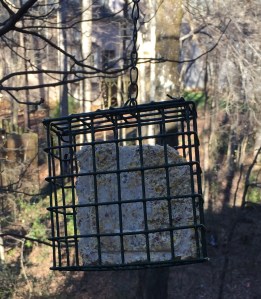
Compare this to the behavior of the stately woodpecker who frequents the suet. Every bit as big as the thrasher, he has no trouble positioning himself on the basket and consuming the nutritious treat. Even if the suet shifts slightly, even if he has to hang from the bottom of the basket when the suet’s almost gone, there’s no anxious flapping of wings or shifting about. The woodpecker remains calm, focused on the sustenance before him.

Just as I recognize I’m not exceptionally adept with puns, I’ll also readily admit I don’t know very much about birds. No doubt a knowledgeable ornithologist could explain the behavior I’ve described. But, as often happens when I’m working in my beloved sphere of horticulture, I see a spiritual analogy. The birds’ behavior reminds me of Peter’s attempt to walk on water, recounted in Matthew 14:25-31:

25 Shortly before dawn Jesus went out to them, walking on the lake. 26 When the disciples saw him walking on the lake, they were terrified. “It’s a ghost,” they said, and cried out in fear. 27 But Jesus immediately said to them: “Take courage! It is I. Don’t be afraid.” 28 “Lord, if it’s you,” Peter replied, “tell me to come to you on the water.” 29 “Come,” he said. Then Peter got down out of the boat, walked on the water and came toward Jesus. 30 But when he saw the wind, he was afraid and, beginning to sink, cried out, “Lord, save me!” 31 Immediately Jesus reached out his hand and caught him. “You of little faith,” he said, “why did you doubt?” (NIV Bible, emphasis mine)

As long as Peter kept his gaze firmly fixed on Jesus he was able to walk on the water. But when he shifted his focus to the storm, he was quickly overwhelmed by his situation.

Too often, when I’m confronted with changing circumstances or buffeted by winds of uncertainty, I become flustered. Like the thrasher, I begin to flail about, thwarting any possibility of finding the stability I seek. And before I know it, I’ve lost sight of the One who is my sure foundation. The One who never changes. The One who still speaks to his followers, saying, “Take courage! It is I. Don’t be afraid.”

As I reflect on the disparate behavior of the woodpecker and the thrasher, may I be reminded to rest in the promises of the One who calms the storms.


Clutter

There’s something about starting a new year that makes me want to clean out and move forward with a lighter load. This year, my desire has been further fueled by the efforts my daughter Mary has made to shed stuff and redecorate her lovely home. It may be her nesting instincts spurring her on or the urgency of needing to help 2-year old Lyla settle into her “big-girl” room before baby Emma arrives. Regardless, seeing what she’s achieved while 7-months pregnant has both inspired me and put me to shame.

I’m a keeper by nature. I find it difficult to part with things that may be useful at some point in the future or were given to me by loved ones. Ok, so that covers a lot of territory. It also explains, for example, why you’ll find lots of buttons in the bottom of my sewing basket – you know the ones that come on shirts, jackets, pants, etc. in case one of the originals ever falls off – and the fact I have every birthday card my girls have ever given me. In spite of my tendency to hold onto things, I don’t consider myself to be a hoarder. After all, there’s plenty of room to walk around in my house without bumping into stacks of old magazines and I’m able to use my garage for its intended purpose.

Nevertheless, every now and then the results of my being a keeper start to wear on me, especially when I get to experience the positive effects of someone else’s house cleaning efforts.

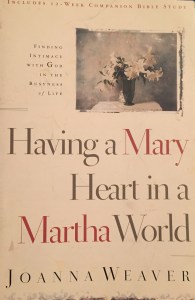
Our living environments aren’t the only thing that can become cluttered, as many of us feel weighed down, even overwhelmed, by to dos associated with the demands of daily living. Joanna Weaver addresses our plight in her book, “Having a Mary Heart in a Martha World”. IMG_0367The story of the two sisters, recorded in Luke 10:38-42, resonates with modern readers even though the events it relates happened almost 2,000 years ago:
As Jesus and his disciples were on their way, he came to a village where a woman named Martha opened her home to him. She had a sister called Mary, who sat at the Lord’s feet listening to what he said. But Martha was distracted by all the preparations that had to be made. She came to him and asked, “Lord, don’t you care that my sister has left me to do the work by myself? Tell her to help me!” “Martha, Martha,” the Lord answered, “you are worried and upset about many things, but few things are needed—or indeed only one. Mary has chosen what is better, and it will not be taken away from her.” (NIV Bible)

A cursory read might lead one to conclude Jesus was condemning Martha’s Type A personality and it’s tempting to stereotype the two sisters, labeling one driven and the other laid back. But our temperaments and abilities are God-given and it takes all kinds of people to accomplish his purposes. No, Jesus wasn’t chiding Martha for her work ethic. He wanted her to realize her focus was off, a message quite similar to the one in Matthew 6 when Jesus told his listeners not to worry about what they would eat, drink or wear, but to seek first his kingdom and his righteousness.

Of everyone who’s ever walked the earth, Jesus alone was capable of “doing it all”, but he didn’t. Instead, he sought to do his Father’s will in all things and to finish the work he’d been sent to do. In Ephesians 2, Paul says believers are God’s handiwork, created in Christ Jesus to do good works, which God prepared in advance for us to do. Isn’t that amazing? Even though God could accomplish everything himself, he allows us to participate in achieving his purposes and equips and enables us to do so.

Too often my mind is cluttered with the demands of the day and my thoughts race from one task to another wondering how I’ll ever get it all done. But more and more, God is reminding me to focus before doing. To seek him and his righteousness. To be still so I can hear him when he says, “This is the way. Walk in it.”

And when I do, He’s faithful to help me determine what is the better part.

Ask

When I came downstairs this morning, there was a squirrel wrapped around the bird feeder, trying to figure out how to get to the precious sunflower seeds within. The spring-loaded feeder was doing a good job of protecting its contents, the weight of the squirrel having caused its outer sleeve to drop and close the openings. I raised the window over the kitchen sink and shooed him away, but the sleeve didn’t pop back up. Closer inspection revealed the squirrel’s determined efforts had unhooked one of the springs. I was NOT happy since this had happened once before and I remembered all-too-well how difficult it had been to reattach since the outer sleeve covered the hole where the hook resided when the spring was attached. Furthermore, I knew my feathered friends would soon be arriving for breakfast and I didn’t want them to be disappointed to find their source of food unavailable.

I brought the feeder inside and began to work, discouraged that my initial efforts to reattach the spring proved unsuccessful. As I tugged and fumbled with the hook, I prayed, “Please, Lord, help me fix this! It’s so hard. The birds count on me to feed them. I don’t want them to go hungry.” And then I saw the obvious solution which I’d completely overlooked when the spring was unhooked months ago and again this morning: the hook at the other end of the spring was exposed. All I had to do was unhook it, reattach the one at the end that was covered when the outer sleeve was raised and then reattach the hook at the lower end! Within minutes I’d refilled the once-again-fully-functioning feeder, returned it to its hanger on the deck and watched happily as the birds came for their morning meal.

As I turned to making my own breakfast it hit me: Too many times when faced with a challenge or a problem to solve I launch into self-initiated, self-sustained efforts that often prove frustrating and futile. Yet I have a Father who’s told me to ask when I lack wisdom, when I don’t know which way to go or what the best course of action is. He’s shown me time and again that his promise to instruct me and teach me, to counsel and watch over me is trustworthy.

More and more, may we begin by coming to the One who tells us to ask . . . taking time to be still before Him instead of heading off on our own . . .  confident in the assurance that He always hears us and will lead us in the way everlasting.

Give life, remix

For over 20 years I’ve been blessed to know Susan Hunt, author, speaker, friend. I’ve benefited from her Bible studies, her writing, her wisdom and her gentle yet firm guidance when it comes to truth and the need to obey God. She is and has been a spiritual mother to me and countless other women.

Of the many Biblical doctrines I’ve learned from Susan, one that resonates most deeply for me is that of being a life-giver instead of a life-taker. Moment by moment, as we go about our daily activities, interacting with others, we have opportunities to give or take life, to build up or tear down, to encourage or criticize.

This precept has become one of my guiding principles.

On an early November day two years ago, I was on the receiving end of life-taking and life-giving actions. The events I’m about to describe occurred one after the other, providing a vivid contrast between the two . . .

When I arrived at a local place of interest for a tour I’d signed up for, I approached the organizer of the event. Instead of greeting me, she turned away. Any benefit of the doubt I tried to grant her regarding the possibility she hadn’t seen me or was having a bad day was quickly erased when she cheerfully welcomed another attendee. Indeed, she spent the next almost-two hours happily interacting with others in attendance without speaking to me or acknowledging my presence in any way. Although I conversed with other participants, the icy treatment I received was difficult to endure. If I hadn’t been concerned about offending the person leading the tour, I would have disappeared somewhere along the way. In many ways I already felt invisible.

I made my way back home in tears, depleted physically as well as emotionally. As I drove into my cul-de-sac, I realized there was a car in my driveway, my daughter’s car. My gaze shifted to the front door where she and my then-two-year-old grandson stood. In an instant, I knew God had sent me a much-needed gift. As I got out of the car Joshua trotted toward me enthusiastically, clutching a bag of freshly baked chocolate chip cookies he and Mary had made. The sticky note on the bag said, “Hi, Grammie! We love you!” I felt life flowing from these two dear ones, warming my heart that had been so badly bruised by the unkindness of the morning. By the time we shared a picnic and I watched Joshua frolic on the playground in my neighborhood, my well-being had been restored. (I would be remiss not to mention my house was Mary and Joshua’s second stop. Their first? A life-giving cookie delivery to a long-time family friend who’d lost his wife to cancer a couple of weeks earlier.)

Admittedly, these actions may seem relatively small in the overall scheme of life – dismissive behavior and a cookie delivery – but isn’t that the point?  As I write about them two years later, both still have the power to bring tears to my eyes albeit for very different reasons. I can feel the pain inflicted by life-taking silence; the healing wrought by life-giving inclusion.

Jesus himself essentially instructed us to be life-givers when He said, “Do unto others as you would have others do unto you.”  Likewise, He refers to the command to love your neighbor as yourself as second only to the command to love God with all our heart, soul, mind and strength. Mighty affirmations of our calling to be life-givers; important reminders of the profound impact our words and actions can have on others . . . for good and for harm.

As we enter this Advent season, when to do lists are long and patience is short, when distractions abound and expectations are high, let us make an extra effort to be life-givers in our homes and our communities. In so doing we’ll honor the One who came that we might have life and have it abundantly.

Drumroll, please!

I’ve wanted to add pages to Back 2 the Garden almost since its inception over a year ago. I’ve read about setting up pages several times and each time I did I’d sigh and leave my site exactly as it was with Home and About being the only menu items. You see, all of the how to info says pages are generally static and I want my pages to be anything but . . . more like seasonal color to enhance the overall experience of visiting the Garden. So, after way too many months of agonizing over not following the rules, I’m going to set up the pages the way I’ve envisioned them and, since they won’t be static, I hope you’ll find them interesting enough to click on them from time to time to see what’s blooming.

Introducing . . .

Did you know . . . ?
This is a Back 2 the Garden potpourri, featuring a range of topics and incidental information – whatever piques my interest at the time of posting.

Give life
One of the most important of many Biblical tenets I’ve learned from my friend and spiritual mother, Susan Hunt, is that of being a life-giver instead of a life-taker. In fact, it has become one of my guiding principles.

Quotable
Quotes are amongst my favorite collectibles – meaningful words, some speaking to me across centuries, others as recent as columnists’ observations in the daily newspaper.

Walking the property
My land holdings consist of approximately 1/3 acre in a typical suburban housing development. Nevertheless, I’m thankful to have stewardship over this parcel of God’s creation. Check here for info on some of the special treasures I find as I stroll the grounds (and others’ gardens) season after season.

Please let me know what you think about these additions to the Garden!

Letting go

Over the years Ray and I were married, I saw him pull up perfectly good plants to make way for the next season’s annuals. I was always a bit appalled since I’m one of those people who doesn’t like to waste anything. Yet he knew the next season’s plants needed time to establish their roots and get acclimated before the harsher temperatures of the upcoming season arrived, be they summer’s highs or winter’s lows.

Purslane, Portulaca oleracea

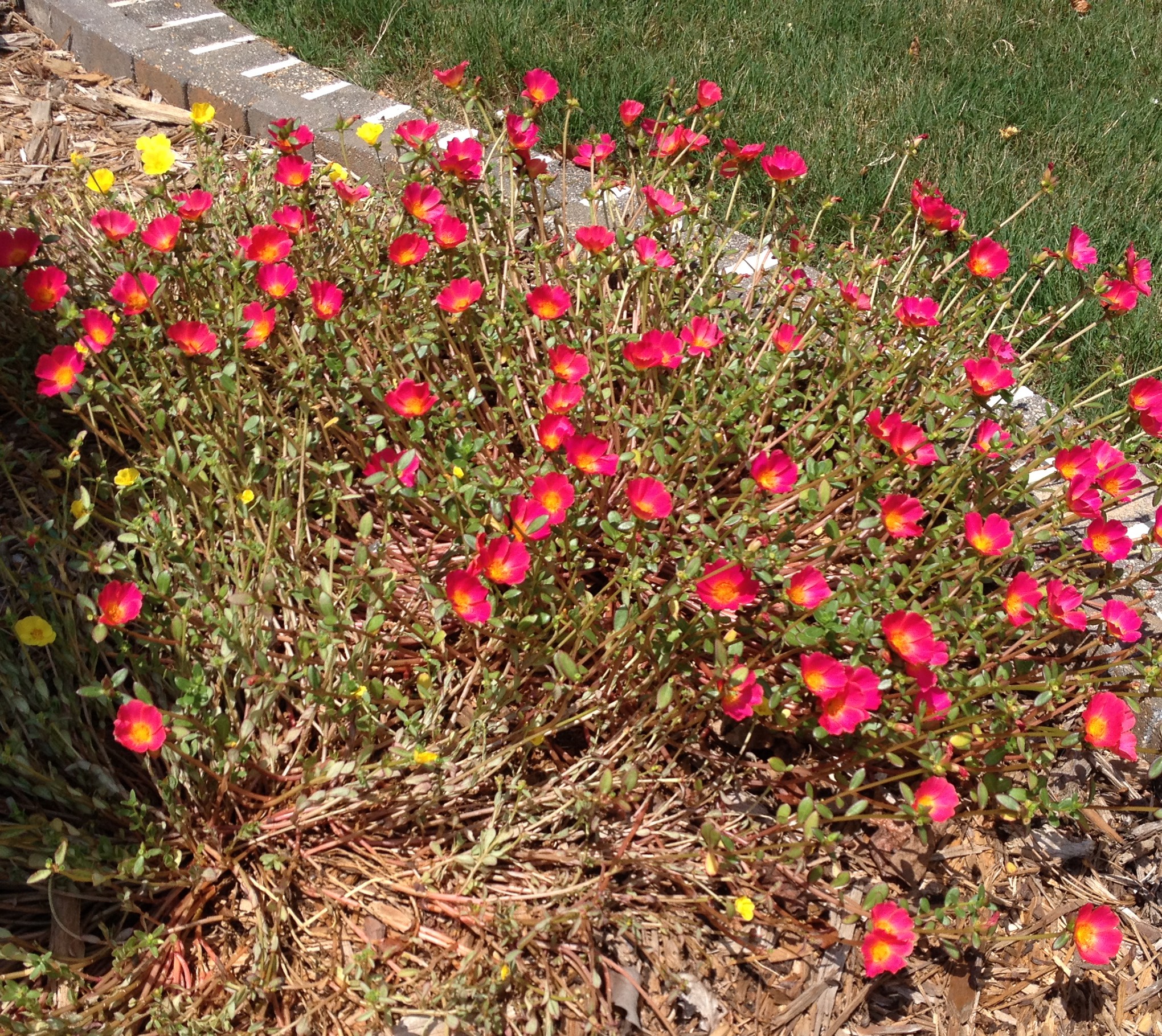
Purslane (Portulaca oleracea) is a dependable sun-loving, drought tolerant summer annual. Mine has bloomed enthusiastically since I planted it in May, but is starting to look a bit tired and leggy. Soon it will be replaced by mums which will in time be replaced by violas.

As I’ve become more knowledgeable horticulturally, I’ve realized Ray was right and I try to get my cool-season annuals placed in their beds at a reasonable time even if it means pulling up still-blooming warm-season plants and vice versa. (I do, however, usually apologize to the plants I’m pulling up and thank them for providing so much enjoyment across their respective season.)

A wise friend recently pointed out that our strengths become weaknesses when pushed to their extremes. I’m loyal and dedicated, a consummate Golden Retriever for those of you familiar with Gary Smalley’s animal-based personality profiles. Just as I hesitate to remove still-flowering plants from my garden, I find it difficult to let go of people or situations, even when it would be best to do so – loyal and dedicated . . . to a fault. I’ve said on many occasions since losing my job four and a half years ago I’d still be sitting in my cube, working away, if God hadn’t made it abundantly clear that chapter of my life was over. And what an amazing adventure I would have missed had He not (lovingly) slammed that door and sent me on my way. After all, I went back to school to study horticulture and became a first-time grandmother within six months of losing my job. What a joyful, and somewhat humorous, combination of events!

Becoming gainfully unemployed is just one of many positive life-changing examples I can look back on. So you’d think I’d be better at letting go by now. Sadly, that’s not the case. Probably because letting go feels too much like giving up or losing. Plus there’s the fear of the unknown. Yet I firmly believe God always knows what’s next. He encourages us, saying, “Forget the former things; do not dwell on the past. See, I am doing a new thing! Now it springs up; do you not perceive it?” (Isaiah 43:18-19a) There are times when I’m so focused on the known and the now I can’t perceive anything beyond an underlying sense of disquiet beckoning me to move forward. Tentatively, I’ll let go with one hand while keeping a tight grip with the other. But God is able to do far more than I can ask or imagine so isn’t it likely I’ll need both hands to receive whatever it is He wants to give? Being a patient and compassionate Father, He works to loosen my grip and enable me to embrace His plan – His good and perfect plan.

Even though it’s only mid-August, a few leaves are starting to fall, early harbingers of the major leaf-drop to come in a couple of months . . . signaling another chapter, another season, reminding me letting go isn’t giving up or losing.  It’s making way for the new.

Anniversaries and accountability

It’s not like me to forget an anniversary. Remembering special events is important to me. Maybe it was the fact I was spending a few days at the beach, blissfully disconnected from the calendar and my normal schedule, when this particular milestone came and went.  Regardless of the reason, it’s too significant to me not to make mention of it, albeit belatedly: July 1st marked the one-year anniversary of my first blog post. After a lot of thought (I’m nothing if not deliberative!) and some trepidation, I started writing in this public forum. My objective: to share some of what I’ve learned spiritually and horticulturally since losing my beloved husband to a heart attack on a warm spring evening in 1997. My primary message: God is faithful, He loves us, He can be trusted. Examples and evidence of his goodness are plentiful throughout his creation and parallels can be drawn between how He cares for the natural world and how He attends to our needs.

I appreciate all of you who’ve read, commented, followed and encouraged me to keep writing. I hope you’ll have even more reasons to come back to the garden with me in the weeks ahead as I add some new pages to this blog, something I’ve been contemplating for a while . . . which leads me to accountability. Now that I’ve told you about the planned additions, I’ll be more likely to follow through! And I’ll be expecting a (gentle) inquiry or two if I don’t . . .

Feed the birds

It had been a long time since I last owned a bird feeder.  For the past three years, my grandson and I have enjoyed watching the birds (and an occasional squirrel, including “Stumpy”, the tail-less one) visit the feeder at my daughter’s house. I’ve also delighted in helping a friend fill his many bird feeders, anticipating the flurry of activity that’s sure to follow. So, I decided I wanted one. My dad granted my wish and gave me a feeder for Christmas.

Not really knowing what to buy in terms of food, I selected a bag of Southern Regional Blend. The tag line on the bag said “Blended to attract Southern Songbirds” while another statement promised “25% sunflower plus safflower” seeds. A closer look at the ingredients list revealed millet to be the predominant ingredient, while a chart on the back indicated this particular blend would be eaten, and presumably enjoyed, by a range of birds common to our area, including cardinals, chickadees, and titmice.

I chose a location for the feeder where I could keep an eye on it from two key vantage points: the window above the kitchen sink and my seat at the table. I filled the feeder and awaited the birds’ arrival with joyful expectancy. It took a couple of days for them to notice the new food source, but one morning a red-headed woodpecker arrived, followed by several tiny chickadees and some titmice.

I mentioned my new-found hobby to my fellow bird-feeding friend who promptly shared some of his stash of the birds’ favorite food: black oil sunflower seed. I’ve gradually transitioned the contents of the feeder from the original blend until it now contains only that delicacy. The changeover along with colder weather and the depletion of their natural food sources has led to increased activity around the feeder. There’s also a broader variety of birds partaking of the feast, as several kinds of finches and sparrows as well as cardinals, doves and juncos have joined the species that originally frequented the feeder.

As I’ve watched the birds consume the food I provide for them, I’ve been reminded of the spiritual nourishment available to us. Just like the different components in the blend of seeds I originally purchased, there are myriad types of books to fortify us for our spiritual journey. Some in the self-help genre are little more than “filler”, like the millet, while devotionals and study guides written by learned theologians offer more nutritious fare.

But one Book surpasses them all. When tempted by Satan in the wilderness to turn stones into bread, Jesus answered, “It is written: ‘Man shall not live on bread alone, but on every word that comes from the mouth of God.’” (Matthew 4:4) As the black oil sunflower seed is highly favored by the birds, so should the Bible, the inspired Word of God, be our preferred source of spiritual sustenance. May we partake frequently of the feast He has so graciously provided.

Prudent pruning

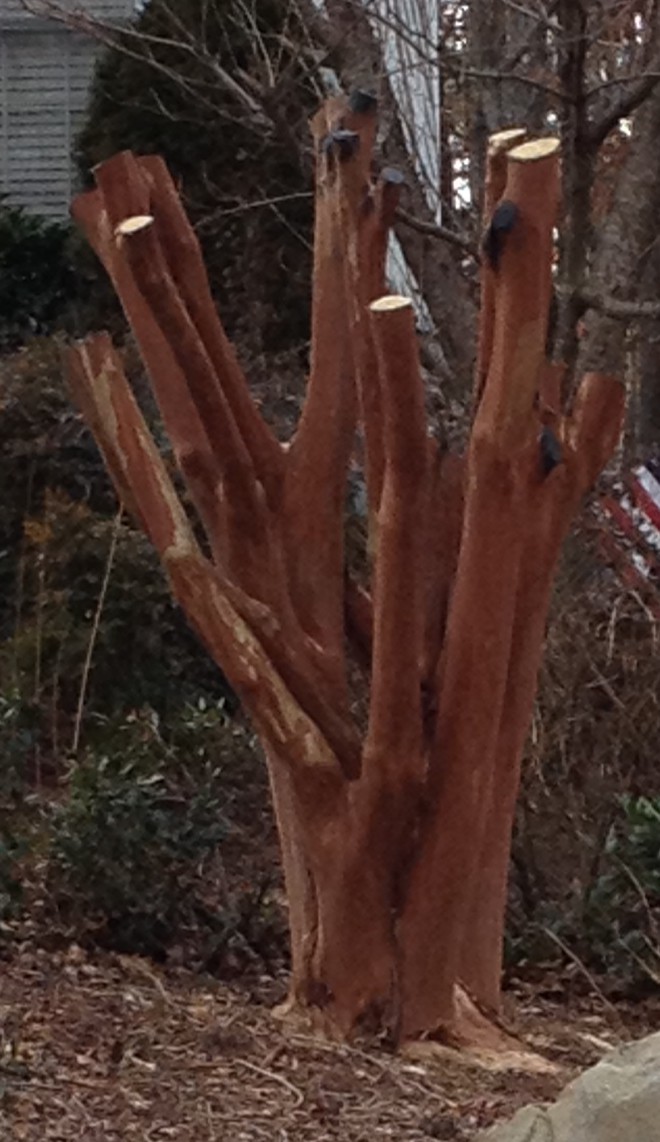
In my October post, “Ode to a Crape Myrtle”, I denounced the practice of severely pruning those lovely trees. The dreadful act is sometimes referred to as “crape murder”. Early to mid-winter each year I see far too many pitiful victims of this particular crime. But this year, on a street I traverse almost every day, stands one of the most pathetic examples I’ve ever beheld. Crape murder victimNot only has the beautiful tree been stripped of its majestic branches, but the perpetrator used a sealant of some sort to paint over several of the wounds. When pruning cuts are made correctly, the tree’s natural defenses will allow it to heal without the application of such products, which in some cases even cause harm to the plant.

As I also mentioned in my previous post, I committed the crime once, in ignorance, before being enlightened. I have since done only minor, clean-up type pruning to the gorgeous ‘Natchez’ Ray planted over 20 years ago.  As the tree has outgrown me, I’ve relied on professional assistance to remove crossed or crowded branches. Most recently, my tree was expertly “limbed up” to provide more light to the plants beneath its canopy and to lighten the load it carries when completely leafed-out and covered with blossoms.Lagerstroemia 'Natchez'

So, you see, I’m not against all pruning, just pruning done recklessly or unnecessarily.  Correct pruning is often an essential part of maintaining a plant’s health, enhancing its aesthetic value or increasing its fruitfulness. Likewise, there are times when we need to be pruned. Fortunately, we belong to a discerning Master Gardener. He determines exactly where and how to make the required cuts to enable us to bear more fruit for Him. Sometimes the pruning is severe and the process is painful, but we can always trust Him. He knows us by name and loves us far more than we can imagine . . . and He’s tenderly transforming us into who He created us to be.

Here comes the sun

I try not to complain about the weather. As a dedicated gardener, I know plants need the rain every bit as much as they need the sun. However, for the past week or so, the sunny South had been anything but. One cold, cloudy, drizzly day followed another in somber progression until I finally succumbed, sadly lamented the lack of sunshine and spent the better part of one day earlier this week in tears.

Yesterday the glorious sphere of light finally reappeared, warming the earth and restoring my customary optimistic outlook. There was renewed activity around the bird feeder, which had been woefully devoid of the happy twittering of my feathered friends on those seemingly endless dreary days. A squirrel scampered back and forth on the deck railing, plotting strategy for an attack on the feeder (which he wisely didn’t try!) The violas planted by my mailbox, drooping after the cold days and frigid nights, began to lift their heads toward the sunlight. Indeed all of us were buoyed by the sun’s return.

The sun shone brightly again today, beckoning me outside to check on my beloved plants. The busyness of the holidays and the recent cold temperatures had deterred me from my practice of walking the property on a regular basis.  I began my afternoon by removing last year’s spent foliage from a number of perennials and then went in search of new growth. I didn’t have to look far. Even though the garden may appear lifeless and barren, plants are alive and well, preparing for a new season. Finding these signs of life gives me great joy and fills me with hope, just like it has every year since I first faced the task of cleaning up the beds by myself (see “Consider it pure joy”, July 1, 2014).

As the succession of overcast days left me feeling dejected, wondering if the sun would ever reappear, there are times when a spiritual chill can settle upon us. Worries and fears cloud our perspective, leading us to question the presence of the Son. Yet, just as the sun is there when we can’t see it or feel its warmth, the Son has promised to be with us always, to the very end of the age (Matthew 28:20). He will guide, sustain and protect us through all the seasons of our lives until the day when we dwell with Him in the City that will not need the sun or the moon to shine on it, for the glory of God will give it light and the Lamb will be its lamp (Revelation 21:23).