We try to deny it, but we all know it’s true – our technology spies on us, keeps track of our whereabouts and catalogs our interests. Why else would I suddenly start receiving ads in my newsfeed for the exact products I’d been shopping online for moments before? Or, the example that unnerves me the most, get unsolicited information regarding how long it would take to get to my daughter’s house on the day of the week and around the time I usually head her way?
So, it shouldn’t have surprised me when headlines pertaining to an alleged feud between Kate and Meghan (Duchess of Cambridge and Duchess of Sussex respectively) kept popping up whenever I used Google this past month. After all, I’ve searched for royal updates a time or two or several in the past. However, I was immersed in holiday-related activities and didn’t take time to read the articles associated with the recent headlines. Nonetheless, they fueled a growing sense of angst, as each reminded me that “Royalty” (see Archives, September 2018) was scheduled to appear on our denomination’s enCourage website this month. Would the purported bickering between the royal sisters-in-law negate the premises of my post?
 Now that I’ve finally resurfaced, I’ve skimmed some of the articles and reviewed “Royalty” in light of them. Fortunately, the analogy in my previous post remains pertinent. In fact, coverage of the duchesses’ squabbles amplified one of my key points: people are always watching, evaluating, commenting. Sadly, some prefer drama over harmony. Some may even be looking for a reason to criticize or reject.
Such was the case with Jesus. The religious leaders were constantly trying to catch Him in compromising situations or bait Him into contradicting Himself, all to no avail.[1] Likewise, there are those who would like to see His followers fail. They’re ever-vigilant for unbecoming behavior or attitudes so they can discount our perfect Savior along with us, His not-so-perfect followers. It’s important to be concerned about our personal reputations, but even more so to walk worthy of our calling and thereby honor the reputation of the One whose Name we bear. (Ephesians 4:1-6)
Interestingly, the supposed feud was brought to an end by Queen Elizabeth who’d reportedly “had enough” of the arguing and its attendant negative press. We’ll never know how much the media embellished the situation to make it appear more dire. And so it is with disagreements between ordinary folk – only those directly involved (and God) know all the details and, even then, they may well perceive the situation differently. After all, each of us is a unique bundle of opinions, strengths and weaknesses. Furthermore, we’ll continue to struggle with sin until we’re called Home. (Romans 7:15-20) But God has given His children clear instructions on how to relate to each other:
- (Jesus said), “A new command I give you, that you love one another: just as I have loved you, you also are to love one another. By this all people will know that you are my disciples, if you have love for one another.” (John 13:34-35)
- So then, as we have opportunity, let us do good to everyone, and especially to those who are of the household of faith. (Galatians 6:10)
- Put on then, as God’s chosen ones, holy and beloved, compassionate hearts, kindness, humility, meekness, and patience, bearing with one another and, if one has a complaint against another, forgiving each other; as the Lord has forgiven you, so you also must forgive. And above all these put on love, which binds everything together in perfect harmony. And let the peace of Christ rule in your hearts, to which indeed you were called in one body. And be thankful. Let the word of Christ dwell in you richly, teaching and admonishing one another in all wisdom, singing psalms and hymns and spiritual songs, with thankfulness in your hearts to God. And whatever you do, in word or deed, do everything in the name of the Lord Jesus, giving thanks to God the Father through him. (Colossians 3:12-17)
- Let no corrupting talk come out of your mouths, but only such as is good for building up, as fits the occasion, that it may give grace to those who hear. And do not grieve the Holy Spirit of God, by whom you were sealed for the day of redemption. Let all bitterness and wrath and anger and clamor and slander be put away from you, along with all malice. Be kind to one another, tenderhearted, forgiving one another, as God in Christ forgave you. (Ephesians 4:29-32)
- Let love be genuine. Abhor what is evil; hold fast to what is good. Love one another with brotherly affection. Outdo one another in showing honor. Do not be slothful in zeal, be fervent in spirit, serve the Lord. Rejoice in hope, be patient in tribulation, be constant in prayer. Contribute to the needs of the saints and seek to show hospitality. Bless those who persecute you; bless and do not curse them. Rejoice with those who rejoice, weep with those who weep. Live in harmony with one another. Do not be haughty, but associate with the lowly. Never be wise in your own sight. Repay no one evil for evil, but give thought to do what is honorable in the sight of all. If possible, so far as it depends on you, live peaceably with all. (Romans 12:9-18)
Misunderstandings and disagreements are an inevitable part of life. Nonetheless, when conflicts arise, we are to deal with them in a way that honors God. We are called to act and think differently, to be transformed more and more into the image of Christ so that the family resemblance is unmistakable. (Romans 8:29; Romans 12:2)
Lord, please help us to live and love in such a way that those watching will take note (Acts 4:13) and inquire about the difference. May we always be prepared to give a reason for the hope that is within us, gently and with respect, remembering that it is better to suffer for doing good, if that should be Your will, than for doing evil. (1 Peter 3:15-17)
[1] See, for example, Mark 3:1-6, Luke 14:1-6 (healing on the Sabbath); Matthew 9:2-7 (forgiving sins); Matthew 12:1-8 (Lord of the Sabbath); Matthew 26:59-60 (false witnesses)
 I’m playing catch-up. December descended, as it always does, with its attendant whirlwind of activities. I’m one of those who revel in the festivities, from sending and receiving cards to plotting gift strategy with family members to savoring special meals with loved ones. But, as I’m enjoying the merriment the season has to offer, day-to-day chores and responsibilities start to pile up and about now, as the celebrations wind down, I realize just how far behind I am. I don’t regret my decision to enjoy the season, since it comes but once a year, while chores persist year-round. But I know I now need to pick up the reins and get the more mundane aspects of life back in order. As much as I relish celebrating, I also look forward to returning to a normal schedule.
 hands have made it clear they’re not happy with the repeated gripping and lifting required to set up my beloved Dickens Village – and the final enemy, death, which paid an unexpected visit to one of our church families. The weight has grown heavy indeed.
 Though petite in stature, Mom’s my biggest cheerleader and most dependable defender. We all need someone who’s unconditionally, unreservedly in our corner. I’m so thankful Mom’s in mine. She’s my rock because she consistently points me to the Rock and reminds me His everlasting arms are securely holding all who belong to Him in an eternal embrace. (Deuteronomy 33:26-27a) O LORD, please help me to do the same for my precious children and grandchildren. Thank You for the priceless blessing of a godly mother!
 Just as I benefitted greatly from learning Spanish in a Spanish-speaking country, Christians thrive best when we’re part of God’s visible church. Scripture is clear that each of us has an important, God-ordained place in His body (1Corinthians 12:12-30) and that we should not neglect meeting together. (Hebrews 10:24-25) Furthermore, God’s family is composed of members of varying ages, abilities and spiritual maturities, just like biological families. We are called to do life together in compassionate covenant communities, where we rejoice with those who rejoice, mourn with those who mourn and come alongside each other to teach, support and encourage according to the gifts we’ve been given. (Romans 12:3-21)
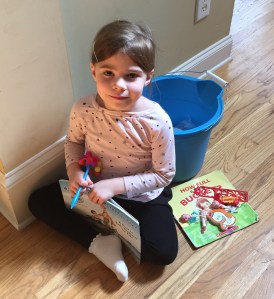 Joshua read the books to us after lunch. They were all about how we fill or empty each other’s imaginary buckets by being kind or being mean. Furthermore, the books pointed out we’re doing one or the other all the time. The narrative went on to say that by filling up others’ buckets, we’re filling up our own as well since being helpful, obedient and thoughtful makes situations better for everyone involved. Bucket-fillers, buoyed by the results of their good deeds, are much happier than bucket-dumpers, whose actions contribute to continued strife.
 My mom was the baby of her family, the youngest of eight siblings and her father’s darling. He called her “Babe” and warmed her clothes by the fire for her before she went off to school on cold mornings. Occasionally my grandmother, a bit more stern in her demeanor, would delegate the task of disciplining a wayward child to my grandfather. He would take the offending party outside beyond her view and tell the child to cry out while he used the switch on some inanimate object instead of their legs.
 “Mr. Jim”, as the people around town knew him, was a man of faith, a deacon in the tiny country church where he worshiped. He embodied the fruits of the Spirit – love, joy, peace, patience, goodness, kindness, faithfulness, gentleness, self-control. (Galatians 5:22-23) When he suffered a heart attack a few months before he died, the doctor told him he had to limit his physical activities. For a man who loved his garden and was used to being outside, it was like a death sentence. He’d sit in the kitchen of the home he shared with my grandmother, his wife of 55 years, turn his gaze toward the little church and comment he’d rather be in the cemetery than just sitting around.
 The house on Dewalt Road was to be our long-term, raise-the-kids residence, but DuPont decided to move my entire work group to Georgia so we could be closer to our customers in the carpet industry. Once again we were faced with selling a house, this time one filled with toys and accessories parents of toddlers are used to stepping over and around. I dreaded the process of keeping the house picked up and ready to show at any moment. After Ray and I signed a contract with our realtor the day before I left for a weeklong business trip to California, I told them, “Ok, you two. I want you to find a buyer before I get back.” (Cue laughter.) But God graciously provided a young family, much like our own, who could no doubt imagine their own children’s toys strewn across the playroom and parked in the yard. They were ready to make an offer by the time I returned home.
 As summer wanes, cracks begin to appear in the bark along the mighty trunk, signaling the coming changes. Soon, the cracks turn into fissures as the old skin lifts away from the tree, before finally letting go completely, falling to the ground in long, jagged shards. To the uninitiated observer, this series of events may be unsettling. How could such a shedding of bark possibly be good for the plant? Yet that very act allows the trunk to increase its girth and grow stronger. Best of all, it reveals the most magnificent cinnamon-colored covering. Ray saw the potential in the sapling he planted so long ago. He knew what it could become.
