Letting go

Over the years Ray and I were married, I saw him pull up perfectly good plants to make way for the next season’s annuals. I was always a bit appalled since I’m one of those people who doesn’t like to waste anything. Yet he knew the next season’s plants needed time to establish their roots and get acclimated before the harsher temperatures of the upcoming season arrived, be they summer’s highs or winter’s lows.

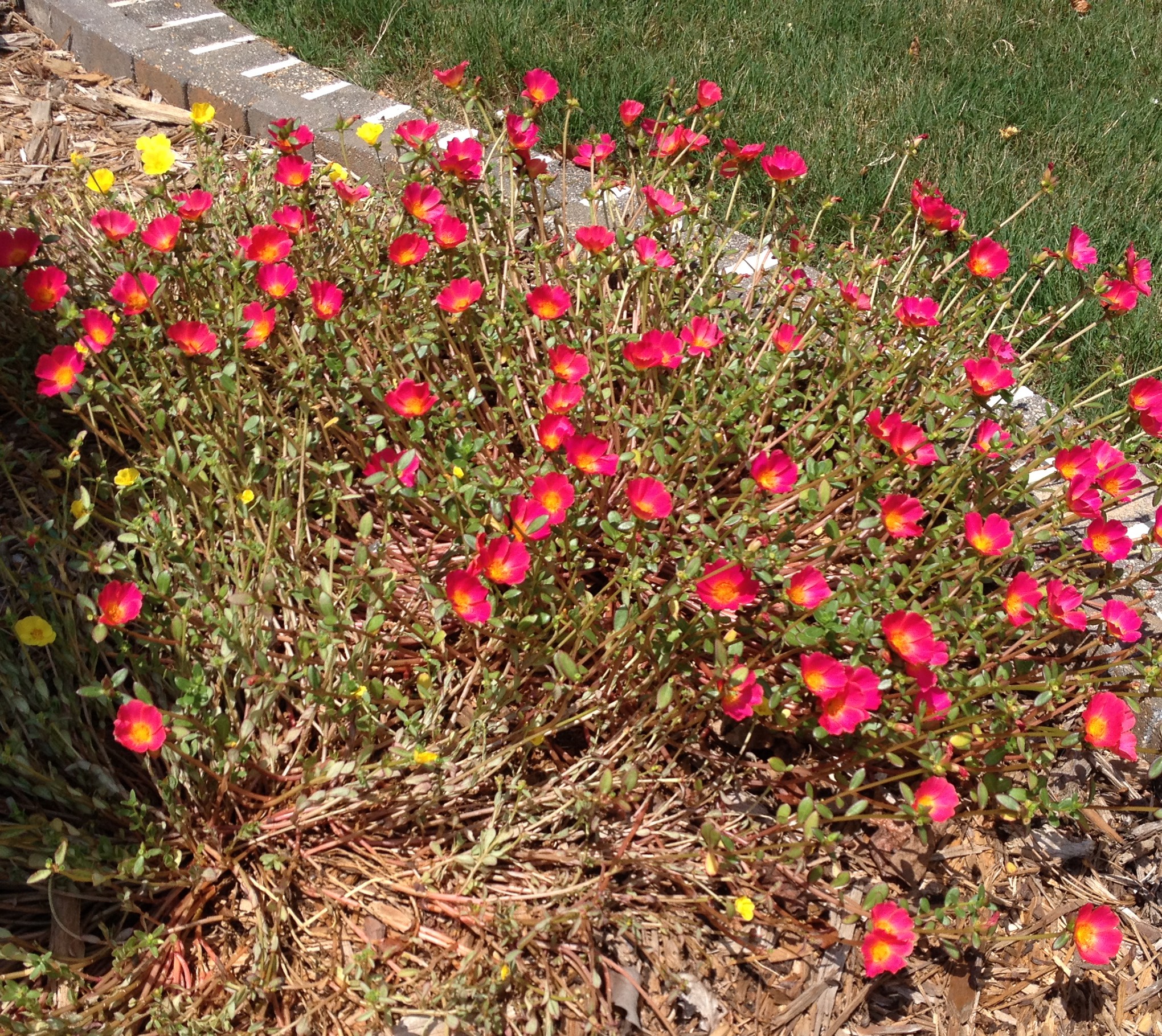
Purslane, Portulaca oleracea

Purslane (Portulaca oleracea) is a dependable sun-loving, drought tolerant summer annual. Mine has bloomed enthusiastically since I planted it in May, but is starting to look a bit tired and leggy. Soon it will be replaced by mums which will in time be replaced by violas.

As I’ve become more knowledgeable horticulturally, I’ve realized Ray was right and I try to get my cool-season annuals placed in their beds at a reasonable time even if it means pulling up still-blooming warm-season plants and vice versa. (I do, however, usually apologize to the plants I’m pulling up and thank them for providing so much enjoyment across their respective season.)

A wise friend recently pointed out that our strengths become weaknesses when pushed to their extremes. I’m loyal and dedicated, a consummate Golden Retriever for those of you familiar with Gary Smalley’s animal-based personality profiles. Just as I hesitate to remove still-flowering plants from my garden, I find it difficult to let go of people or situations, even when it would be best to do so – loyal and dedicated . . . to a fault. I’ve said on many occasions since losing my job four and a half years ago I’d still be sitting in my cube, working away, if God hadn’t made it abundantly clear that chapter of my life was over. And what an amazing adventure I would have missed had He not (lovingly) slammed that door and sent me on my way. After all, I went back to school to study horticulture and became a first-time grandmother within six months of losing my job. What a joyful, and somewhat humorous, combination of events!

Becoming gainfully unemployed is just one of many positive life-changing examples I can look back on. So you’d think I’d be better at letting go by now. Sadly, that’s not the case. Probably because letting go feels too much like giving up or losing. Plus there’s the fear of the unknown. Yet I firmly believe God always knows what’s next. He encourages us, saying, “Forget the former things; do not dwell on the past. See, I am doing a new thing! Now it springs up; do you not perceive it?” (Isaiah 43:18-19a) There are times when I’m so focused on the known and the now I can’t perceive anything beyond an underlying sense of disquiet beckoning me to move forward. Tentatively, I’ll let go with one hand while keeping a tight grip with the other. But God is able to do far more than I can ask or imagine so isn’t it likely I’ll need both hands to receive whatever it is He wants to give? Being a patient and compassionate Father, He works to loosen my grip and enable me to embrace His plan – His good and perfect plan.

Even though it’s only mid-August, a few leaves are starting to fall, early harbingers of the major leaf-drop to come in a couple of months . . . signaling another chapter, another season, reminding me letting go isn’t giving up or losing.  It’s making way for the new.

Are you contagious?

As part of my horticultural studies, I spent several months interning at a botanical garden near my home. Each day was different as I and another intern assisted the Head Gardener with whatever he needed to get done. I found the majority of our activities to be interesting, educational and, for the most part, enjoyable. However, one activity repeated every couple of weeks throughout the summer wasn’t much fun. That task? Removing leaves affected with early blight from the tomato plants. It was a rather tedious process which required us to dip the blades of our pruners into alcohol after every snip of an infected leaf. Why? To decrease the possibility of spreading the disease to other areas of the plant or to other plants entirely. In addition, we bagged up the diseased leaves and put them in the trash, not the compost bin, since blight spores can survive on plant debris, causing more problems later. Even though following the procedure took more time than clipping a succession of leaves with no dipping in between, it was worth it. It slowed the progression of the blight, enabling the tomatoes to survive and bear fruit.

Removing diseased leaves from a coneflower one evening this week reminded me of the great lengths we went to in our quest to protect the tomato plants. As is often the case when I’m working in my garden, my thoughts turned to spiritual parallels. Criticism, anger, gossip, complaining. They can be as contagious as any disease and every bit as deadly when it comes to relationships. How are we to keep from spreading the spores of negativity? Just as the alcohol cleansed the blades of the pruners, immersing ourselves in God’s Word can purify our thoughts and refine our intentions. In Philippians 4:8, Paul encourages us to think on things that are excellent and praiseworthy; whatever is noble, right, pure, lovely and admirable. And in 2 Corinthians 10:5 he says we are to take captive every thought to make it obedient to Christ. Difficult? Absolutely! But the One who is making all things new took our infirmities upon Himself and heals us by His wounds that we might bear abundant fruit for His glory . . . love, joy, peace, patience, kindness, goodness, faithfulness, gentleness, self-control . . . conditions others won’t mind catching.

Listen!

As usual, I over-packed for a recent vacation. Nonetheless, I somehow managed to forget my mascara. Not wanting to appear eyelash-less for an entire week, I put “buy mascara” at the top of my to do list when I started out on my first field trip. Shortly after leaving my home-away-from-home I came upon a CVS, but it was on the other side of the street and I would have had to cross traffic to get to it. “Surely there will be another, more conveniently-located drug store before I reach my destination”, I told myself. Alas, there was no such drug store and I ended up stopping at a Walmart. Not only was it busier than the CVS would have been, it also required crossing traffic plus I got turned around in its convoluted parking lot both entering AND exiting.

A couple of days later I was heading off on another adventure. It was almost, but not quite, time for my afternoon tea. I passed a Starbucks soon after getting underway. Knowing I had at least an hour’s drive ahead of me I thought, “I bet I’ll pass another Starbucks soon.” Nope! This time I ended up backtracking to a Target which Siri indicated was home to the closest Starbucks. I had to endure the busyness of the store itself, its parking area AND the traffic on the mall access road leading to said parking lot. All told I added at least 20 minutes to my trip.

When would I learn? . . .

As most travelers know, it’s best to return rental cars with a full tank of gas to avoid excess refueling charges so finding a gas station was top priority as I started to the airport. I didn’t have to look far; there were two within a stone’s throw of the hotel where I spent my last night of vacation. Knowing I had a 35-mile drive I thought, “There will be more gas stations along the way.” (Cue internal conversation.) “Whoa! You’re not going to follow that logic again are you?! Do you really want to risk having to go off course to find another gas station and make yourself late for your flight?” (Anyone else out there have these conversations with themselves?) I’m happy to report I had learned my lesson. I pulled into one of the stations, refueled, and went blissfully on my needle-past-full, stress-free way to the airport.

As I drove I couldn’t help but think about other times when I don’t listen, times when I choose not to heed obvious directions when it comes to my spiritual journey. God promises to instruct us in the way we should go. He speaks clearly through Scripture, sermon messages, the godly advice of believing friends. Even so, there are instances when I’m slow to obey or I decide to take a different route altogether. And my detours often result in frustration and lead to needless sorrow. Yet God is compassionate, slow to anger and abounding in steadfast love toward me, his sometimes wayward daughter. He tenderly draws me back to himself and leads me on the sure pathway Home.

Anniversaries and accountability

It’s not like me to forget an anniversary. Remembering special events is important to me. Maybe it was the fact I was spending a few days at the beach, blissfully disconnected from the calendar and my normal schedule, when this particular milestone came and went.  Regardless of the reason, it’s too significant to me not to make mention of it, albeit belatedly: July 1st marked the one-year anniversary of my first blog post. After a lot of thought (I’m nothing if not deliberative!) and some trepidation, I started writing in this public forum. My objective: to share some of what I’ve learned spiritually and horticulturally since losing my beloved husband to a heart attack on a warm spring evening in 1997. My primary message: God is faithful, He loves us, He can be trusted. Examples and evidence of his goodness are plentiful throughout his creation and parallels can be drawn between how He cares for the natural world and how He attends to our needs.

I appreciate all of you who’ve read, commented, followed and encouraged me to keep writing. I hope you’ll have even more reasons to come back to the garden with me in the weeks ahead as I add some new pages to this blog, something I’ve been contemplating for a while . . . which leads me to accountability. Now that I’ve told you about the planned additions, I’ll be more likely to follow through! And I’ll be expecting a (gentle) inquiry or two if I don’t . . .

Healing

I was hungry when I finally arrived at home after our longer-than-usual church service. My first inclination was to go inside and fix lunch, but we’d gotten a much-needed shower overnight and I wanted to check the rain gauge. My front walk was still wet, though not terribly slippery. Nonetheless, I was careful as I made my way to the rain gauge and noted its contents. As I was returning it to its place, my neighbors pulled into their driveway so I waved to them as they got out of the car.

And then it happened. As I turned back, I caught the toe of my shoe on the edge of the walk. Before I knew it I was falling – not one of those slow motion kind of falls, but a rapid, slam-into-the-pavement plunge. In the second or two it took to unceremoniously reach the ground, all I could think was “Don’t hit your face!!!” (I’d recently re-read a friend’s account of hitting the floor face-first when he was younger, cracking both front teeth in the process, and was praying I wouldn’t meet a similar fate.) Bam! I came to an abrupt halt, but sprang up just as quickly. I didn’t wait to see if I’d hurt myself, wanting instead to avoid the embarrassment of being seen sprawled out on my front walk by the neighbors I’d cheerfully greeted just moments before.

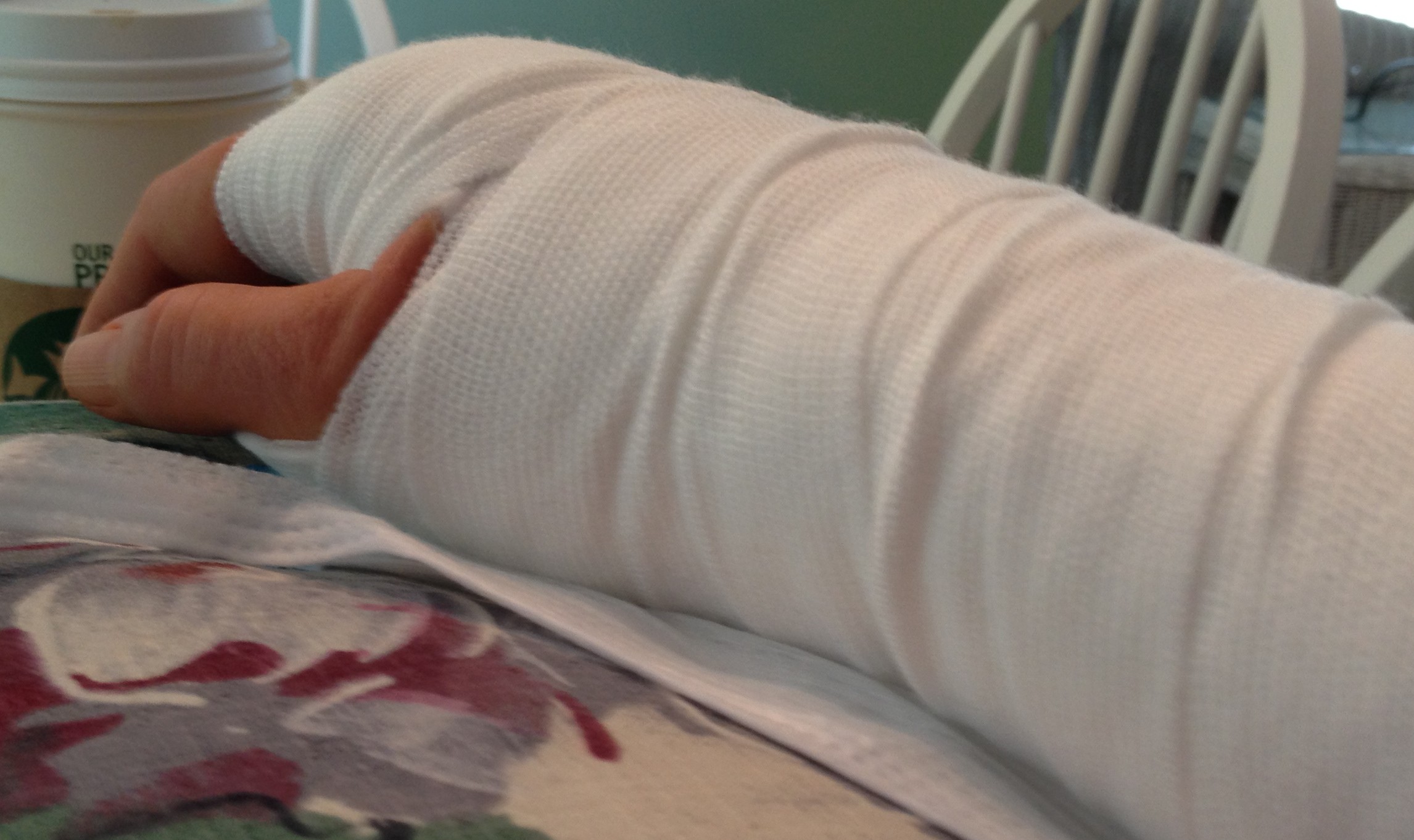
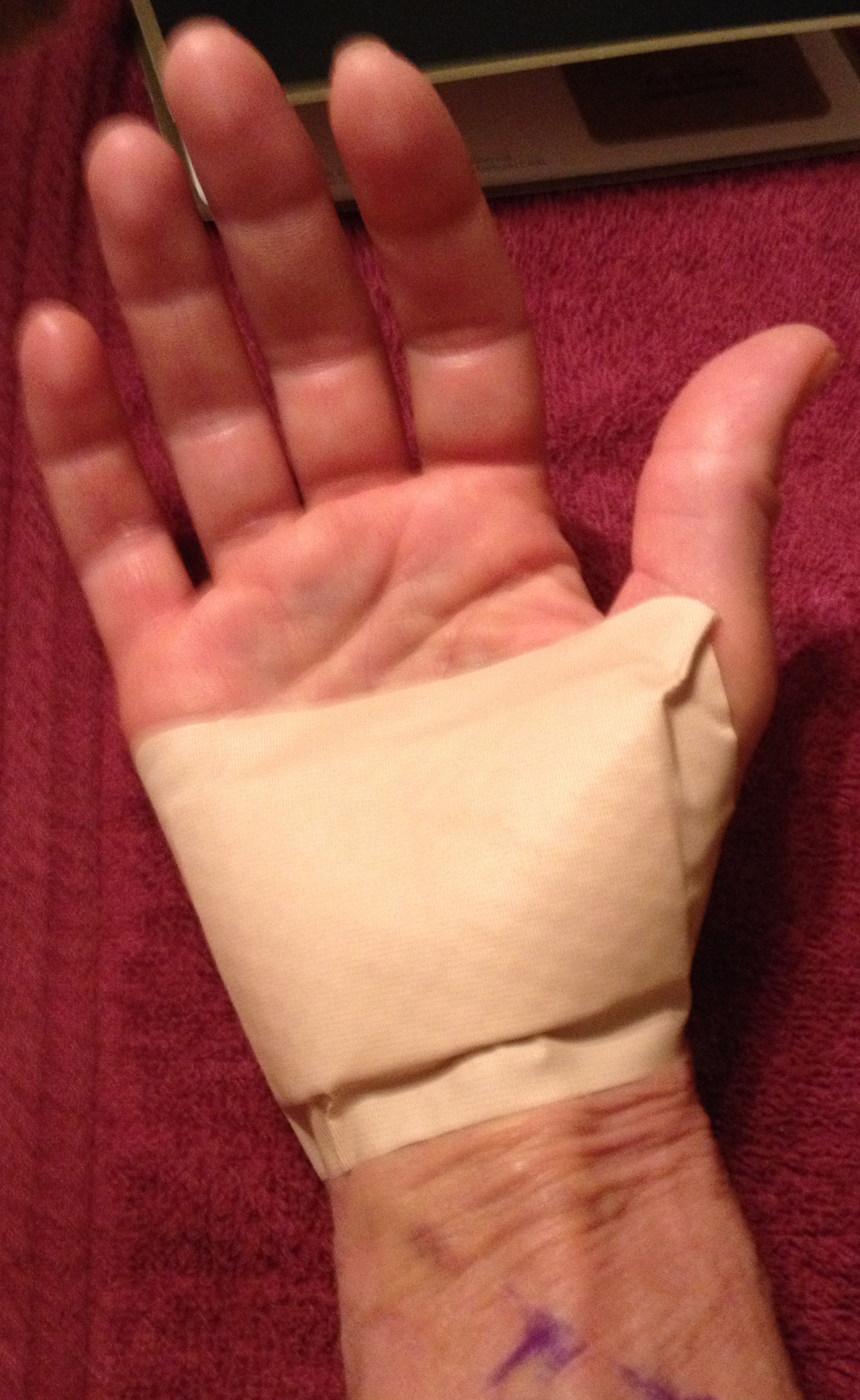
Within seconds I realized my right hand had taken the brunt of the fall. The edge of the walk opened up a deep gash approximately an inch long in the flesh beneath my thumb. The shock of falling quickly combined with my low blood sugar, making me woozy as I saw the blood seeping out of my palm. I walked unsteadily to my neighbor’s house for assistance bandaging the wound then returned home and lay down. I don’t remember when I finally felt like eating.

The good news: no broken bones (or teeth!) In addition to the gash on my hand there were only some scratches across my nose and a small cut on my upper lip. I can’t imagine how I managed to plummet without sustaining any other injuries – nary a scratch or bruise anywhere else!

The next day I told Joshua about my fall. As I showed him my various injuries, I asked if he’d kiss them and make them better for me like I always do for him. He carefully considered my request then replied, “No Grammie, that’s too many boo-boos.” Later in the week I lifted the bandage on my hand and let him take a peek at the wound. After briefly contemplating the sight, he said, “Don’t worry, Grammie, God will give you new skin to cover up the hole.” And so He has. Slowly, steadily over the weeks since I nearly face-planted on my front walk, the gash has closed and new skin has appeared.  Truly we are fearfully and wonderfully made.

Several weeks after my fall, Joshua suffered an unpleasant injury of his own. He and June, the family dog, were both interested in a prized turkey feather. When Joshua reached for it June showed her displeasure by nipping him under his left eye. Wincing in pain, Joshua started wailing. When I got to him moments later, there was a trickle of blood on his face. I attempted to remain calm so I could comfort my little buddy, but my anxiety increased as his sobbing continued. Then my phone chimed. Justin, alerted by Mary as to the drama unfolding at home, requested to FaceTime with Joshua. Upon seeing his father’s face, Joshua quieted enough to hear what Justin had to say. In a calm, steady voice he reassured Joshua, reminding him of other times he’d been hurt, how things had subsequently gotten better and that this time would be no different. As Joshua’s tears subsided into intermittent sniffling, tears sprang to my eyes and spilled down my cheeks. In allowing me to witness this affectionate act of reassurance by an earthly father toward his distraught child, God reminded me of His love for me. Justin’s words echoed a message I needed to hear, “You’re hurting, but you’ve been hurt before. Remember, Patsy, it will get better. I’ve never left or forsaken you and I never will.”

Suffering comes in many forms. Some of the most painful injuries aren’t physical ones. Disappointments and losses can pierce our hearts and threaten to crush our spirits. But they don’t have the final say . . .

There’s now a scar at the base of my right thumb. It reminds me of the One whose wounds bring ultimate healing. Who is faithful to all His promises.  Who assures His children that a day will come when He’ll wipe away every tear.

In Remembrance

“Death leaves a heartache no one can heal. Love leaves a memory no one can steal.” (Unknown)

Eighteen years ago today my beloved husband was laid to rest in a tiny cemetery in North Carolina. The part of my heart that belonged to Ray went into the grave with him that sunny, late-April afternoon. Several weeks later I placed a call to “Focus on the Family” to request materials on dealing with grief. In the midst of my conversation with the kind person who answered I said, “I feel like part of me is missing.” I’ll never forget her reply, both compassionate and oh-so-insightful: “During the time you were married you and your husband became one. Part of you is missing.”

Months passed and I was having yet another day where I was struggling with the pain of losing someone so dear. Sensing my sadness, the woman I was meeting with inquired about how I was coping. When I confessed how difficult some days were she introduced me to a concept I’ve held onto ever since. She suggested I envision a beautiful piece of furniture, a chest with many drawers, each containing memories and their associated emotions. She went on with the analogy saying, “When memories of your husband’s death arise at a time when you feel you aren’t able to deal with them, imagine tucking them into one of the drawers, closing it gently and re-opening it when you’re ready to do so.” I’ll admit there have been times when a drawer has sprung open and caught me off guard. Times when a memory has overwhelmed me and I’ve struggled to shut the drawer. But more often the mental image has served me well.

The week before and the week after the anniversary of Ray’s death I’m quite intentional about opening the drawer. I think about how we spent our last few days, oblivious to the fact our time together was winding down. I remember the day of his passing with such clarity it could have happened recently, not so long ago. And I recollect the days following, when I had to make decisions I never expected, much less wanted to make at such an early age. My reminiscences are deliberate and purposeful, a way to honor Ray as well as remind myself of lessons learned and affirmed by losing him, such as:

  • The importance of numbering our days aright and keeping current in our relationships with those we hold dear.
  • The need to keep things in perspective, saving emotional distress for things that can’t be “fixed,” no matter how much money or time you invest. (And its corollary: things can be replaced, people can’t be.)
  • The ability of prayer to strengthen and support when raised up by myriad family members and friends on one’s behalf.

I’ve kept a journal for ages. On the night I returned home from the hospital, dazed and in a mild state of shock, I penned these words: “This is the worst day of my life up to this point – Ray, my dear, dear husband and friend died tonight. Even as I write it I don’t believe it. It will probably take time for the numbness to wear off, but when it does, Lord, please enfold Mary, Jessie and me in your love. I don’t understand this and I can’t even begin to imagine what my life will be like without him.” I was right. I couldn’t imagine what life would be like and to this day I don’t understand. But God heard my cry that night and many nights since. He’s been so faithful to me and my family, loving and sustaining us all the years we’ve been without Ray.

Which brings me to another point regarding the imaginary chest: it contains numerous drawers. Although some hold remembrances that evoke sadness, there are many more containing memories associated with great joy. I open those on a regular basis, reliving and savoring the moments, praising God for His goodness and grace. And each year when April 19th comes around, I remind myself I’m another year closer to once again seeing the man I was blessed to call my husband. The reunion is guaranteed because of the broken body and spilled blood of the One who instructed His followers to remember Him, His sacrifice, His promises. And so we wait in hope and assurance.

He is Risen!

For me, Easter is the best day of the year. I wake up thinking, “He is Risen!”, and my heart continues to sing that joyful refrain throughout the day as it celebrates the assurance that death has been swallowed up in victory. I rejoice over the certainty of life eternal in the presence of God where the most beautiful of earthly days will dim by comparison.

Yet God, in His goodness, has blessed us with much beauty in this world. I can’t help but believe spring gives us a glimpse of what awaits when we get Home. In this glorious season of rebirth, creation not only reflects God’s glory, but shouts as well as whispers praise to the Creator in myriad ways, from flower-laden branches to the tiniest of wild flowers. And so I offer the following photos, most taken around my garden, as my contribution to the chorus of thanksgiving to the One who is most worthy of praise.

Joyful, joyful we adore Thee

“All Thy works with joy surround Thee, Earth and heaven reflect Thy rays,
Stars and angels sing around Thee, Center of unbroken praise.
Field and forest, vale and mountain, Flowery meadow, flashing sea,
Chanting bird and flowing fountain, Call us to rejoice in Thee.”
(Henry van Dyke)

My heart is content. Having spent part of this beautiful afternoon outside under a crystal blue sky, warmed by the sun and caressed by a gentle breeze, I am rejoicing in the One who created it all. Although I raked a small mountain of leaves into the woods (you’d think I hadn’t raked at all last fall!), my top priority was strolling the grounds to see what I could find. I wasn’t disappointed, as my scouting efforts yielded all sorts of tiny treasures – trillium beginning to unfurl their leaves; May-apples, looking like miniature umbrellas, tightly closed, as they poke their way through the soil; a solitary flower on the Hepatica, with the promise of more to come; Tipularia leaves, their deep purple undersides a key identifier; Lenten roses sprinkled happily about the garden, their seeds having freely dispersed over the years.

Not only do the plants bring me joy in and of themselves, but many of them are linked to special people, gifts from their gardens. Now growing in mine, they remind me of the friends who graciously shared them with me and delightful times we’ve spent together immersed in various horticultural pursuits.

So much to savor on this spring-is-almost-here Sunday!  So much love poured out on me in the form of flowers and friends, by a Father willing and able to do far more than I can ask or imagine! And so, with the Psalmists and hymn writers, I proclaim, “How great Thou art!”

Feed the birds, take 2

My alarm clock didn’t go off this morning. Consequently I made it downstairs later than usual and later than I’d planned. A quick glance at the bird feeder revealed an almost-empty receptacle, with only an inch or so of millet languishing in the bottom of the cylinder. A few hopeful birds hopped along the deck railing and then, upon finding no sunflower seed, flew forlornly back to the branches of the snow-covered trees. Yes, we had a light snow last night, just enough to decorate everything and make for a lovely sight this morning. But it was also enough to make the birds even more in need of those precious seeds than usual so I pulled a coat on over my robe and pjs and refilled the feeder  before making my own breakfast.

I was immediately rewarded by the appearance of several dozen birds – on the feeder, on the deck and dotted throughout the trees closest to the house, awaiting their turn to retrieve one of the highly-coveted seeds. Chickadees, titmice, juncos, cardinals (including a male, his red feathers appearing especially bright against the white snow), plus several kinds of sparrows and finches flitted merrily about – all rejoicing over the replenished food supply.Although I enjoy seeing all the different kinds of birds that frequent my feeder, I think the chickadees are my favorites.

Within a few days of first placing the feeder on a plant hook by my deck, I became aware of how quickly the birds accustomed themselves to dining on the seeds it holds, depending on me to fill and refill it. And, as their reliance on me has grown, I feel a corresponding responsibility to make sure they’re well fed. I delight in the relationship that’s developed between me and these small creatures. In caring for them, I know I’m helping keep an eye on some of God’s sparrows. I can’t help but think He takes joy in watching me partake of all He provides just as I relish watching the birds feast on the sunflower seed. Unlike me, though, God is never late in providing what I need; neither will His storehouses ever be empty. Not only do the cattle on a thousand hills (along with everything else) belong to Him, but as my loving heavenly Father, I can trust Him for all my needs. As the birds rejoiced over the restocked feeder this morning, may I ever exalt and give thanks to the One who tenderly sustains me.

Feed the birds

It had been a long time since I last owned a bird feeder.  For the past three years, my grandson and I have enjoyed watching the birds (and an occasional squirrel, including “Stumpy”, the tail-less one) visit the feeder at my daughter’s house. I’ve also delighted in helping a friend fill his many bird feeders, anticipating the flurry of activity that’s sure to follow. So, I decided I wanted one. My dad granted my wish and gave me a feeder for Christmas.

Not really knowing what to buy in terms of food, I selected a bag of Southern Regional Blend. The tag line on the bag said “Blended to attract Southern Songbirds” while another statement promised “25% sunflower plus safflower” seeds. A closer look at the ingredients list revealed millet to be the predominant ingredient, while a chart on the back indicated this particular blend would be eaten, and presumably enjoyed, by a range of birds common to our area, including cardinals, chickadees, and titmice.

I chose a location for the feeder where I could keep an eye on it from two key vantage points: the window above the kitchen sink and my seat at the table. I filled the feeder and awaited the birds’ arrival with joyful expectancy. It took a couple of days for them to notice the new food source, but one morning a red-headed woodpecker arrived, followed by several tiny chickadees and some titmice.

I mentioned my new-found hobby to my fellow bird-feeding friend who promptly shared some of his stash of the birds’ favorite food: black oil sunflower seed. I’ve gradually transitioned the contents of the feeder from the original blend until it now contains only that delicacy. The changeover along with colder weather and the depletion of their natural food sources has led to increased activity around the feeder. There’s also a broader variety of birds partaking of the feast, as several kinds of finches and sparrows as well as cardinals, doves and juncos have joined the species that originally frequented the feeder.

As I’ve watched the birds consume the food I provide for them, I’ve been reminded of the spiritual nourishment available to us. Just like the different components in the blend of seeds I originally purchased, there are myriad types of books to fortify us for our spiritual journey. Some in the self-help genre are little more than “filler”, like the millet, while devotionals and study guides written by learned theologians offer more nutritious fare.

But one Book surpasses them all. When tempted by Satan in the wilderness to turn stones into bread, Jesus answered, “It is written: ‘Man shall not live on bread alone, but on every word that comes from the mouth of God.’” (Matthew 4:4) As the black oil sunflower seed is highly favored by the birds, so should the Bible, the inspired Word of God, be our preferred source of spiritual sustenance. May we partake frequently of the feast He has so graciously provided.