The church I attend recently began a small-group discipleship ministry for our women. As part of getting to know each other better, the leader of my group asked us to share a little-known fact about ourselves. I decided to tell the group about living in Argentina in the early-1970’s. The usual questions regarding life in a foreign country followed, accompanied by my well-practiced answers. Being so far away from family and friends at a time when communication was limited to snail mail was decidedly difficult, but the opportunity to experience a different culture and learn a second language was priceless.
Our 2-year stay abroad resulted from my dad accepting a temporary transfer to work for the Argentine subsidiary of his U.S. employer. Thus, part of the pre-move preparations involved my parents’ 2-week, company-paid attendance at a local Berlitz total-immersion language school. It was a stressful, morning-to-night grind, no English allowed.
Unlike my beleaguered parents, I began my language studies once we landed in Argentina. I was enrolled in an American school where I had classes in English in the morning and classes in Spanish in the afternoon. That, plus daily interaction with native speakers in our community, provided an excellent learning environment. Nonetheless, my parents hired a tutor to help me with the intricacies of sentence structure and verb tenses.
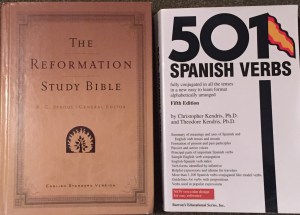 Just as I benefitted greatly from learning Spanish in a Spanish-speaking country, Christians thrive best when we’re part of God’s visible church. Scripture is clear that each of us has an important, God-ordained place in His body (1Corinthians 12:12-30) and that we should not neglect meeting together. (Hebrews 10:24-25) Furthermore, God’s family is composed of members of varying ages, abilities and spiritual maturities, just like biological families. We are called to do life together in compassionate covenant communities, where we rejoice with those who rejoice, mourn with those who mourn and come alongside each other to teach, support and encourage according to the gifts we’ve been given. (Romans 12:3-21)
In addition, we have a responsibility to tell the younger generations of the mighty deeds of the Lord and to instruct them in His ways. (Deuteronomy 6:4-7; Psalm 145:10-13) Likewise, the Apostle Paul’s directions to Titus are clear regarding the role older women are to play in tutoring the younger women, teaching them the finer points of Biblical womanhood through both word and action. (Titus 2:3-5)
I don’t remember how long it took, but one day, to my amazement, I realized I could speak and respond in Spanish without a conscious translation step. The second language had become second-nature.
And so it is with our spiritual transformation. Because of Jesus’ atoning sacrifice on our behalf, we’re no longer slaves to sin. Instead, we’ve become slaves to righteousness. (Romans 6) Through the Spirit’s power at work within us, we’re able to discern what is right and true, something we could never do when we were dead in our trespasses. Furthermore, as our sanctification progresses, Christ’s light shines ever-brighter in us and we produce spiritual fruit. (Matthew 5:14-15; Galatians 5:22-23) More and more, our renewed nature becomes second-nature as we seek to please God and abide in Him. (John 15:5)
Nonetheless, aspects of our old selves will persist until God calls us Home, as Paul so eloquently describes in his letter to the Romans. (Romans 7:15-20) And so we press on to become fluent in God’s ways, by studying His Word, praying and joining with fellow believers to worship Him and stir one another to love and good works.
Even now, over four decades later and without daily use, I’m apt to spontaneously sprinkle Spanish sentences into conversations with my grandchildren. They’ve become used to these linguistic detours and know an immediate translation-repetition-translation mini-lesson is sure to follow. Yes, I can speak Spanish, though far from flawlessly – I still can’t roll my Rs and I mix up verb tenses – but I enjoy the language and sharing it with my grandchildren.
How much more I savor sharing our Savior with them. I’m far from perfect when it comes to fluency in my Christian walk as well. But I pray I’ll always be faithful to spontaneously sprinkle His ways and words into our conversations as I point them to the only perfect One who loves them even more than I do and encourage them to take their places in His family. May His nature become increasingly second-nature for us all.
“Hear, O Israel: The Lord our God, the Lord is one. You shall love the Lord your God with all your heart and with all your soul and with all your might. And these words that I command you today shall be on your heart. You shall teach them diligently to your children, and shall talk of them when you sit in your house, and when you walk by the way, and when you lie down, and when you rise.” (Deuteronomy 6:4-7)
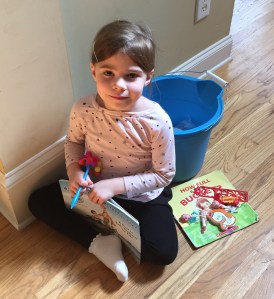 Joshua read the books to us after lunch. They were all about how we fill or empty each other’s imaginary buckets by being kind or being mean. Furthermore, the books pointed out we’re doing one or the other all the time. The narrative went on to say that by filling up others’ buckets, we’re filling up our own as well since being helpful, obedient and thoughtful makes situations better for everyone involved. Bucket-fillers, buoyed by the results of their good deeds, are much happier than bucket-dumpers, whose actions contribute to continued strife.
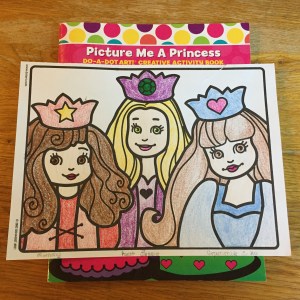 I enjoy coloring with my young granddaughters. A recent art session found me recreating myself and my daughters on the page. When I saw the title of the book the page was pulled from, I smiled. “Picture me a Princess”. Why, yes, I will! Because God calls me His child, I am a princess, a daughter of the King!
 I was barely halfway down the stairs, looking forward to a day at home to do a few chores, maybe some writing and a little weeding, when I saw it. Instead of facing outward toward the sun like its fellow flowers, one beautiful blossom on the althea on my front porch was peeking in the left sidelight. A joyful, irrepressible exclamation escaped my lips, “Good morning, Lord! Thank You!!” I knew, without a doubt, Who was responsible for the perfectly-placed greeting.
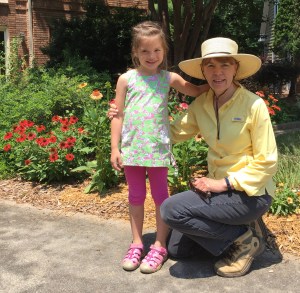 I was working in my garden one recent afternoon, when my youngest neighbor, sweet-spirited Sadie, paid me a visit. We were chatting about flowers and butterflies and bumblebees when she suddenly asked, “Do you have a husband?” I replied, “I used to, but he’s already in heaven. He planted a lot of my trees. That’s why I love them so much.” As I watched, belatedly realizing I’d given a much-too-detailed reply to her simple question, her countenance was overshadowed by a pensive consternation. Nonetheless, before I had a chance to offer up something more appropriate, Sadie’s expression brightened once again as she assured me, “But you’re not alone! You have lots of people around you!” I immediately followed up with, “You’re right! I have such good neighbors.”
 Of all the fruits and gifts of the Spirit, love reigns supreme.
 Mom says she could always tell when I saw her in the audience at one or another of my elementary school concerts. A smile would spread across my face and I would relax, knowing my biggest fan was there. And so it was with my daughters and now my grandchildren. Indeed, wise directors of lower-school productions allow a few minutes before commencing for their performers to connect with those who’ve come to watch. Exchanging waves and grins makes for a cheerful beginning all around.
 Back 2 the Garden