 I suppose I should begin with a confession: I’m an equal-opportunity crier. My eyes are just as likely to well up in moments of joy as in sorrow – while reading sweet sentiments in Hallmark cards, watching heartbreaking news stories, attending weddings or funerals, even when leading Bible study as the magnitude of God’s grace and mercy floods over me. Yes, from a barely-there trickle to gut-wrenching sobs, I’ve shed my share of tears and expect to shed plenty more.
A quick search on Google reveals three different types of tears. Basal tears keep our eyes lubricated, while reflex tears pop up in response to irritants like slicing onions or having a pesky gnat flit into your eye. And then there are psychic tears, those associated with our emotions, distinct from the other two in that they contain stress hormones.[1] No wonder we often feel better after shedding them. They’re like an overflow valve for the soul.
Even so, our attempts to comfort others are often accompanied by, “Don’t cry!”
The Bible has much to say about tears and the circumstances surrounding them. Consider for example:
- Loss of a loved one by separation or death
- David grieved the loss of his closer-than-a-brother friend, Jonathan, first from necessary distancing and then by death (1 Samuel 20:41; 2 Samuel 1:12).
- Mary and Martha bemoaned Lazarus’ death. Seeing their bereavement, Jesus wept too, even though He knew his Father would hear his prayer to raise him. Jesus had compassion on the sisters in their time of loss and He has compassion on us as well (John 11:31-35).
- Jesus’ followers were bereft and befuddled after His death in spite of the many times He’d told them what was to come (Luke 18:31-34; 36:13-49).
- Disappointments of various sorts
- Esau wept over the loss of his birthright, when he realized how his brother had tricked their father (Genesis 27:30-38).
- Hannah’s unfulfilled desire for a child, exacerbated by her rival’s provocation and her husband’s lack of understanding, led to her fervent, tear-stained prayer for relief (1 Samuel 1:1-10)
- Sorrow for sin
- Three of the four Gospels recount Peter’s tear-punctuated dismay when Jesus’ statement that he’d betray Him came to pass (Matthew 26:75; Mark 14:72; Luke 22:62).
- James says we should be wretched and mourn and weep over our transgressions, humbly drawing near to God for forgiveness and restoration (James 4:8-10).
- Worship and Gratitude
- The penitent woman who wet Jesus’ feet with her tears, wiped them with her hair, and anointed them with ointment was motivated by her love for her Savior.
- Joyous reunion
- Though bitterness marked their estrangement and Jacob feared the worst from Esau, the brothers’ reunion was accompanied by joyful tears (Genesis 33:4).
- I’m taking some liberty here because none of the translations I consulted mention crying, but I’ve got to believe the prodigal son’s compassionate father had tears of elation streaming down his face as he ran to greet his returning son (Luke 15:20).
Even though these passages and others make it clear psychic tears are part of our God-given emotions, we’re quick to admonish, “Don’t cry!” Could it be others’ tears make us uncomfortable or tearful ourselves? Or worse, might we believe God’s children aren’t supposed to cry because we know the end of the story?
Mournful tears have dotted my days this past month. They sneak up on me as the reality of the COVID-19 pandemic breaks through my carefully-constructed mantle of Truth. Woven together from precious promises and reliable assurances found in Scripture it protects me from despair and hopelessness.[2] Nonetheless, people are hurting on a worldwide scale for myriad reasons. Closer to home, I miss seeing my children and grandchildren, worshiping in person with my covenant family. And so tears flow as I grieve the loss and brokenness.
The women who witnessed Jesus’ crucifixion no doubt wailed at the sight of their beloved son, teacher, friend, bloodied and beaten, being nailed to a Roman cross. The innocent One, put to death for the sins of others. Isaiah 53 is one of my most cherished passages, but also one which I can rarely get through without tears. Man of sorrows, acquainted with grief. Despised. Rejected. Wounded for our transgressions, crushed for our iniquities. My transgressions. My iniquities.
We are so blessed to live on this side of the Resurrection. No matter how dark the days or how great the losses, we know Jesus’ atoning sacrifice ensures our own resurrection and eternal security. Furthermore, as we go through difficulties in this life, we know He is seated at the right hand of God, interceding for us. Nothing can separate us from His love (Romans 8:31-39).
The One who keeps track of every tear (Psalm 56:8) has promised to return, to usher in a new heaven and a new earth, to wipe every tear from our eyes (Revelation 21:1-4). Until then, may we rejoice with those who rejoice and weep with those who weep, unafraid of our tears.
O Lord, how I thank You that You hear our cries for help. Though weeping may last through the night, joy comes with the morning (Psalm 30). You have shown your great mercy in sending Jesus to die for our sins and will turn our mourning into gladness. For we know this momentary affliction is preparing an eternal weight of glory beyond all comparison (2 Corinthians 4:17). May we sing your praise forever!
[1] “What are the three different types of tears found in our eyes?”, http://www.sharecare.com
[2] Please see previous posts, “It is Well” and “Pollen Season”.
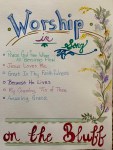 Last week, when I wrote “It is Well”, I figured everything that was going to suspend operations and activities had done so. Wrong! Notices of closings and cancellations continued to mount up, though at a slower pace. I found myself turning repeatedly to the passages I included in that post, truth to combat fear and quell anxious thoughts.
 I’ve also been outside more, strolling through my neighborhood, working in my garden. I’ve seen sidewalks chalked with cheerful messages. Encouraging posts fill my Facebook feed. And earlier today I joined my neighbors for a hymn sing as we gathered, socially-distanced, outside our piano-playing neighbor’s home. God is working difficult circumstances for good. He always does. (Romans 8:28)
 In the midst of the uncertainty surrounding COVID-19, spring is here, full of hope and visible reminders of God’s goodness. I’ll let photos, scripture passages, and hymn lyrics do the talking for the rest of this post – my offering of praise to the One who lovingly sustains us, my contribution to the thread of encouragement weaving its way through social media.
 “Fairest Lord Jesus, Ruler of all nature, O Thou of God and man the Son; Thee will I cherish, Thee will I honor, Thou my soul’s glory, joy, and crown. Fair are the meadows, Fairer still the woodlands, Robed in the blooming garb of spring: Jesus is fairer, Jesus is purer, Who makes the woeful heart to sing.”
 Consider the lilies of the field, how they grow: they neither toil nor spin, yet I tell you, even Solomon in all his glory was not arrayed like one of these. (Matthew 6:28a-29)
 Why are you cast down, O my soul, and why are you in turmoil within me? Hope in God; for I shall again praise him, my salvation and my God. (Psalm 42:11)
 “O Lord my God, when I in awesome wonder Consider all the words They hands have made, I see the stars, I hear the rolling thunder, Thy pow’r throughout the universe displayed. When thro’ the woods and forest glades I wander And hear the birds sing sweetly in the trees, When I look down from lofty mountain grandeur, And hear the brook and feel the gentle breeze. Then sings my soul, my Saviour God, to Thee; How great Thou art, how great Thou art! Then sings my soul, my Savior God, to Thee: How great Thou art, how great Thou art!”
 I will praise the name of God with a song; I will magnify him with thanksgiving . . . Let heaven and earth praise him, the seas and everything that moves in them. (Psalm 69:30, 34)
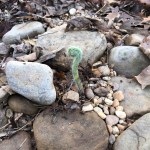 “This is my Father’s world, And to my listening ears All nature sings, and round me rings The music of the spheres. This is my Father’s world: I rest me in the thought Of rocks and trees, of skies and seas – His hands the wonders wrought. This is my Father’s world, The birds their carols raise, The morning light, the lily white, Declare their Maker’s praise. This is my Father’s world: He shines in all that’s fair; In the rustling grass I hear Him pass, He speaks to me everywhere.”
 For you, O Lord, have made me glad by your work; at the works of your hands I sing for joy. (Psalm 92:4)


 Similar thoughts accompanied me as I strolled my woods exclaiming over the latest plant finds. Jesus’ declaration that we need not worry because the God who cares for the birds and the lilies will watch over His beloved children, who are much more precious, is among my most cherished (Matthew 6:25-34). It’s also one of the reasons I find so much solace in my garden since I see the truth of His statement played out repeatedly.
 You may argue that the birds and flowers aren’t capable of worrying since they don’t know what we know or reason as we reason. But God says the same about us. Even though we’re created in His image, His ways and His thoughts are higher than ours, beyond our finite minds (Isaiah 55:8-9). He is Sovereign. We aren’t. And it often takes events that are obviously out of our control to remind us, even though every breath we take is a gift from God.
 The small specimens he planted now tower high above the back corner of my house. Each fall their needles create a brilliant color display before they let go, drift to the ground, and blanket the bed beneath their intertwined branches. I’ve thought so often about Ray’s comments and how special the trees are.
 I dug several of the seedlings and potted them in individual containers. In the seasons since, I watered, watched, and worried them along, hoping at least three of them – one for each grandchild – would make it. And make it they did. Last week, we moved them to Mary and son-in-law Justin’s house. With the help of a friend, the children planted the offspring of their grandfather’s favorite conifers.
 I took several deep breaths to settle my nerves. There in my safe cocoon, surrounded by clothes and innumerable prayers, I proceeded to have a pleasant chat with Karen. Within 24 hours I received the all-clear – the recording was usable. When I listened to it a few days later, I sounded more conversational, less stressed than the first time. Though some of the details varied, the message was the same: God is faithful. We can trust Him, even in our most difficult circumstances when we don’t understand. He’ll never leave us or forsake us. My story to steward, my testimony to bear.
 Those hours allow for some sweet, uninterrupted chats with Miss Emma, something that ranges from difficult to impossible when all of us are there. Never fear, we’re working on the basic building block of conversation etiquette – having one person talk while everyone else listens. However, more often than not, the listeners grow impatient for their turn and before I know it I’m trying to keep track of multiple storylines. I’m only able to catch a word or two from their various tales, resulting in frustration for all of us, frequently accompanied by shouts of “Hey, I wanted to tell Grammie!”
 Even though over three decades have passed, I clearly remember a customer meeting where we were requesting input on a developmental fiber. I touted its attributes and started a single sample on its journey around the conference room table. It never made it beyond the owner of the company. Like a child with a pet bunny, he stroked the sample repeatedly, exclaiming over its softness. I passed out other samples featuring styling suggestions for existing fibers. He’d finger them, comment, then pass them along, all the while retaining possession of his far-superior prize.
 Surely one of the earliest and most endearing games we play with babies involves disappearing behind our hands only to reappear moments later, smiling and exclaiming, “peek-a-boo!” We repeat the sequence of movements multiple times, rewarded with baby’s surprised chuckles.
 Before long, infants turn into mobile toddlers, able to participate in the hiding aspect of the game. In fact, hide-and-seek becomes an oft-requested favorite, complete with random-number counting and much laughter while scurrying to find the perfect hiding spot. Shrieks are just as likely to accompany finding as being found.
 Sometimes the hiding isn’t all that effective. For instance, even though most of the tiny body is covered up, a foot may remain visible. Or, try as I might, I can’t fully wedge myself between the wall and the recliner when the little people are hunting me.
 Uh oh! As they prepared to clean the deck, they found a lovingly-crafted nest containing four tiny blue eggs. Under normal circumstances, the location selected by the mama bird – perched on a ladder stored horizontally under the deck – would have been ideal – out of sight of predators and protected from the elements. But these were not normal circumstances. Knowing the commotion of scouring and staining the deck would most likely scare the mother away and that the high-powered stream of water might damage the tiny home, the painters carefully moved the ladder out of their work zone.
 Fluffy white masses towering in a blue summer sky. Busy bees with full pollen baskets. Birds singing their praises to the One who assures us if He cares for the lilies and sparrows, He’ll certainly care for His children.
  (Matthew 6:25-34) Your list will look different, my friend, but make that list. Look. For glimpses of what the new earth will be like. Listen. For whispers of love from our Father who attends to every detail of our lives. Taste and see that the Lord is good, His love endures forever! (Psalm 34; 1 Chronicles 16:34; Psalm 106:1)
 Back 2 the Garden