For we know that the whole creation has been groaning together in the pains of childbirth until now. And not only the creation, but we ourselves, who have the firstfruits of the Spirit, groan inwardly as we wait eagerly for adoption as sons, the redemption of our bodies (Romans 8:22-23).
Gulf fritillary butterflies depend on passionflower for survival. The vigorous vine, native to the southeastern United States, is the only food source for their caterpillars. As part of my efforts to create a pollinator oasis in my suburban neighborhood, I planted a passionflower vine by my mailbox. It took a couple of years to become established, but by the third year, it was flourishing – plenty of foliage for the caterpillars to devour and lots of lovely flowers for me to enjoy.
Except I couldn’t find any caterpillars.
I examined the vine every morning when I went out to collect the newspaper and every evening when I checked for mail. No caterpillars. Then one day, I saw a tiny caterpillar in the clutches of a wasp. What did I do? I turned to Google, of course! “Do wasps eat caterpillars?” Unfortunately, they do.
I kept up my twice-daily vigil, hoping there would eventually be enough caterpillars to satisfy the wasps and still leave some to make it through their life cycle. Days passed with only an occasional sighting. Then I realized there was an army of ants busily traversing the sprawling vines. Back to Google. “Do ants eat caterpillars?” Yes, they do. By this time, my anticipation at getting to watch wave after wave of caterpillars reach maturity on my vine had given way to despair since I doubted it would be possible to get rid of the ants without negatively impacting the caterpillars.
Grandson Joshua, five-years-old at the time, encouraged me to find the ant mound and deal with the pesky marauders at their source. I was somewhat surprised he didn’t say, “That’s the way the world works, Grammie,” as he often does when I mourn the fact some predator has taken down its prey. Being an avid fan of “Wild Kratts,” Joshua is incredibly knowledgeable about a multitude of creatures. He takes the food chain in stride, knowing some animals get eaten by other animals as God provides for all of his creation.
Yet the world isn’t working the way God originally intended, particularly when it comes to death. Some time ago, I was reading the first chapter of Genesis, a passage I’ve read countless times, when I noticed something. Take a look at verses 29 and 30: Then God said, “I give you every seed-bearing plant on the face of the whole earth and every tree that has fruit with seed in it. They will be yours for food. And to all the beasts of the earth and all the birds in the sky and all the creatures that move along the ground—everything that has the breath of life in it—I give every green plant for food.” (Emphasis added.) Do you see it too? In the beginning, when God created everything and it was all good, there was no death, not even animals eating each other.
Death entered in only after the fall, the penalty for disobedience (Genesis 2:16-17). I wonder what Adam and Eve thought when they saw the blood of the innocent animal God killed to provide garments of skin to cover their nakedness. What horror they must have felt when Cain killed Abel. The shedding of blood became commonplace. Sadly, that’s the way the world works now.
But the spotless Lamb of God came to save and restore by shedding His own precious blood. Without the shedding of blood there is no forgiveness. With it, we have the assurance that someday all things will be set right again. The world will work once more as its Creator initially intended. Speaking of Jesus’ return, the prophet Isaiah said,
Righteousness will be his belt and faithfulness
the sash around his waist.
The wolf will live with the lamb,
the leopard will lie down with the goat,
the calf and the lion and the yearling together;
and a little child will lead them.
The cow will feed with the bear,
their young will lie down together,
and the lion will eat straw like the ox.
The infant will play near the cobra’s den,
and the young child will put its hand into the viper’s nest.
They will neither harm nor destroy on all my holy mountain,
for the earth will be filled with the knowledge of the Lord
as the waters cover the sea”(Isaiah 11:5-9) (Emphasis added.)
Jesus’ promised return is certain. We can wait confidently and expectantly for the day when death is swallowed up in victory. And while we wait, God graciously sustains his creation.
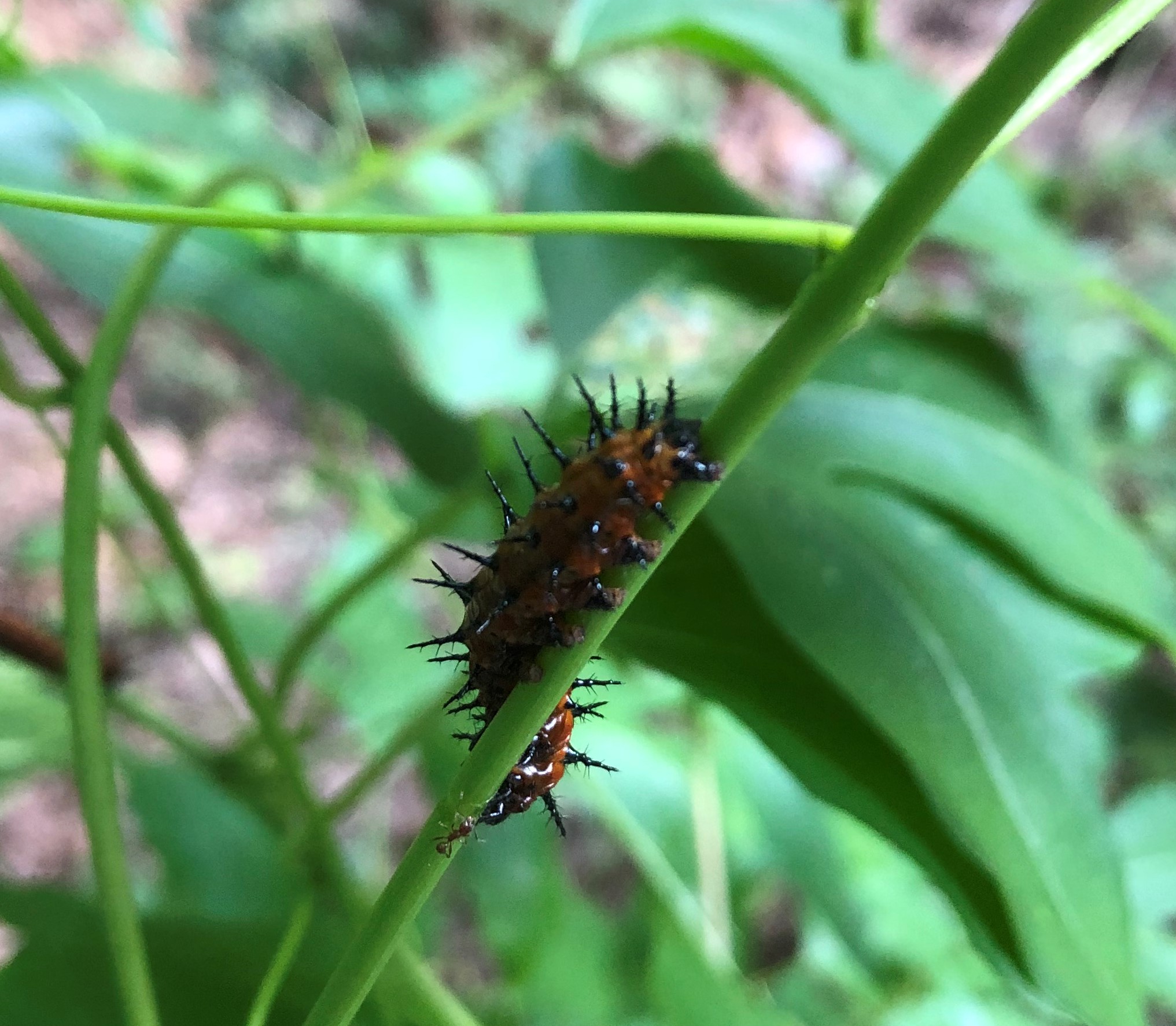 My daily caterpillar search eventually yielded the results I’d been hoping for – a dozen or so voracious nibblers of various sizes. More followed as several generations consumed the vine. I suppose it’s a small thing in the overall scheme of life. But I see it as a gift from the One who knows how much I delight in hosting the Gulf fritillaries and their offspring each year.
O Lord, how I look forward to the day of Jesus’ return when the world will finally work as You’ve intended from the beginning. No more tears, no more death, no more harm on all Your holy mountain.
 Last year, my daughter, Mary, helped start an American Heritage Girls troop at her church and serves as one of the leaders. Each week, Mary and my granddaughters, Lyla and Emma, look forward to meeting with their friends. They engage in a variety of activities as they work toward the organization’s goal of developing Christ-like character and leadership skills.
 After a long period of separation related to coronavirus restrictions, the troop began meeting again last month. Though always vital, the skills they’re learning to earn their Emergency Preparedness badge seem especially appropriate during this time of uncertainty. They’ve talked about stranger danger, paid a virtual visit to a local fire station, and got an up-close look at an ambulance, all while discussing how to help themselves and others during emergency situations.
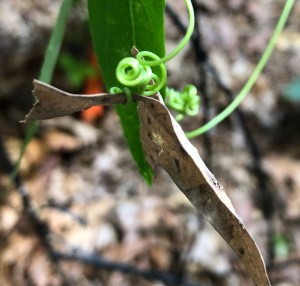 During a recent reconnaissance walk through my woods, I discovered a patch of passionflower vine. Though it chose to pop up on its own, I was delighted to see it since it’s the food source for caterpillars of Gulf Fritillary butterflies. The petite vine was already sprouting tendrils and reaching out for support. I smiled and shook my head when I found one tiny green appendage wrapped around a leaf lying on the ground. Even though the tendril had a stranglehold on the leaf, the latter could never help the passionflower rise above the ground.
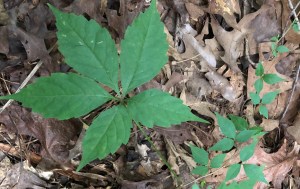 Virginia creeper, a native vine with 5-leaved adult foliage, is sometimes mistaken for poison ivy, because its juvenile foliage frequently has three leaves, like the pesky purveyor of itch-producing oil. Its ability to scale walls and tree trunks thanks to holdfasts that act like sticky toes, reminds me of the tiny lizards I see scampering up the bricks on the front of my house. Though both plant and critter are capable of ascending considerable heights, they’re easy to dislodge.
 Multiple members of my generation love tending plants, as do a number of our children and grandchildren. Recognizing our shared passion, I smile when cousins post pictures of their gardens, sometimes with young offspring sampling produce fresh from the vine.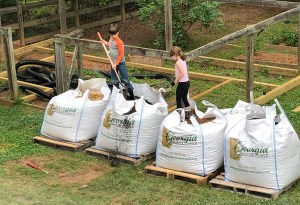
 I launched Back 2 the Garden six years ago today with “Consider It Pure Joy”. (July 2014 Archives) My venture into the world of blogging was fueled by a desire to use my God-given writing ability to tell whoever would read my words of His great love and faithfulness. I wanted to encourage others with the promises and assurances God has brought to my mind as I’ve dealt with challenges stemming from widowhood, job loss, family illnesses, the deaths of beloved friends and family members, and world events.
 When my grandchildren were born, I continued the tradition their grandfather and I began with their mother, soothing them to sleep with Amazing Grace, planting seeds of faith from their earliest days. Six-year-old granddaughter Lyla is prone to humming as she works on a craft project or tackles one of her small household chores. I believe it’s an overflow of her happy heart. Occasionally she’ll sigh, “I’ve got this song stuck in my head!”
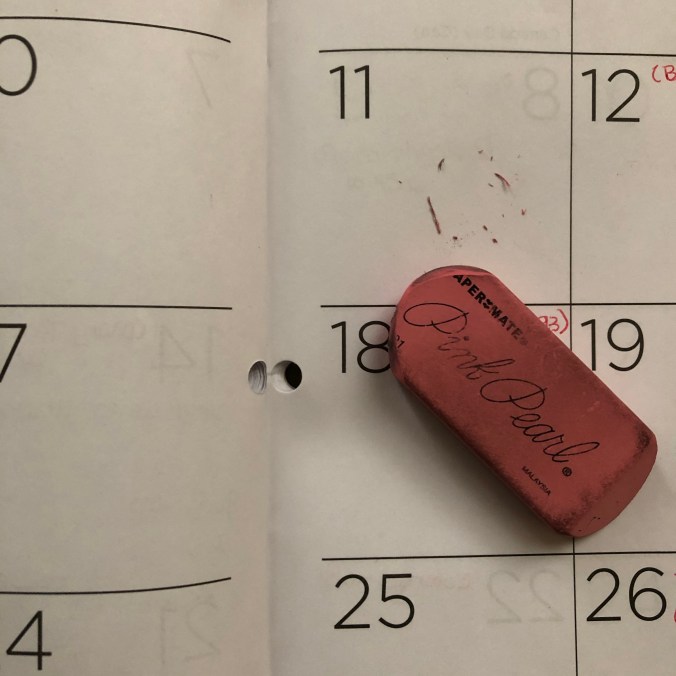 I never would have imagined all the times I’d reach for my trusty Pink Pearl eraser the past several weeks. One by one, activities came off my calendar – appointments of various kinds, lunch with friends, 5k races, garden tours, even Grammie days
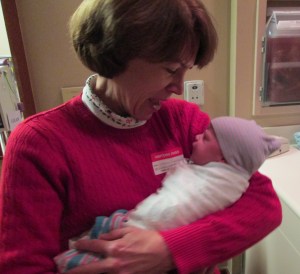 I suppose I should begin with a confession: I’m an equal-opportunity crier. My eyes are just as likely to well up in moments of joy as in sorrow – while reading sweet sentiments in Hallmark cards, watching heartbreaking news stories, attending weddings or funerals, even when leading Bible study as the magnitude of God’s grace and mercy floods over me. Yes, from a barely-there trickle to gut-wrenching sobs, I’ve shed my share of tears and expect to shed plenty more.
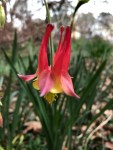 Similar thoughts accompanied me as I strolled my woods exclaiming over the latest plant finds. Jesus’ declaration that we need not worry because the God who cares for the birds and the lilies will watch over His beloved children, who are much more precious, is among my most cherished (Matthew 6:25-34). It’s also one of the reasons I find so much solace in my garden since I see the truth of His statement played out repeatedly.
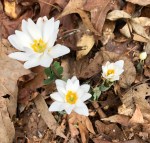 You may argue that the birds and flowers aren’t capable of worrying since they don’t know what we know or reason as we reason. But God says the same about us. Even though we’re created in His image, His ways and His thoughts are higher than ours, beyond our finite minds (Isaiah 55:8-9). He is Sovereign. We aren’t. And it often takes events that are obviously out of our control to remind us, even though every breath we take is a gift from God.
 My late husband, Ray, long-suffering when it came to my foibles, drew the line at fast food orders. In the days before “have it your way” became a slogan, I’d request a cheeseburger, lettuce, tomato, no mayo, no onions. Minutes drug past while they made my special order.
 Back 2 the Garden