Her children rise up and call her blessed.
Proverbs 31:28a
Ok, you probably think I’ve gotten my holidays mixed up. No, I know it’s not Mother’s Day. But it is the season of Thanksgiving and today is my dear mom’s 87th birthday. Thus, I want to thank God for the blessing of a godly mother as well as celebrate this very special woman by documenting some of the nuggets of wisdom she’s shared with me for as long as I can remember.
People will let you down, but God never will. Mom and I have been through numerous trials together in the nearly-60 years since she gave birth to me. Lies, disappointments, job loss, broken relationships, deaths. Through it all, Mom has taught me to depend on the One who says He’ll never leave or forsake us (Deuteronomy 31:6); who faithfully keeps His promises (Hebrews 10:23) and speaks only truth. (Hebrews 6:18) We will have troubles in this world, but Jesus has overcome the world. We can find peace in Him. (John 16:33)
When faced with a list of tasks, do whatever’s bothering you the most first and get it behind you. When I feel overwhelmed, which is more often than I like to admit, Mom encourages me with this time-tested advice bestowed upon her by one of her grade-school teachers. Though it may not have been inspired by scripture originally, there’s certainly a Biblical tie-in. Usually when my to-do list becomes over-loaded, it’s filled with chores associated with temporal concerns. Cooking, cleaning, weeding, mulching, paying bills and the like are necessary. But Jesus makes it clear we’re to seek eternal things first, trusting Him to provide all we need (Matthew 6:25-33) and spending time at His feet to learn of Him. (Luke 10:38-42)
We can’t change anyone else, much as we’d like to sometimes. We can only give an account of ourselves. My reply when Mom tells me this? “You’re right. I have a hard enough time keeping myself in line!” Once again, there’s Biblical truth in Mom’s statement. As part of His magnificent Sermon on the Mount, Jesus warned against judging others, especially since we have sin in our own lives to deal with. (Matthew 7:1-5) Praise God for giving us His Spirit, which is at work in us to bring about the transformation we’re incapable of accomplishing on our own. (2 Corinthians 3:17-18) Furthermore, we’re called to pray for others, but only He can soften hardened hearts. (Ezekiel 36:25-27)
We can’t give up. We’ve got to hold on to our faith and keep going. Throughout her life, Mom’s faced challenges that may have led some to quit or become bitter. In the last decade alone, she:
- shattered the bones in her right shoulder, an injury that required surgery to install a plate and multiple screws and left her with limited range of motion in that arm.
- suffered a heart attack that led to the discovery of three severely-blocked arteries resulting in emergency open-heart surgery.
- fractured a vertebra in her back and had a procedure known as kyphoplasty to repair it.
Mom endures daily pain due to the ravages of arthritis that have led to enlarged joints in her fingers and cartilage deterioration in her now-bone-on-bone right knee. Yet she rarely mentions her constant aches. Instead, she clings to God’s mercies which are new every morning (Lamentations 3:22-24) and encourages those in her inner circle to do the same. Though she’s never declared a favorite verse, I expect Philippians 4:13, “I can do all things through Christ who strengthens me”, would be a front-runner.
That’s a Gulf song. Granted, this statement isn’t advice, but I include it because it alludes to my heritage of faith. Mom grew up in the tiny town of Gulf, NC, where she attended a small Presbyterian church established in the 1800’s. When the strains of a familiar hymn from her childhood begin to play at our current church, Mom’s face brightens and one of us will usually lean toward the other and whisper, “That’s a Gulf song.” I don’t know how many generations my heritage of faith encompasses, but I know there are at least two behind me and two in front. I pray that legacy of faith will be passed continually from generation to generation until Christ returns. (Deuteronomy 6:4-9)
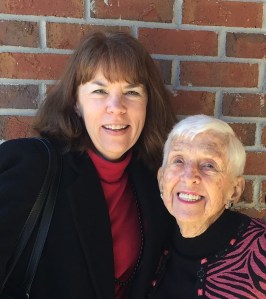 Though petite in stature, Mom’s my biggest cheerleader and most dependable defender. We all need someone who’s unconditionally, unreservedly in our corner. I’m so thankful Mom’s in mine. She’s my rock because she consistently points me to the Rock and reminds me His everlasting arms are securely holding all who belong to Him in an eternal embrace. (Deuteronomy 33:26-27a) O LORD, please help me to do the same for my precious children and grandchildren. Thank You for the priceless blessing of a godly mother!
Give ear, O my people, to my teaching; incline your ears to the words of my mouth! I will open my mouth in a parable; I will utter dark sayings from of old, things that we have heard and known, that our fathers have told us. We will not hide them from their children, but tell to the coming generation the glorious deeds of the Lord, and his might, and the wonders that he has done. (Psalm 78:1-4)
Make a joyful noise to the Lord, all the earth! Serve the Lord with gladness! Come into his presence with singing! Know that the Lord, he is God! It is he who made us, and we are his; we are his people, and the sheep of his pasture. Enter his gates with thanksgiving and his courts with praise! Give thanks to him; bless his name! For the Lord is good; his steadfast love endures forever, and his faithfulness to all generations. (Psalm 100)
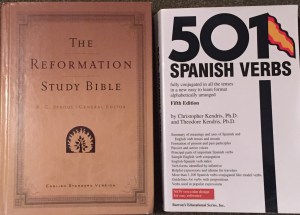 Just as I benefitted greatly from learning Spanish in a Spanish-speaking country, Christians thrive best when we’re part of God’s visible church. Scripture is clear that each of us has an important, God-ordained place in His body (1Corinthians 12:12-30) and that we should not neglect meeting together. (Hebrews 10:24-25) Furthermore, God’s family is composed of members of varying ages, abilities and spiritual maturities, just like biological families. We are called to do life together in compassionate covenant communities, where we rejoice with those who rejoice, mourn with those who mourn and come alongside each other to teach, support and encourage according to the gifts we’ve been given. (Romans 12:3-21)
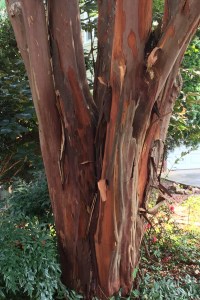 As summer wanes, cracks begin to appear in the bark along the mighty trunk, signaling the coming changes. Soon, the cracks turn into fissures as the old skin lifts away from the tree, before finally letting go completely, falling to the ground in long, jagged shards. To the uninitiated observer, this series of events may be unsettling. How could such a shedding of bark possibly be good for the plant? Yet that very act allows the trunk to increase its girth and grow stronger. Best of all, it reveals the most magnificent cinnamon-colored covering. Ray saw the potential in the sapling he planted so long ago. He knew what it could become.
 Yet the most sobering examples are times when I haven’t asked God. Years ago, I realized I was praying to God about BIG things, but I didn’t want to bother Him with matters I thought were too trivial. After all, He’s a BIG God, Sovereign over everything. He spoke the world into existence (Genesis 1:1-25), makes the sun rise and set (Jeremiah 31:35), and sustains all of creation. (Matthew 6:25-34)
 2 Samuel 11 recounts the whole sordid scenario. David’s first mistake? He didn’t lead his troops into battle against the Ammonites. (v. 1) He chose to stay home instead, which meant he was available to take an afternoon stroll on his rooftop. As he gazed about, he spied a beautiful woman, mid-bath. Instead of respectfully averting his eyes, he inquired as to who she was. Even when informed that she was a married woman, he had her brought to the palace so he could lay with her. (vs. 2-4) When this dalliance led to Bathsheba becoming pregnant, King David concocted a scheme to bring her husband back from the front lines so he could spend time with his wife. But Uriah was an honorable man and refused the conjugal visit while his fellow soldiers and the ark remained camped in an open field. Instead, he slept at the door of the king’s house. The next day, David encouraged him to go to Bathsheba, even making him drunk. Still Uriah refused. (vs. 5-13)
 Back 2 the Garden