Joyful, joyful we adore Thee

“All Thy works with joy surround Thee, Earth and heaven reflect Thy rays,
Stars and angels sing around Thee, Center of unbroken praise.
Field and forest, vale and mountain, Flowery meadow, flashing sea,
Chanting bird and flowing fountain, Call us to rejoice in Thee.”
(Henry van Dyke)

My heart is content. Having spent part of this beautiful afternoon outside under a crystal blue sky, warmed by the sun and caressed by a gentle breeze, I am rejoicing in the One who created it all. Although I raked a small mountain of leaves into the woods (you’d think I hadn’t raked at all last fall!), my top priority was strolling the grounds to see what I could find. I wasn’t disappointed, as my scouting efforts yielded all sorts of tiny treasures – trillium beginning to unfurl their leaves; May-apples, looking like miniature umbrellas, tightly closed, as they poke their way through the soil; a solitary flower on the Hepatica, with the promise of more to come; Tipularia leaves, their deep purple undersides a key identifier; Lenten roses sprinkled happily about the garden, their seeds having freely dispersed over the years.

Not only do the plants bring me joy in and of themselves, but many of them are linked to special people, gifts from their gardens. Now growing in mine, they remind me of the friends who graciously shared them with me and delightful times we’ve spent together immersed in various horticultural pursuits.

So much to savor on this spring-is-almost-here Sunday!  So much love poured out on me in the form of flowers and friends, by a Father willing and able to do far more than I can ask or imagine! And so, with the Psalmists and hymn writers, I proclaim, “How great Thou art!”

Feed the birds, take 2

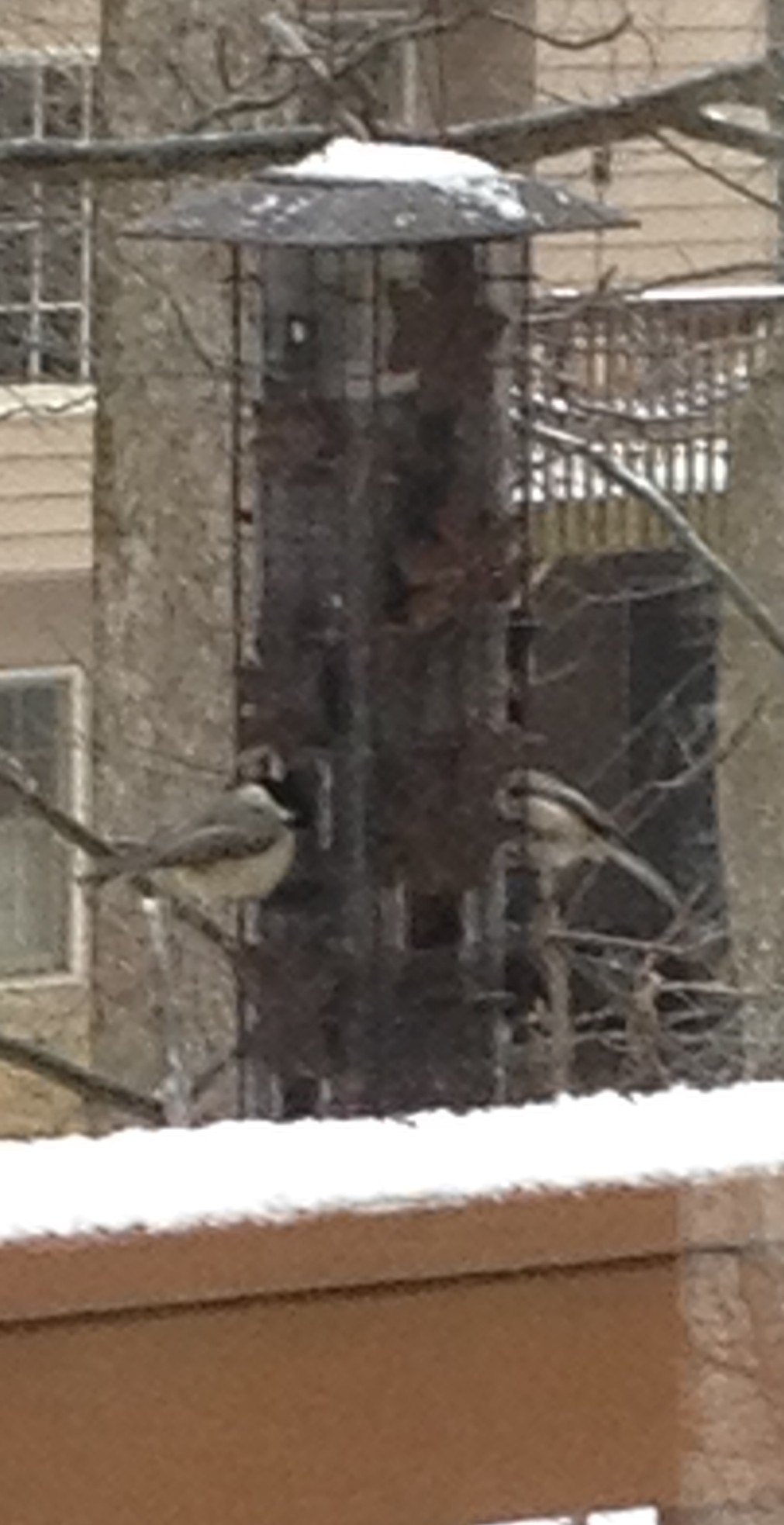
My alarm clock didn’t go off this morning. Consequently I made it downstairs later than usual and later than I’d planned. A quick glance at the bird feeder revealed an almost-empty receptacle, with only an inch or so of millet languishing in the bottom of the cylinder. A few hopeful birds hopped along the deck railing and then, upon finding no sunflower seed, flew forlornly back to the branches of the snow-covered trees. Yes, we had a light snow last night, just enough to decorate everything and make for a lovely sight this morning. But it was also enough to make the birds even more in need of those precious seeds than usual so I pulled a coat on over my robe and pjs and refilled the feeder  before making my own breakfast.

I was immediately rewarded by the appearance of several dozen birds – on the feeder, on the deck and dotted throughout the trees closest to the house, awaiting their turn to retrieve one of the highly-coveted seeds. Chickadees, titmice, juncos, cardinals (including a male, his red feathers appearing especially bright against the white snow), plus several kinds of sparrows and finches flitted merrily about – all rejoicing over the replenished food supply.Although I enjoy seeing all the different kinds of birds that frequent my feeder, I think the chickadees are my favorites.

Within a few days of first placing the feeder on a plant hook by my deck, I became aware of how quickly the birds accustomed themselves to dining on the seeds it holds, depending on me to fill and refill it. And, as their reliance on me has grown, I feel a corresponding responsibility to make sure they’re well fed. I delight in the relationship that’s developed between me and these small creatures. In caring for them, I know I’m helping keep an eye on some of God’s sparrows. I can’t help but think He takes joy in watching me partake of all He provides just as I relish watching the birds feast on the sunflower seed. Unlike me, though, God is never late in providing what I need; neither will His storehouses ever be empty. Not only do the cattle on a thousand hills (along with everything else) belong to Him, but as my loving heavenly Father, I can trust Him for all my needs. As the birds rejoiced over the restocked feeder this morning, may I ever exalt and give thanks to the One who tenderly sustains me.

Feed the birds

It had been a long time since I last owned a bird feeder.  For the past three years, my grandson and I have enjoyed watching the birds (and an occasional squirrel, including “Stumpy”, the tail-less one) visit the feeder at my daughter’s house. I’ve also delighted in helping a friend fill his many bird feeders, anticipating the flurry of activity that’s sure to follow. So, I decided I wanted one. My dad granted my wish and gave me a feeder for Christmas.

Not really knowing what to buy in terms of food, I selected a bag of Southern Regional Blend. The tag line on the bag said “Blended to attract Southern Songbirds” while another statement promised “25% sunflower plus safflower” seeds. A closer look at the ingredients list revealed millet to be the predominant ingredient, while a chart on the back indicated this particular blend would be eaten, and presumably enjoyed, by a range of birds common to our area, including cardinals, chickadees, and titmice.

I chose a location for the feeder where I could keep an eye on it from two key vantage points: the window above the kitchen sink and my seat at the table. I filled the feeder and awaited the birds’ arrival with joyful expectancy. It took a couple of days for them to notice the new food source, but one morning a red-headed woodpecker arrived, followed by several tiny chickadees and some titmice.

I mentioned my new-found hobby to my fellow bird-feeding friend who promptly shared some of his stash of the birds’ favorite food: black oil sunflower seed. I’ve gradually transitioned the contents of the feeder from the original blend until it now contains only that delicacy. The changeover along with colder weather and the depletion of their natural food sources has led to increased activity around the feeder. There’s also a broader variety of birds partaking of the feast, as several kinds of finches and sparrows as well as cardinals, doves and juncos have joined the species that originally frequented the feeder.

As I’ve watched the birds consume the food I provide for them, I’ve been reminded of the spiritual nourishment available to us. Just like the different components in the blend of seeds I originally purchased, there are myriad types of books to fortify us for our spiritual journey. Some in the self-help genre are little more than “filler”, like the millet, while devotionals and study guides written by learned theologians offer more nutritious fare.

But one Book surpasses them all. When tempted by Satan in the wilderness to turn stones into bread, Jesus answered, “It is written: ‘Man shall not live on bread alone, but on every word that comes from the mouth of God.’” (Matthew 4:4) As the black oil sunflower seed is highly favored by the birds, so should the Bible, the inspired Word of God, be our preferred source of spiritual sustenance. May we partake frequently of the feast He has so graciously provided.

Prudent pruning

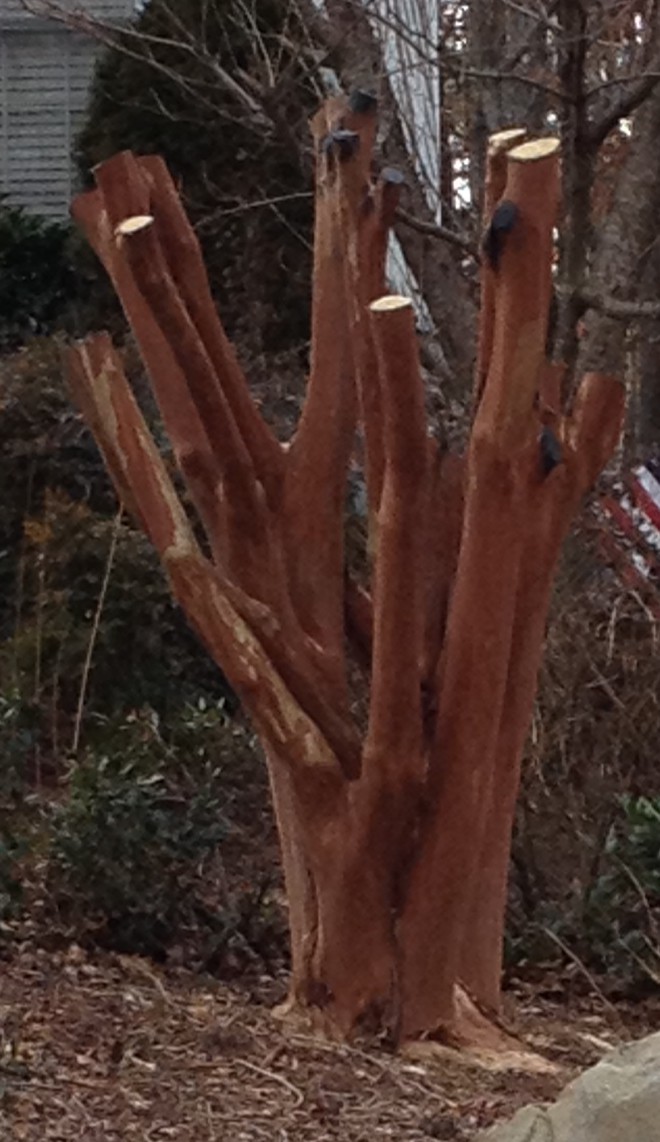
In my October post, “Ode to a Crape Myrtle”, I denounced the practice of severely pruning those lovely trees. The dreadful act is sometimes referred to as “crape murder”. Early to mid-winter each year I see far too many pitiful victims of this particular crime. But this year, on a street I traverse almost every day, stands one of the most pathetic examples I’ve ever beheld. Crape murder victimNot only has the beautiful tree been stripped of its majestic branches, but the perpetrator used a sealant of some sort to paint over several of the wounds. When pruning cuts are made correctly, the tree’s natural defenses will allow it to heal without the application of such products, which in some cases even cause harm to the plant.

As I also mentioned in my previous post, I committed the crime once, in ignorance, before being enlightened. I have since done only minor, clean-up type pruning to the gorgeous ‘Natchez’ Ray planted over 20 years ago.  As the tree has outgrown me, I’ve relied on professional assistance to remove crossed or crowded branches. Most recently, my tree was expertly “limbed up” to provide more light to the plants beneath its canopy and to lighten the load it carries when completely leafed-out and covered with blossoms.Lagerstroemia 'Natchez'

So, you see, I’m not against all pruning, just pruning done recklessly or unnecessarily.  Correct pruning is often an essential part of maintaining a plant’s health, enhancing its aesthetic value or increasing its fruitfulness. Likewise, there are times when we need to be pruned. Fortunately, we belong to a discerning Master Gardener. He determines exactly where and how to make the required cuts to enable us to bear more fruit for Him. Sometimes the pruning is severe and the process is painful, but we can always trust Him. He knows us by name and loves us far more than we can imagine . . . and He’s tenderly transforming us into who He created us to be.

Here comes the sun

I try not to complain about the weather. As a dedicated gardener, I know plants need the rain every bit as much as they need the sun. However, for the past week or so, the sunny South had been anything but. One cold, cloudy, drizzly day followed another in somber progression until I finally succumbed, sadly lamented the lack of sunshine and spent the better part of one day earlier this week in tears.

Yesterday the glorious sphere of light finally reappeared, warming the earth and restoring my customary optimistic outlook. There was renewed activity around the bird feeder, which had been woefully devoid of the happy twittering of my feathered friends on those seemingly endless dreary days. A squirrel scampered back and forth on the deck railing, plotting strategy for an attack on the feeder (which he wisely didn’t try!) The violas planted by my mailbox, drooping after the cold days and frigid nights, began to lift their heads toward the sunlight. Indeed all of us were buoyed by the sun’s return.

The sun shone brightly again today, beckoning me outside to check on my beloved plants. The busyness of the holidays and the recent cold temperatures had deterred me from my practice of walking the property on a regular basis.  I began my afternoon by removing last year’s spent foliage from a number of perennials and then went in search of new growth. I didn’t have to look far. Even though the garden may appear lifeless and barren, plants are alive and well, preparing for a new season. Finding these signs of life gives me great joy and fills me with hope, just like it has every year since I first faced the task of cleaning up the beds by myself (see “Consider it pure joy”, July 1, 2014).

As the succession of overcast days left me feeling dejected, wondering if the sun would ever reappear, there are times when a spiritual chill can settle upon us. Worries and fears cloud our perspective, leading us to question the presence of the Son. Yet, just as the sun is there when we can’t see it or feel its warmth, the Son has promised to be with us always, to the very end of the age (Matthew 28:20). He will guide, sustain and protect us through all the seasons of our lives until the day when we dwell with Him in the City that will not need the sun or the moon to shine on it, for the glory of God will give it light and the Lamb will be its lamp (Revelation 21:23).

Put off, put on

In October, I posted “Ode to a Crape Myrtle” in which I extolled the many delightful features of one of the trees I hold in highest esteem in my landscape. The numerous desirable characteristics allow crape myrtles the distinction of being multiple-seasons-of-interest plants.  One of my favorite traits, its exfoliating bark, provided the spiritual tie-in for that post, the mandate to put off the old and put on the new.  Now that a new year is upon us, a time when we often take stock of where we’ve been and where we want to go, it seems appropriate to delve more deeply into the concept of putting off and putting on.

In one of several recorded confrontations with the Pharisees, Jesus warned it isn’t enough to become presentable on the outside by putting something off. Superficial change isn’t what’s required. Instead, it is necessary to embrace Jesus and put on his ways or risk finding yourself in a worse state than before. We find the story in Matthew 12: “When an unclean spirit comes out of a man, it goes through arid places seeking rest and does not find it. Then it says, ‘I will return to the house I left.’ When it arrives, it finds the house unoccupied, swept clean and put in order. Then it goes and takes with it seven other spirits more wicked than itself, and they go in and live there. And the final condition of that man is worse than the first.”

Fortunately, Scripture is full of examples of not only what to put off, but also what to put on. A passage in Ephesians 4 is one of the most comprehensive on the subject.  Some of the paired put offs/put ons therein include: falsehood/truth; stealing/making a living honestly; unwholesome talk/speaking that which builds others up; bitterness, rage, and anger/kindness, compassion, and forgiveness. It seems like a daunting task, this business of becoming new, but Scripture assures us “if anyone is in Christ, he is a new creation, the old has gone, the new has come!” (2 Corinthians 5:17)

Just like the crape myrtle gradually sheds its outer bark, exposing the beauty that lies beneath, we can be certain the Spirit will help us put off our old ways, revealing more and more the One whose attributes we are called to put on.

A single red rose

Red roses have been associated with romantic love for centuries. According to the ProFlowers website, “The red rose began its illustrious symbolic history in Greek and Roman iconography, where it was tied to Aphrodite, or Venus, the goddess of love.” In his enduring poem, “A Red, Red Rose”, Robert Burns likened his true love to one of the exquisite flowers. I, too, have been touched by the beauty of red roses. As a matter of fact, it’s probably not an overstatement to say one played a role in changing the course of my life . . .

When I was in my early twenties, I met a handsome young man and promptly fell head-over-heels for him. Surely he was “the one”! Some months later, it became evident he wasn’t, as he stated his desire to return to his college sweetheart, who he’d never completely gotten over. I was crushed. Yet, a mere week later, I met Ray, another handsome young man who I’d come to know and love. He was thoughtful and kind and had a bit of a stubborn streak. His tenacity came in handy since it took no small effort on his part to break through the fog of despondency that settled around me after “not-the-one-after-all” broke up with me. As summer turned into fall, I continued to turn down Ray’s invitations, seeing him instead at activities sponsored by the singles group where we first met. I commented to my mom, “I’m not sure why he keeps asking me out.” Her reply, “He’s obviously found someone he likes and isn’t going to give up easily!”

The Singles Group Christmas dinner was held on my birthday that year. After the banquet, Ray presented me with a single red rose. Somehow that rose broke through my defenses and opened my heart to the possibility of loving again. And, as the saying goes, the rest is history. Wedding photo for blogWhen Ray and I got married, I carried a red rose with a sprig of baby’s breath and some greenery, despite the florist’s protestations that the bridesmaids’ bouquets would cost more than mine. Over the years we were married, Ray frequently gave me a single red rose for my birthday, our anniversary and other special occasions, hearkening back to the first one and what it meant to us.

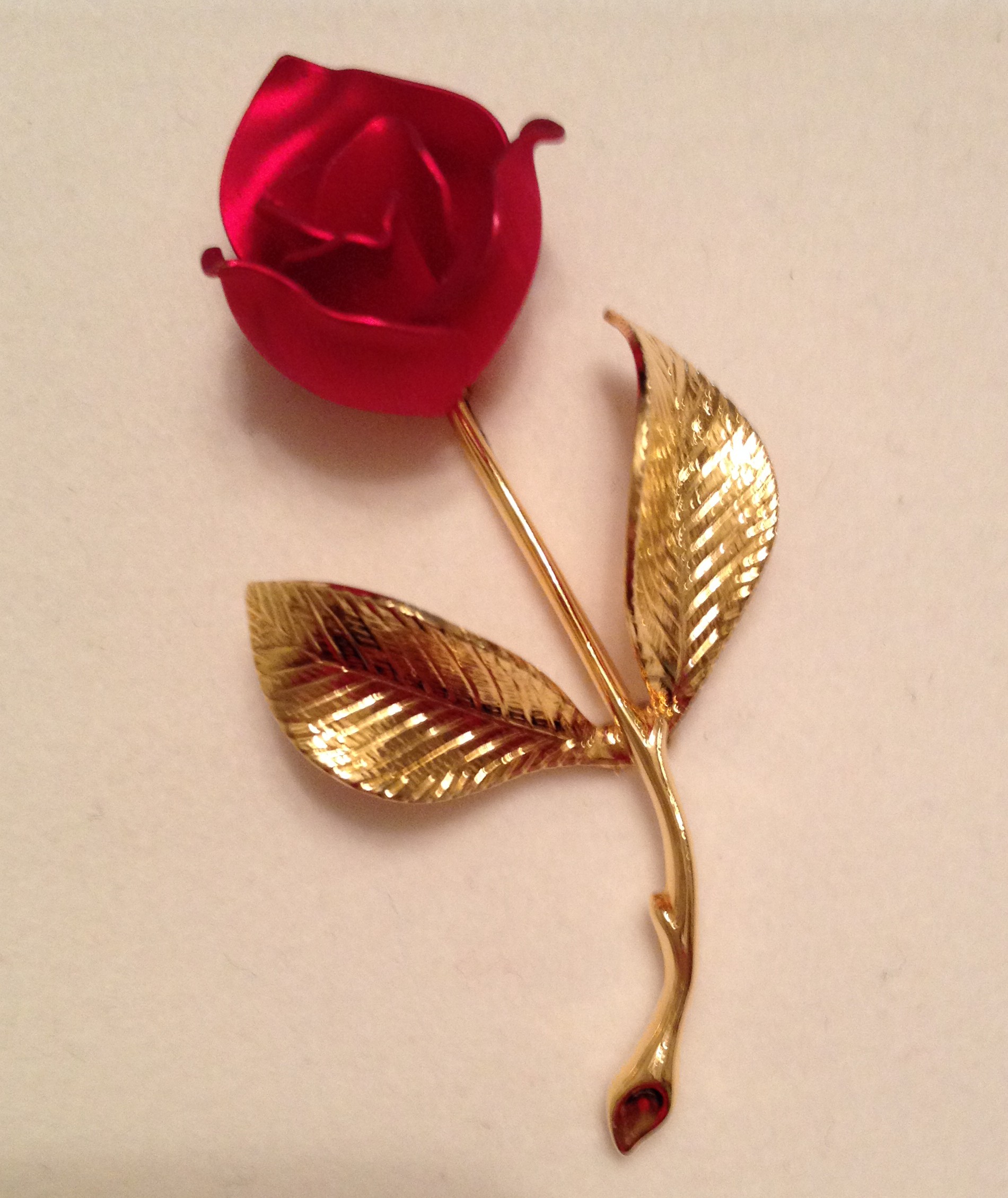
The last birthday Ray spent with me was no different. When I came home from work that night it seemed like the kitchen was full of roses – miniature pink ones for our daughters, a dozen yellow ones and a single red one for me. In addition to the real red rose, Ray gave me a beautiful pin. 010I still marvel at this gift in light of the fact he died four months to the day later. Ray didn’t know he wouldn’t be around to give me single red roses on birthdays yet to come, but God did and I believe he somehow encouraged Ray to give me the pin which I wear one day each year – now 18 birthdays and counting.

When Ray died, I took a single red rose to the funeral home and asked the funeral director to place it in his hands for me. It was a fitting close to our tradition. Sometimes I think about what it will be like when I finally get to see Ray again. Might he have that rose in his hands, ready to give it back to me? After all, nothing’s impossible for God. Yet rose or no rose, I’m certain the longed for reunion will take place. I will see Ray again and we’ll spend eternity together worshipping and praising our great Redeemer. I can be sure because the baby whose birth we just celebrated was the Word made flesh, who dwelt among us, lived a sinless life and died on a rugged cross that we might live with him FOREVER.

His eye is on the sparrow

When I sit at my kitchen table, I have a lovely view into my wooded backyard. The recent rain and wind coaxed most of the remaining leaves off the branches of the deciduous trees and vines in the woods. Now as I gaze out the window from my vantage point at the table, I see mostly bare branches, which have a beauty all their own. I’ll watch them over the next few months, as buds swell and open to reveal leaves or flowers.

But the other morning, I had a different “show” to enjoy – the woods were atwitter with several kinds of birds, enjoying berries from the dogwood trees and the winterberry hollies. I couldn’t help but think how silent the woods were when we moved in over 20 years ago, devoid of the cheerful twitters and chirps. Our house was one of the first ones completed in our section of the neighborhood so we were surrounded by construction for several months. The noise of hammers and heavy equipment and the destruction of the birds’ habitat had no doubt caused them to flee. I’ve delighted in watching them return over the years until now, even though I’m not a bird connoisseur by any means, I can detect a number of different songs and calls when the birds are active in the early morning hours. And, now that the leaves have fallen, I can see them more easily too!

As I sat at my table and watched a tiny finch flit from branch to branch, my mind turned to Scripture and Jesus’ directive not to worry.  He backed up his command with the assurance that if our heavenly Father takes care of the birds of the air and the lilies of the field, he’ll surely take care of us. (Matthew 6:25-34) I’m thankful Jesus chose simple, visible examples like this to teach us profound lessons. If we’ll take the time to truly see, we’ll be continually reminded of our Father’s great, sustaining love toward all he has made.

Exceeding abundance

One of the things that amazed me most when I started studying horticulture was the vast assortment of plants that exists in the world. God wasn’t content to create one type of tree, one sort of shrub, one kind of vine. No! He created thousands upon thousands of different plants.

In general conversation, we usually refer to plants by their genus (maple, holly, pine). Botanically speaking, we refer to plants by their “specific epithet”, i.e. genus and species (in Latin), plus a cultivar if applicable. For example, red maple is Acer rubrum and Winterberry holly is Ilex verticillata. I studied approximately 165 plants each in my Woody ID and Herbaceous ID classes – just enough to know I’ve barely scratched the surface when it comes to being able to identify plants in my part of the world, much less those in other regions! For example, there are approximately 120 different species of maples and at least 400 species of hollies. Cultivars exist for many of these, further expanding the range of color, size and textural possibilities.

I often marvel at the diversity that exists in our beautiful world. Was it the sheer pleasure of creation that led God to design so many different kinds of plants? Maybe so, but I can’t help but believe he also did it to delight us and to turn our hearts toward him. And the joyful abundance he’s lavished upon us doesn’t exist solely in the plant kingdom. If we’ll take the time to truly see, we’ll realize we’re surrounded by gifts, big and small – reasons to be thankful, not only on a day designated for giving thanks, but every day.

“You are my God, and I will give you thanks; you are my God, and I will exalt you. Give thanks to the LORD, for he is good; his love endures forever.” Psalm 118:28-29

Warmed by the Son

Contrary to popular belief, fall, not spring, is the best time to plant most perennials. As air temperatures cool, top growth gradually comes to a halt. Since soil temperatures drop more slowly, the plant can then shift additional energy to its roots, thereby establishing a healthy network to convey water and nutrients to support the plant’s next round of growth the following year.

As is usually the case, we’ve been experiencing a beautiful fall here in the Atlanta area, with daytime highs near 70⁰F and nighttime lows in the 50s. However, I’ve been busy and haven’t been able to spend nearly as much time outside as I would have liked. Finally, there was an opening on my calendar last Thursday. I set my sights on installing numerous plants, some purchased, some adopted from friends, along the path taking shape through the woods.

Wouldn’t you know it? By the time Thursday rolled around, the arctic blast that’s put a big part of the country into an early deep freeze had made its way to north Georgia. Not one to be deterred from my mission to get the plants out of their pots and into the ground, I proceeded to spend several hours happily planting my new friends as my fingers and toes got colder and colder.

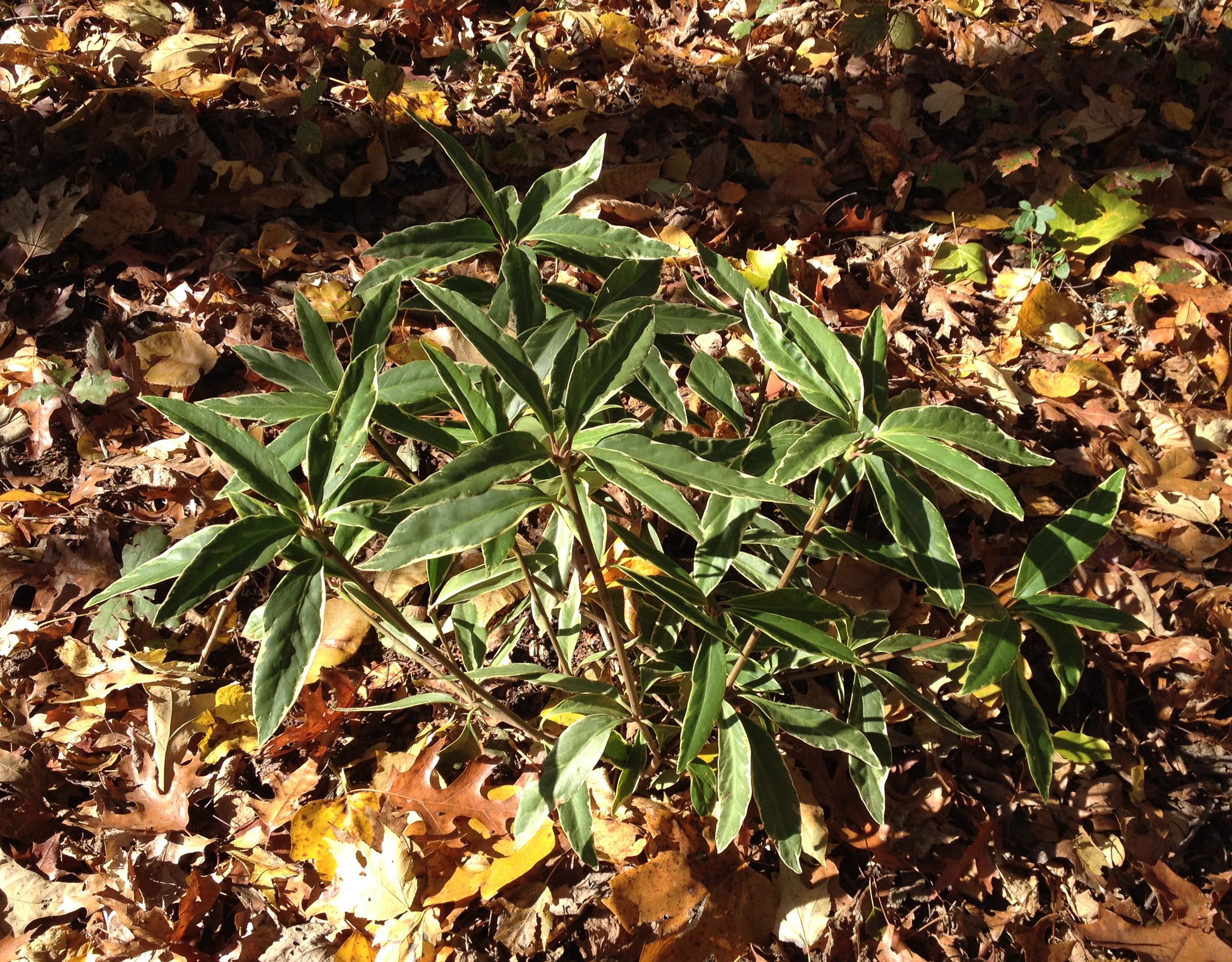
As forecast, temperatures that night dipped below freezing – well below when the wind chill was factored in. When I got downstairs the next morning, I went to the kitchen window overlooking the woods and scanned the scene, trying to ascertain how the plants had fared in the less-than-ideal conditions. The Calycanthus was upright, its bright yellow leaves a cheerful greeting in the early morning light. The Fatsia were slightly drooped, yet still green. But where was the beautiful Ilicium floridanum ‘Pink Frost’ that had enchanted me the day before with its spicy scent and lovely green leaves outlined with a margin of creamy white? Illicium floridanum Pink Frost nipped by the coldSurely that brownish mass of sagging leaves wasn’t it! I quickly pulled a heavy coat on over my PJs, slipped my feet into my work boots and headed to the woods for a closer look. Alas, it was the Ilicium. Its leaves so graceful and aromatic the day before were stiff. In that moment, I think I knew what Charlie Brown must have felt like when he put the first ornament on his spindly little Christmas tree, only to watch it bend to the ground, overwhelmed by the weight. “I’ve killed it!” As I trudged back inside, I chided myself with thoughts of “Why didn’t I heed the forecast and leave the Illicium in its pot in a sheltered area?”
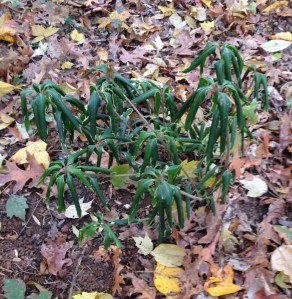
Even though there was a brisk wind and the temperature remained below average, the sun shone brightly throughout the day. Several hours after I made my initial trek to the woods, I peered out the window again. Much to my surprise, the color had returned to the Illicium! Once more, I made my way to the woods for a closer look. Sure enough – the leaves were supple and fragrant.  Just like Charlie Brown’s tree, all it needed was a little tender love and care. In this case, the TLC came in the form of warmth from the sun. Illicium floridanum 'Pink Frost' warmed by the sun
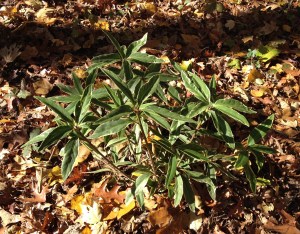
There are times when chilling winds blow through our lives. They present themselves in myriad forms – harsh words, a disappointing turn of events, unfulfilled hopes. Jesus told us, “In this world you will have trouble. But take heart! I have overcome the world.” (John 16:33) Indeed, he is the Light of the world, guiding, reassuring, encouraging us along the way. The warmth of his presence can revive and restore our souls. And we are called to provide that same care to others. “Praise be to the God and Father of our Lord Jesus Christ, the Father of compassion and the God of all comfort, who comforts us in all our troubles so that we can comfort those in any trouble with the comfort we ourselves have received from God.” (2 Corinthians 1: 3-4)

May we love others well because we have been well-loved. (I John 4:19)