A single red rose

Red roses have been associated with romantic love for centuries. According to the ProFlowers website, “The red rose began its illustrious symbolic history in Greek and Roman iconography, where it was tied to Aphrodite, or Venus, the goddess of love.” In his enduring poem, “A Red, Red Rose”, Robert Burns likened his true love to one of the exquisite flowers. I, too, have been touched by the beauty of red roses. As a matter of fact, it’s probably not an overstatement to say one played a role in changing the course of my life . . .

When I was in my early twenties, I met a handsome young man and promptly fell head-over-heels for him. Surely he was “the one”! Some months later, it became evident he wasn’t, as he stated his desire to return to his college sweetheart, who he’d never completely gotten over. I was crushed. Yet, a mere week later, I met Ray, another handsome young man who I’d come to know and love. He was thoughtful and kind and had a bit of a stubborn streak. His tenacity came in handy since it took no small effort on his part to break through the fog of despondency that settled around me after “not-the-one-after-all” broke up with me. As summer turned into fall, I continued to turn down Ray’s invitations, seeing him instead at activities sponsored by the singles group where we first met. I commented to my mom, “I’m not sure why he keeps asking me out.” Her reply, “He’s obviously found someone he likes and isn’t going to give up easily!”

The Singles Group Christmas dinner was held on my birthday that year. After the banquet, Ray presented me with a single red rose. Somehow that rose broke through my defenses and opened my heart to the possibility of loving again. And, as the saying goes, the rest is history. Wedding photo for blogWhen Ray and I got married, I carried a red rose with a sprig of baby’s breath and some greenery, despite the florist’s protestations that the bridesmaids’ bouquets would cost more than mine. Over the years we were married, Ray frequently gave me a single red rose for my birthday, our anniversary and other special occasions, hearkening back to the first one and what it meant to us.

The last birthday Ray spent with me was no different. When I came home from work that night it seemed like the kitchen was full of roses – miniature pink ones for our daughters, a dozen yellow ones and a single red one for me. In addition to the real red rose, Ray gave me a beautiful pin. 010I still marvel at this gift in light of the fact he died four months to the day later. Ray didn’t know he wouldn’t be around to give me single red roses on birthdays yet to come, but God did and I believe he somehow encouraged Ray to give me the pin which I wear one day each year – now 18 birthdays and counting.
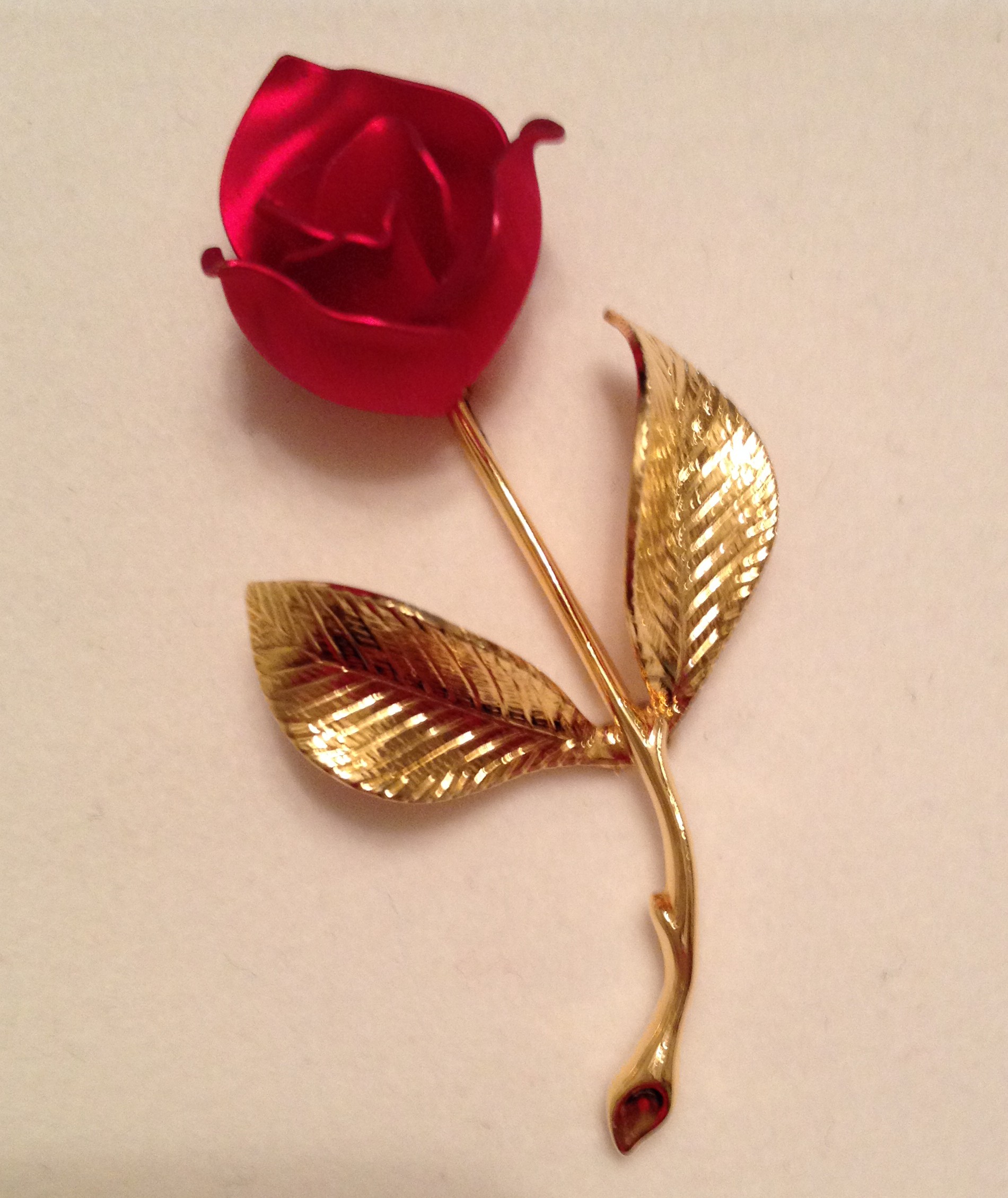
When Ray died, I took a single red rose to the funeral home and asked the funeral director to place it in his hands for me. It was a fitting close to our tradition. Sometimes I think about what it will be like when I finally get to see Ray again. Might he have that rose in his hands, ready to give it back to me? After all, nothing’s impossible for God. Yet rose or no rose, I’m certain the longed for reunion will take place. I will see Ray again and we’ll spend eternity together worshipping and praising our great Redeemer. I can be sure because the baby whose birth we just celebrated was the Word made flesh, who dwelt among us, lived a sinless life and died on a rugged cross that we might live with him FOREVER.

Exceeding abundance

One of the things that amazed me most when I started studying horticulture was the vast assortment of plants that exists in the world. God wasn’t content to create one type of tree, one sort of shrub, one kind of vine. No! He created thousands upon thousands of different plants.

In general conversation, we usually refer to plants by their genus (maple, holly, pine). Botanically speaking, we refer to plants by their “specific epithet”, i.e. genus and species (in Latin), plus a cultivar if applicable. For example, red maple is Acer rubrum and Winterberry holly is Ilex verticillata. I studied approximately 165 plants each in my Woody ID and Herbaceous ID classes – just enough to know I’ve barely scratched the surface when it comes to being able to identify plants in my part of the world, much less those in other regions! For example, there are approximately 120 different species of maples and at least 400 species of hollies. Cultivars exist for many of these, further expanding the range of color, size and textural possibilities.

I often marvel at the diversity that exists in our beautiful world. Was it the sheer pleasure of creation that led God to design so many different kinds of plants? Maybe so, but I can’t help but believe he also did it to delight us and to turn our hearts toward him. And the joyful abundance he’s lavished upon us doesn’t exist solely in the plant kingdom. If we’ll take the time to truly see, we’ll realize we’re surrounded by gifts, big and small – reasons to be thankful, not only on a day designated for giving thanks, but every day.

“You are my God, and I will give you thanks; you are my God, and I will exalt you. Give thanks to the LORD, for he is good; his love endures forever.” Psalm 118:28-29

Be still

I was somewhat taken aback when I saw “Black Friday” Christmas specials being advertised the day after Halloween. Since when is that retail free-for-all associated with trick-or-treat instead of Thanksgiving?! Yes, it seems the Christmas rush has started even earlier than usual. Don’t get me wrong, this is one of my favorite seasons. My daughter Mary’s late-October birthday officially kicks off our family’s holiday celebrations, which include Thanksgiving and my mom’s birthday in November and my and granddaughter Lyla’s birthdays and Christmas in December. Then there’s New Year’s, straddled by a month’s worth of college football playoffs and bowl games. (In addition to faith and flowers, college football happens to be one of my other passions!)

Yet, even though I enjoy the festivities associated with all these happy occasions, I, like many others, struggle not to feel overwhelmed by my calendar and my to-do list. When I was employed full-time, I would think, “If only I could have the whole month of December off . . .” Well, technically, I’m always “off” these days, but I often quote a long-time friend who I worked with for many years, “I’m so busy now that I’m retired, I wonder how I ever had time to work!”

And so, as I wrote in my last post, it gets back to what I choose to focus on and Who I choose to please. A number of things combined yesterday to disquiet my outlook. As I fell asleep last night, I was still mulling over everything I have to do in the days ahead plus the possibility of taking on some other commitments. I certainly wasn’t following Jesus’ mandate not to worry about tomorrow. As a matter of fact, I was worrying about several weeks’ worth of tomorrows plus things that haven’t even officially made it onto my list of obligations!

Zephaniah 3:17 says “The LORD your God is with you, he is mighty to save. He will take great delight in you, he will quiet you with his love, he will rejoice over you with singing.” What an amazing verse! Imagine, the Lord of all creation quiets us as a mother calms her beloved child. Sometimes I think he must sing over me while I sleep. When I woke up this morning, one of the first things that came to my mind was Psalm 46:10, “Be still and know that I am God; I will be exalted among the nations, I will be exalted in the earth.” With his help, I’ve tried to focus on him today, enjoying the beauty of his handiwork which is exuberantly exalting him with a vibrant array of fall colors. I hope you’ll enjoy the following collage of images. May they help you to be still as well.


Ode to a crape myrtle

There are a number of special plants in my yard, dear to me because Ray selected and installed them. They are lasting gifts from him as I’ve had the pleasure of watching them grow for many years. One of the most cherished is my crape myrtle.

When we moved to Georgia, I was a colorist for a large fiber-producer. In my role, I followed color trends and chose colors for fibers the company produced as well as for carpet samples we showed our customers. I was delighted to have the opportunity to put my expertise to use choosing colors for the interior and exterior finishes of the home being built for us.

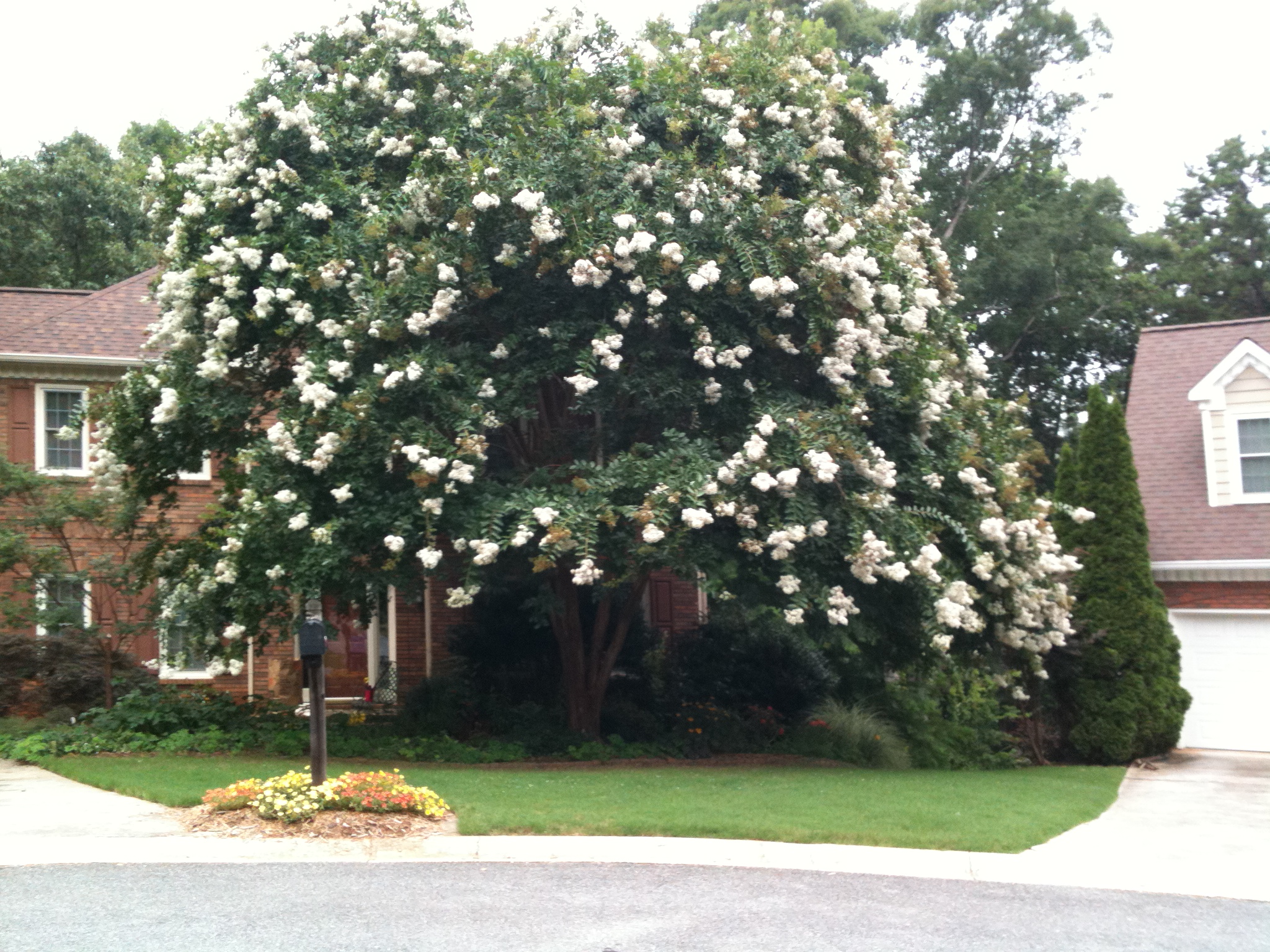
Likewise, Ray was looking forward to having a nearly-blank slate to work with outside since the builder-installed landscaping left a lot to be desired. Little did I know the exterior colors I picked (cream accented with various shades of rust and cinnamon) would present a challenge for Ray when it came to selecting a crape myrtle to reside in the main bed in front of the house. Varieties with pink or purple or magenta blossoms would clash with the brick and shutter colors and clashing just wasn’t an option! Never one to shrink from a challenge, especially one involving horticulture, Ray came up with the perfect solution, a cultivar called ‘Natchez’, with creamy white flowers and cinnamon-colored bark.

I don’t recall how tall the small tree was when Ray planted it over 20 years ago, but it’s reached a height which surpasses its age, with a canopy almost as wide. When in full bloom, its size and splendor prompt visitors to ask, somewhat in awe, “What is that?” I reply, “It’s a crape myrtle. That’s what they can look like if you don’t commit ‘crape murder’.” For those of you unfamiliar with the term, “crape murder” refers to the severe and unnecessary pruning of these lovely trees, usually in late winter. Although some early cultivars supposedly produced more blooms after such treatment, most of those used today flower just as well without being subjected to such torture. I cringe when the annual amputations begin, envisioning the tiny new branches which will sprout from the large remaining limbs, much like fingers emerging from a shoulder. I’m thankful I only committed this crime once, the winter after Ray died, when I was still trying to figure out how to take care of the garden treasures I’d inherited. Fortunately, I quickly learned making my crape myrtle look like everyone else’s was not the thing to do!

(Ok, I’m stepping down from that soap box so I can return to the story at hand . . .)

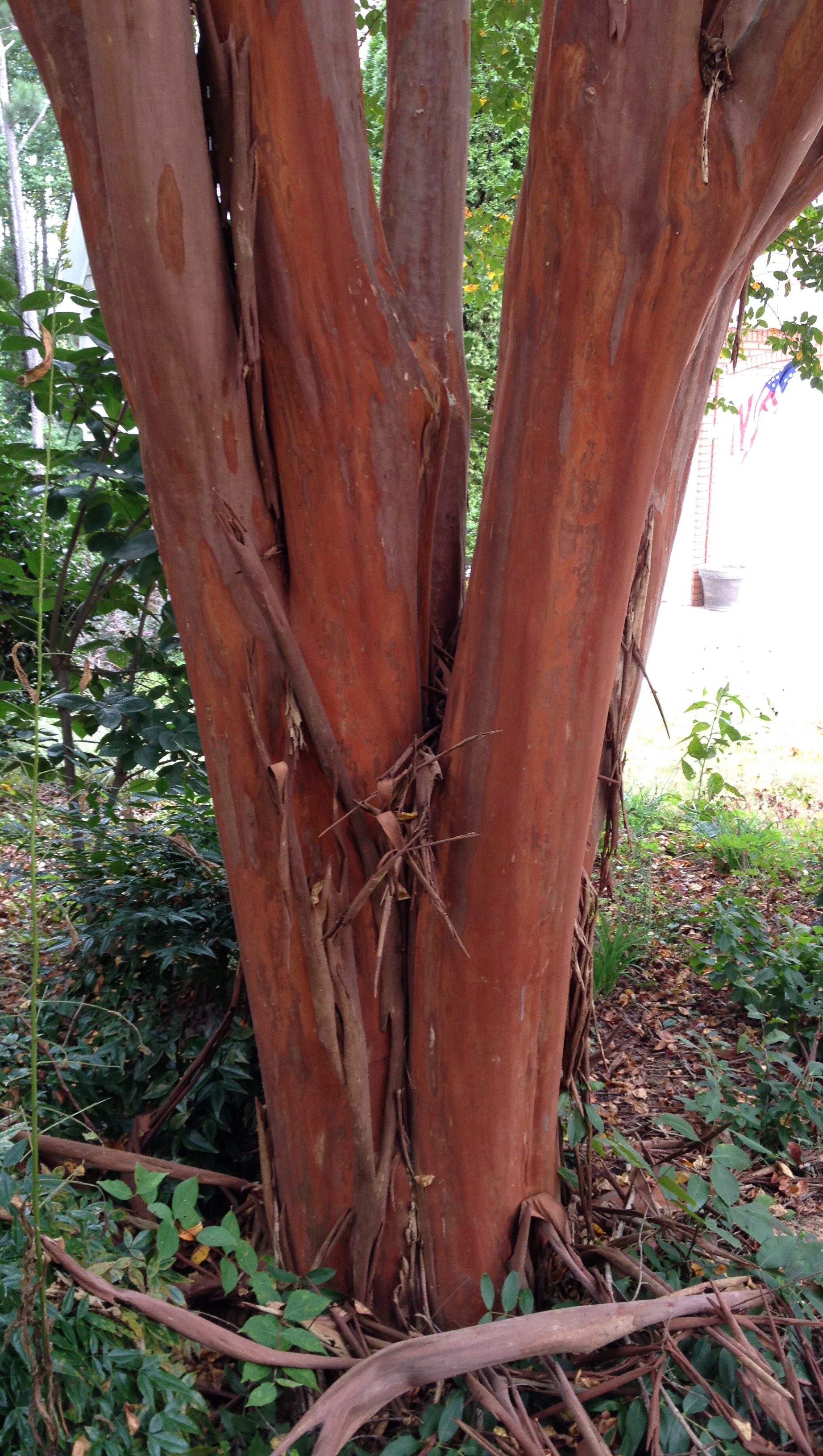
My hort mentor sometimes speaks of plants as having single-season or multiple-season interest, not that one kind is better than the other, just different in its appeal. The first category includes plants such as spring-flowering specimens or those with vibrant fall color which take center stage for a few weeks each year and then play more of a supporting role in the landscape until time for them to burst forth and captivate us once again. I would put my crape myrtle in the latter category, as it has something to offer year-round. Some might question the beauty of the leafless branches, but the leftover seed pods contribute textural interest throughout the winter. Sometimes I even get to see the limbs decorated with a layer of snow. Beginning in the spring, the massive canopy provides shelter for numerous birds and shade for the southeast side of my house. In the summer, its flowers attract a variety of pollinators that dart in and out of the blossoms, creating a low humming as they go about their task. Then there’s its aesthetic value. My tree was so floriferous this year, its flower-filled branches resembled a cascade of blossoms. In late summer, the bark starts to exfoliate, peeling off to reveal the new layer underneath. The process can be a bit alarming to the uninitiated since it almost looks like the tree is falling apart, but exfoliation is one of the characteristics I most like about my crape myrtle.

002And, in case you’re wondering, it’s the feature that inspired the spiritual tie-in for this post. As I’ve watched the bark begin to peel away this season, exposing the beautiful surface beneath, I’ve been reminded of the mandates in Scripture to “put off the old and put on the new”, a concept so important I’ll dedicate a separate essay to it. Today, I’m grateful for a thoughtful husband who chose just the right plant and for a loving Father who’s sustained it and me across all the years since He called him Home.


Family Resemblance

How great is the love the Father has lavished on us, that we should be called children of God!  And that is what we are! 1 John 3:1

Before I got the opportunity to study horticulture, I would look at leaves when trying to identify trees.  Even then I was only familiar with the leaf shapes traditionally associated with plants such as oaks, maples and hollies. I now realize there are many different species in those genera, some with leaf shapes people typically associate with those trees and some fairly dissimilar.  I’ve also learned that even though botanists consider leaves and stems when classifying plants, they use fruit and flowers, the reproductive parts of plants, to group them into families. I don’t know if it’s my eye for detail or my love of family, (maybe some of both!) but I enjoy recognizing similarities in the flower structures of different plants and then checking to see if they’re in the same family.

Just like plants can be identified by their fruit, Jesus told his disciples people would be known by their fruit. Because of the amazing grace of God and Jesus’s sacrifice on our behalf, we’re part of God’s family and, as such, we’re called to resemble Jesus, “the firstborn among many brothers”. (Romans 8:29) Fortunately, we are enabled to become more and more like him through the power of the Spirit, whose fruit is “love, joy, peace, patience, kindness, goodness, faithfulness, gentleness and self-control.” (Galatians 5:22-23)

Not only are we called on to “produce fruit in keeping with repentance” (Matthew 3:8), we’re instructed to impress God’s commands on our children. “Talk about them when you sit at home and when you walk along the road, when you lie down and when you get up” (Deuteronomy 6:7). In other words, telling our children about God, his directives, his covenant and his character should be woven into the daily ebb and flow of life, not just reserved for Sunday school, and we must endeavor to teach by example, not just words.

As is probably true of most parents, when my daughters were young, I used to wish they’d always be as happy and carefree as they were during those pre-school years. At the very least, I yearned to protect them from adversity and pain. I have similar feelings now when I look at my precious grandchildren. Yet I know life can be difficult and no one makes it through without some measure of grief, disappointment, and hardship. But God, in his providence, often uses our most trying times to draw us closer to himself, teaching us experientially that we can trust him no matter what. And that, in turn, is what I most want my children and grandchildren to know. There is a Father who loves us. There is a Son who we are to resemble. There is a world in great need of the fruit we’re called to bear.

Thoughts on Romans 8:32

“He who did not spare his own Son, but gave him up for us all—how will he not also, along with him, graciously give us all things?” Romans 8:32

Commenting on this verse in his book “Future Grace”, pages 112-113 and 114 (Multnomah Press, 2012), John Piper says:

“He did not spare his Son.  And therefore it is impossible that he should spare us the promise for which the Son died — he will with him give us all things.  What a truth!  Giving us all things is the easy thing! Think on that every time you fear being denied something that would be good for you.  You think it is a hard thing.  You see many obstacles.  It looks impossible.  At that discouraging moment think about his heavenly logic.  Giving you what you need is the easy part.  And the hard part is already done.  Creating the world and running it for the good of his people is a relatively easy thing for God to do compared to handing over his Son to ridicule and torture.  But he did it.  And now all future grace is not only sure; it is easy . . . The great promise of future grace, guaranteed in the logic of Romans 8:32, is that nothing will ever enter your experience as God’s child that, by God’s sovereign grace, will not turn out to be a benefit to you.  This is what it means for God to be God, and for God to be for you, and for God to freely give you all things with Christ.”

And Susannah Spurgeon in a compilation of her devotions, “Free Grace and Dying Love”, page 3 (The Banner of Truth Trust, 2006), writes:

‘He that spared not his own Son.’  He gave his most precious treasure; could he withhold any lesser good from you?  He has given you pounds; will he refuse you pence? . . . ‘How shall he not with him also freely give us all things?’  Think well my heart, what ‘all things’ mean to you! . . . All spiritual blessings, rich and precious, are laid up for you in this divine storehouse . . . There is not a need or desire of your inner life which cannot be triumphantly met by faith’s unwavering challenge, ‘How shall he not?’  Nor is there a necessity of your temporal state which cannot equally claim the blessing of possessing ‘all things’ in Christ.”

My heart is heavy this morning and in need of reassurance.  These quotes remind me that nothing is impossible for God, nor will He withhold any good or necessary thing from me. Therefore, it seems reasonable to conclude if He is withholding something it must not be best or needful, at least not at this moment in my life.

Over the years, God has given me glimpses of his truth in some rather mundane situations. As I typed the last couple of sentences, one such episode came to mind. I’d been to the store and was putting the purchased provisions away. More specifically, at the moment this particular insight came, I was placing packages of toilet paper in my young daughters’ bathroom closet – can’t get much more mundane than that! I thought, “Mary and Jessie don’t have to worry about having things available when they need them. I make sure whatever they need is on hand.” And then I realized, “I don’t have to worry either. Everything I’ll ever need is already in God’s ‘closet’ and He’ll make it available as needed.” Furthermore, if I, as a finite, imperfect human parent know how to give good gifts to my children, I can certainly count on my perfect, infinite heavenly Father to give good gifts to me. (Matthew 7:11 and Luke 11:13)

And so, with the Psalmist, I’ll say, “Why, my soul, are you downcast? Why so disturbed within me? Put your hope in God, for I will yet praise him, my Savior and my God.” (Psalm 42:11)

What about the little things?

Losing a job is a BIG deal, but what about smaller events, details that matter to me, yet are miniscule in the overall scheme of life? I’ve had countless reminders God cares about those too . . . like the presumed demise of my prized trillium.

Two years ago, some friends came over to assist with yard work. Things had gotten ahead of me, to say the least, so the extra help was greatly appreciated. I tried to supervise the various activities as my helpers diligently labored on their assigned tasks. Nevertheless, there was too much going on for me to keep track of everyone and, in spite of good intentions, a few things were damaged. During my post-work session walkaround, I was especially dismayed to find no sign of my trillium, a cherished wild flower salvaged years before during a plant rescue. One of the fellows used a leaf blower to clear several of the beds, not realizing my spring ephemerals, including the trillium, were too fragile to be subjected to the gale force winds created by that piece of equipment. Not only was I heart broken, I’d have to wait until the following year to see if it would come back.

Exhibiting one of my favorite characteristics of plants, perseverance, the trillium did indeed return the next spring, even bigger and more beautiful than before. However, imagine my surprise and delight this year when not only did the mama trillium reappear, but a number of babies came up in the woods. The most logical explanation for the presence of those new trilliums, located below and many feet from the mother plant?: “seed dispersion by leaf blower”! Once again, God took something I thought was a loss and turned it into a gift, a cause for joy and celebration.

I know Almighty God will handle the big things. After all, He raised Jesus from the dead, makes the sun rise and set and holds all things together. Yet this all-powerful God sees me, loves me and repeatedly stoops to bless me in tiny, intimate ways. Each time He does so, I’m humbled and amazed that Almighty God is also Abba, Father, “Daddy”.

John Piper’s Thoughts on Romans 8:28

From time to time, I’ll share some of my favorite quotes, especially ones that relate to my posts. Here’s one I particularly like from John Piper regarding Romans 8:28. It appears on pages 118-119 of his book “Future Grace”. (Multnomah Books, 2012)

“When it comes to the architecture of future grace and the buildings we call the promises of God, Romans 8:28 shares the tribute of being one of the two or three greatest. This structure is staggering in its size. The infinitely wise, infinitely powerful God pledges that in this building, future grace will make everything beneficial to his people!  Not just nice things, but horrible things too – like tribulation and distress and peril and famine and sword (Romans 8:35-37)  Once you walk through the door of love into the massive, unshakable structure of Romans 8:28, everything changes.  There come into your life stability and depth and freedom.  You simply can’t be blown over anymore.  The confidence that a sovereign God governs for your good all the pain and all the pleasure that you will ever experience is an incomparable refuge and security and hope and power in your life.  When God’s people really live by the future grace of Romans 8:28 – from measles to the mortuary – they are the freest and strongest and most generous people in the world.”


Working all things together for good

And we know that in all things God works for the good of those who love him, who have been called according to his purpose. Romans 8:28

This is one of my go-to verses, one I turn to repeatedly for reassurance. Having made my profession of faith almost 40 years ago, I have plenty of life experiences that confirm the veracity of this verse. Even when things are bleak, even when I don’t understand, even when I can’t see how good could possibly come from a given situation or series of events, God is at work to accomplish what will be most glorifying to him and most beneficial to me. Following is one such example.

I was blessed to be continually employed by a large corporation for just over 30 years. I had an interesting and challenging job and a good salary and benefits package, critically important when I became the sole source of support for my daughters after my husband, Ray, died. As with anything in life, my job had its ups and downs over the years, but things took a downward turn the last year I worked and didn’t recover. I was assigned to a new manager. In a time when layoffs were happening on a regular basis and with two children of her own to support, I began to feel like she wanted to make sure she was the last woman standing. Bit by bit, my role was diminished. I was left out of meetings, told I could no longer travel to visit customers (some of whom I’d called on for almost 20 years), and wasn’t given meaningful work to do. I became increasingly frustrated. And I was ANGRY!

By the time the July 4th holiday approached, I’d been working for the new manager for almost seven months. As was often the case, I took the week of the 4th off. Attempting to regain some perspective, I spent most of my vacation reading my Bible, praying, journaling and working in my yard. Gradually, as the week passed, God reminded me He, not my manager, was in control. When I returned to work, the situation remained unchanged, but I tried to stay focused on the truth that God was indeed in control. I continued to pray for wisdom. Was God allowing things to become so miserable I’d leave or did He want me to remain and be a “life-giver” in a difficult environment, learning patience and humility along the way?

The answer came on January 26, 2011. My annual review was scheduled for that afternoon and things had gotten so bad I told my family I fully expected to be terminated or put on probation. I sat across the table from my manager and her boss as she said, “I know you’re expecting to have your review, but you won’t be having it because your job has been eliminated.” My first thought was, “This is really happening”, my second was, “Thank you, Lord, for giving me a black and white answer.” I turned in my badge, my computer, my keys. And just like that, a 30-year career was over. No retirement lunch. No goodbyes. No celebrations.

God had other plans. Over the years since Ray died,  as I cared for the beautiful garden he started, God was quietly, tenderly nurturing a new dream in me. A few months before my job was eliminated, I checked out the website of a local technical school while I sat in my cube eating lunch. When I read through the class descriptions for the horticulture program, my desire to take those courses was so strong I wrote on a sticky note: “My dream: Environmental Horticulture Diploma, Horticulturist Specialty”. I stuck it in the back of my planner, thinking it was unlikely, but treasuring my dream nonetheless. A mere two days after my job was eliminated I contacted the admissions office at Chattahoochee Tech and started the process of enrolling. I received my diploma eighteen months later.

Not only did God take the pain of losing my job and work it for good, He did far more than I could ask or imagine. Going back to school was an amazing, unexpected gift and having a more flexible schedule allowed me to spend time on a regular basis with my first grandchild, Joshua, who was born in July 2011. He became my study buddy from his earliest days. I delight in telling him about plants and, as he grows up, I look forward to telling him about his very special grandfather and God’s faithfulness to me and to our family.

My diploma with original sticky note attached.

My diploma with original sticky note attached.

Consider it pure joy

“Consider it pure joy, my brothers, whenever you face trials of many kinds, because you know that the testing of your faith develops perseverance.” James 1:2-3

It was February 1998 and I was feeling anything but joyful. Ten months before, my beloved husband, Ray, had died of a massive heart attack a few weeks after his 39th birthday. Even though I was a rational person and knew all-too-well the details of what happened, on some level I maintained a protective mantle of denial. I couldn’t accept or fathom how he could go to work one sunny spring Saturday and never return home to me and our two young daughters. But bit by bit the reality dripped into my soul, creating an underlying sadness that colored many of my days.

In preparing for Ray’s funeral, I wrote a letter to him which one of our pastors read during the service. Amongst other comments I stated he’d not only left a lasting legacy in the lives of our daughters, but also in the beauty of our garden. You see, Ray had a horticulture degree and he planted many interesting things in our yard. He would tell me about the special plants he selected and teach me their names. Although he didn’t eschew better-known plants like pansies and daffodils, he was interested in having unique items as well. When several of his horticulture colleagues paid a visit and walked the garden with me after Ray died, oohing and ahhing over a number of specimens, I took note all over again how special that part of his legacy was. I also recognized how important it was for me to try to learn how to take care of it, otherwise it would only be a matter of time before it was gone.

And so that February day found me outside preparing to remove the blanket of leaves that still enshrouded the planting beds, with an aching in my heart as I longed for Ray and wished he was there to remove those leaves. As I started clearing the beds, I noticed a number of the perennials Ray planted were beginning to emerge from the soil. Seeing those plants and knowing they had persevered through the cold, dark winter gave me a glimmer of hope. If they could make it through that stark season, maybe I could survive my season of darkness.

Little did I know, gardening would become my passion and would provide many moments of hope and healing as well as a very real connection to Ray. Not only has God faithfully provided for me and my family since Ray’s death, He has ministered to me over and over again through the beauty of his creation. While “playing in the dirt”, I’ve been reminded of his promises, seen tangible examples of Scriptural principles and found solace for my soul.

This blog is born of a desire to share some of what I’ve learned spiritually and horticulturally. I hope you’ll come back to the garden with me.


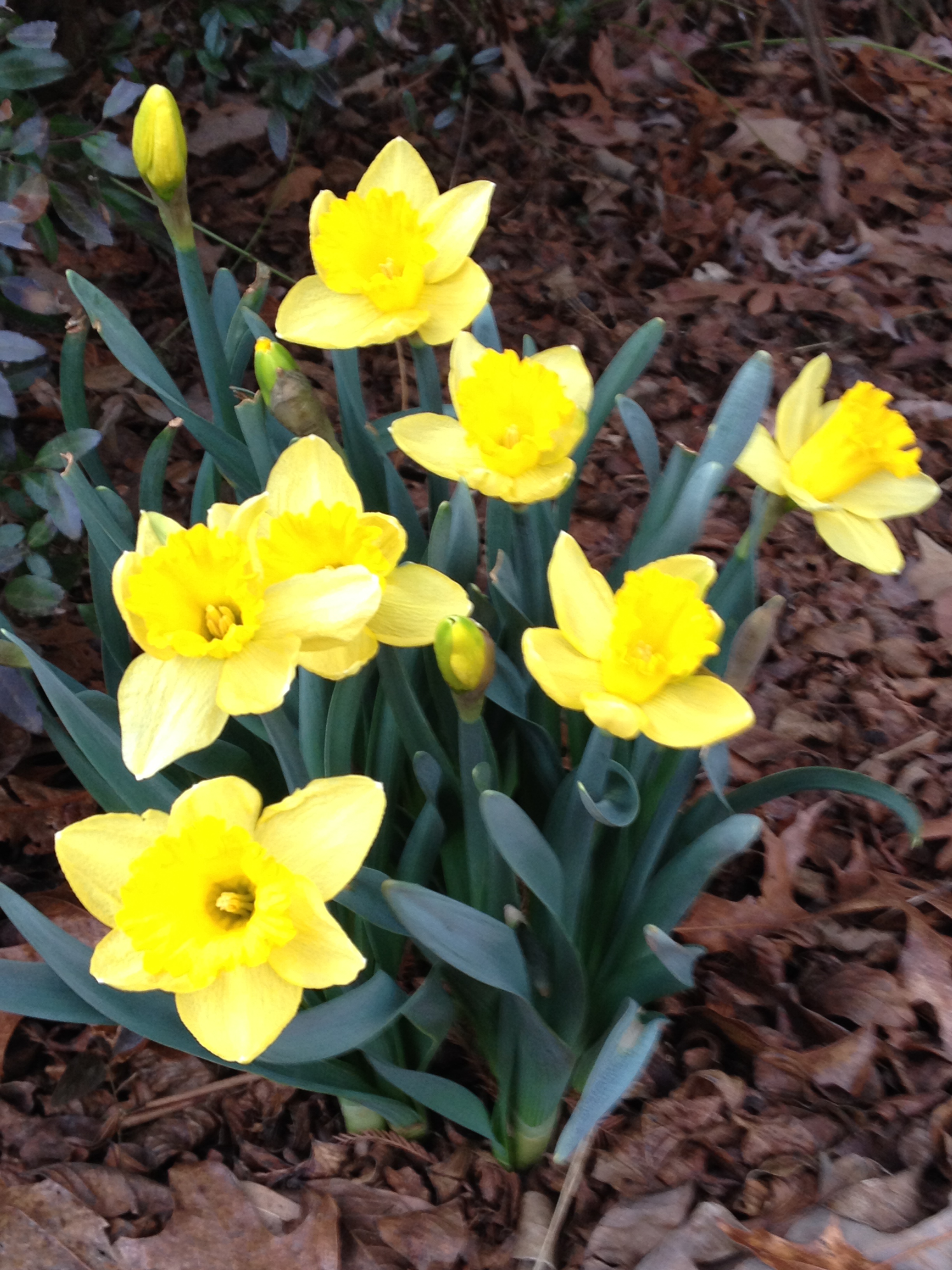
One of several varieties of daffodils Ray planted and the earliest to bloom. They come back year after year, a cheerful reminder of him!

One of several varieties of daffodils Ray planted and the earliest to bloom. They come back year after year, a cheerful reminder of him!