Feed the birds, take 2

My alarm clock didn’t go off this morning. Consequently I made it downstairs later than usual and later than I’d planned. A quick glance at the bird feeder revealed an almost-empty receptacle, with only an inch or so of millet languishing in the bottom of the cylinder. A few hopeful birds hopped along the deck railing and then, upon finding no sunflower seed, flew forlornly back to the branches of the snow-covered trees. Yes, we had a light snow last night, just enough to decorate everything and make for a lovely sight this morning. But it was also enough to make the birds even more in need of those precious seeds than usual so I pulled a coat on over my robe and pjs and refilled the feeder  before making my own breakfast.

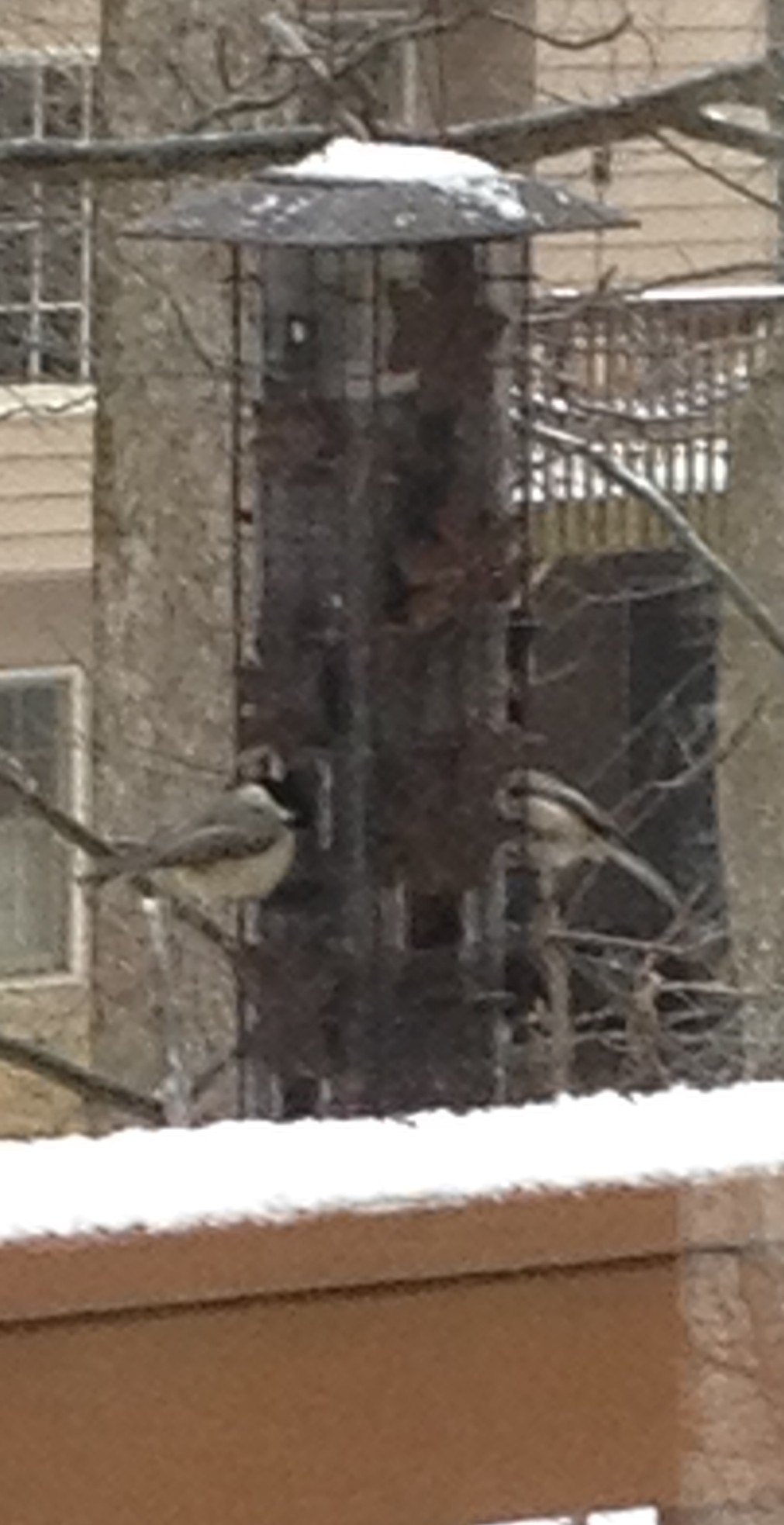
I was immediately rewarded by the appearance of several dozen birds – on the feeder, on the deck and dotted throughout the trees closest to the house, awaiting their turn to retrieve one of the highly-coveted seeds. Chickadees, titmice, juncos, cardinals (including a male, his red feathers appearing especially bright against the white snow), plus several kinds of sparrows and finches flitted merrily about – all rejoicing over the replenished food supply.Although I enjoy seeing all the different kinds of birds that frequent my feeder, I think the chickadees are my favorites.

Within a few days of first placing the feeder on a plant hook by my deck, I became aware of how quickly the birds accustomed themselves to dining on the seeds it holds, depending on me to fill and refill it. And, as their reliance on me has grown, I feel a corresponding responsibility to make sure they’re well fed. I delight in the relationship that’s developed between me and these small creatures. In caring for them, I know I’m helping keep an eye on some of God’s sparrows. I can’t help but think He takes joy in watching me partake of all He provides just as I relish watching the birds feast on the sunflower seed. Unlike me, though, God is never late in providing what I need; neither will His storehouses ever be empty. Not only do the cattle on a thousand hills (along with everything else) belong to Him, but as my loving heavenly Father, I can trust Him for all my needs. As the birds rejoiced over the restocked feeder this morning, may I ever exalt and give thanks to the One who tenderly sustains me.

Feed the birds

It had been a long time since I last owned a bird feeder.  For the past three years, my grandson and I have enjoyed watching the birds (and an occasional squirrel, including “Stumpy”, the tail-less one) visit the feeder at my daughter’s house. I’ve also delighted in helping a friend fill his many bird feeders, anticipating the flurry of activity that’s sure to follow. So, I decided I wanted one. My dad granted my wish and gave me a feeder for Christmas.

Not really knowing what to buy in terms of food, I selected a bag of Southern Regional Blend. The tag line on the bag said “Blended to attract Southern Songbirds” while another statement promised “25% sunflower plus safflower” seeds. A closer look at the ingredients list revealed millet to be the predominant ingredient, while a chart on the back indicated this particular blend would be eaten, and presumably enjoyed, by a range of birds common to our area, including cardinals, chickadees, and titmice.

I chose a location for the feeder where I could keep an eye on it from two key vantage points: the window above the kitchen sink and my seat at the table. I filled the feeder and awaited the birds’ arrival with joyful expectancy. It took a couple of days for them to notice the new food source, but one morning a red-headed woodpecker arrived, followed by several tiny chickadees and some titmice.

I mentioned my new-found hobby to my fellow bird-feeding friend who promptly shared some of his stash of the birds’ favorite food: black oil sunflower seed. I’ve gradually transitioned the contents of the feeder from the original blend until it now contains only that delicacy. The changeover along with colder weather and the depletion of their natural food sources has led to increased activity around the feeder. There’s also a broader variety of birds partaking of the feast, as several kinds of finches and sparrows as well as cardinals, doves and juncos have joined the species that originally frequented the feeder.

As I’ve watched the birds consume the food I provide for them, I’ve been reminded of the spiritual nourishment available to us. Just like the different components in the blend of seeds I originally purchased, there are myriad types of books to fortify us for our spiritual journey. Some in the self-help genre are little more than “filler”, like the millet, while devotionals and study guides written by learned theologians offer more nutritious fare.

But one Book surpasses them all. When tempted by Satan in the wilderness to turn stones into bread, Jesus answered, “It is written: ‘Man shall not live on bread alone, but on every word that comes from the mouth of God.’” (Matthew 4:4) As the black oil sunflower seed is highly favored by the birds, so should the Bible, the inspired Word of God, be our preferred source of spiritual sustenance. May we partake frequently of the feast He has so graciously provided.

His eye is on the sparrow

When I sit at my kitchen table, I have a lovely view into my wooded backyard. The recent rain and wind coaxed most of the remaining leaves off the branches of the deciduous trees and vines in the woods. Now as I gaze out the window from my vantage point at the table, I see mostly bare branches, which have a beauty all their own. I’ll watch them over the next few months, as buds swell and open to reveal leaves or flowers.

But the other morning, I had a different “show” to enjoy – the woods were atwitter with several kinds of birds, enjoying berries from the dogwood trees and the winterberry hollies. I couldn’t help but think how silent the woods were when we moved in over 20 years ago, devoid of the cheerful twitters and chirps. Our house was one of the first ones completed in our section of the neighborhood so we were surrounded by construction for several months. The noise of hammers and heavy equipment and the destruction of the birds’ habitat had no doubt caused them to flee. I’ve delighted in watching them return over the years until now, even though I’m not a bird connoisseur by any means, I can detect a number of different songs and calls when the birds are active in the early morning hours. And, now that the leaves have fallen, I can see them more easily too!

As I sat at my table and watched a tiny finch flit from branch to branch, my mind turned to Scripture and Jesus’ directive not to worry.  He backed up his command with the assurance that if our heavenly Father takes care of the birds of the air and the lilies of the field, he’ll surely take care of us. (Matthew 6:25-34) I’m thankful Jesus chose simple, visible examples like this to teach us profound lessons. If we’ll take the time to truly see, we’ll be continually reminded of our Father’s great, sustaining love toward all he has made.

Where’s your focus?

“Turn your eyes upon Jesus, look full in His wonderful face, and the things of earth will grow strangely dim in the light of His glory and grace.” Helen H. Lemmel

In landscaping, a specimen plant can be used to create a focal point. To merit such a special role, the plant generally has some unique or impressive attribute. I described one such example, my beloved crape myrtle, in my last post. Depending on the season, its size, exfoliating bark and/or flower-laden branches command attention. It’s often the first thing people notice when they stop by to visit.

Just as experienced landscapers carefully select specimen plants to create garden-enhancing focal points, we need to take great care in choosing what we focus on moment-by-moment and day-by-day as we go about our lives. We’re all surrounded by varying demands, requiring action or decisions on our part. The weight of responsibility and pace of life can frequently result in a sense of disquiet and anxiety, especially if we concentrate on our circumstances. But what if we could shift our focus to something, or better yet, Someone, who offers peace amidst all the hustle and bustle?

The apostle Peter learned much about the importance of choosing wisely when it comes to deciding what to focus on. In the well-known account of him walking on water (Matthew 14:22-32), Peter was able to perform the miraculous feat as long as he kept his eyes on Jesus. “But when he saw the wind, he was afraid and, beginning to sink, cried out, Lord, save me! Immediately Jesus reached out his hand and caught him.” (verses 30-31)

Likewise, when Jesus and his disciples visited the home of Martha and Mary, “Martha was distracted by all the preparations that had to be made.” Not only was she preoccupied with the details involved with feeding her guests, she became quite exasperated when her sister, Mary, decided to sit at Jesus’ feet and listen to his teaching instead of helping. In fact, Martha was so annoyed she asked Jesus to tell Mary to assist with the meal. To her surprise and possibly dismay, she was the one who received a gentle rebuke: “Martha, Martha”, the Lord answered, “you are worried about many things, but only one thing is needed. Mary has chosen what is better, and it will not be taken away from her.” (Luke 10:41-42)

Similarly, as recounted in Matthew 6:25-34, Jesus told his listeners not to worry about what they would eat or drink or wear, but to “seek first his kingdom and his righteousness, and all these things will be given to you as well. Therefore do not worry about tomorrow, for tomorrow will worry about itself. Each day has enough trouble of its own.” (verses 33-34)

So, does this mean we shouldn’t take care of ourselves and our loved ones or tend to the details of our lives? Of course not! There will always be demands on our time and resources, meals to be prepared, laundry to be washed and folded, bills to be paid. But, instead of becoming anxious and afraid, burdened and weighed down by focusing on our circumstances, we need to “turn our eyes upon Jesus”. Earlier, I described a specimen plant as one that usually has an impressive or unique attribute. In four brief but very rich verses, Hebrews 1:1-4 declares a number of Jesus’ amazing, matchless characteristics. He is the Son of God, the radiance of God’s glory, heir of all things, superior to the angels. Not only was everything created through him, but he sustains all things through his powerful word. He’s seated at God’s right hand, interceding for us (Romans 8:34).

Jesus, our Lord and Savior, is supremely worthy to be our focal point. We can rest in the assurance of all he’s done for us and all he’s promised to do for us, confident he’ll never leave us or forsake us.


Very Hungry Caterpillars

“The caterpillar ate through one nice green leaf, and after that he felt much better.”
Eric Carle

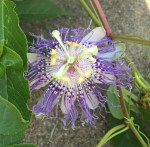
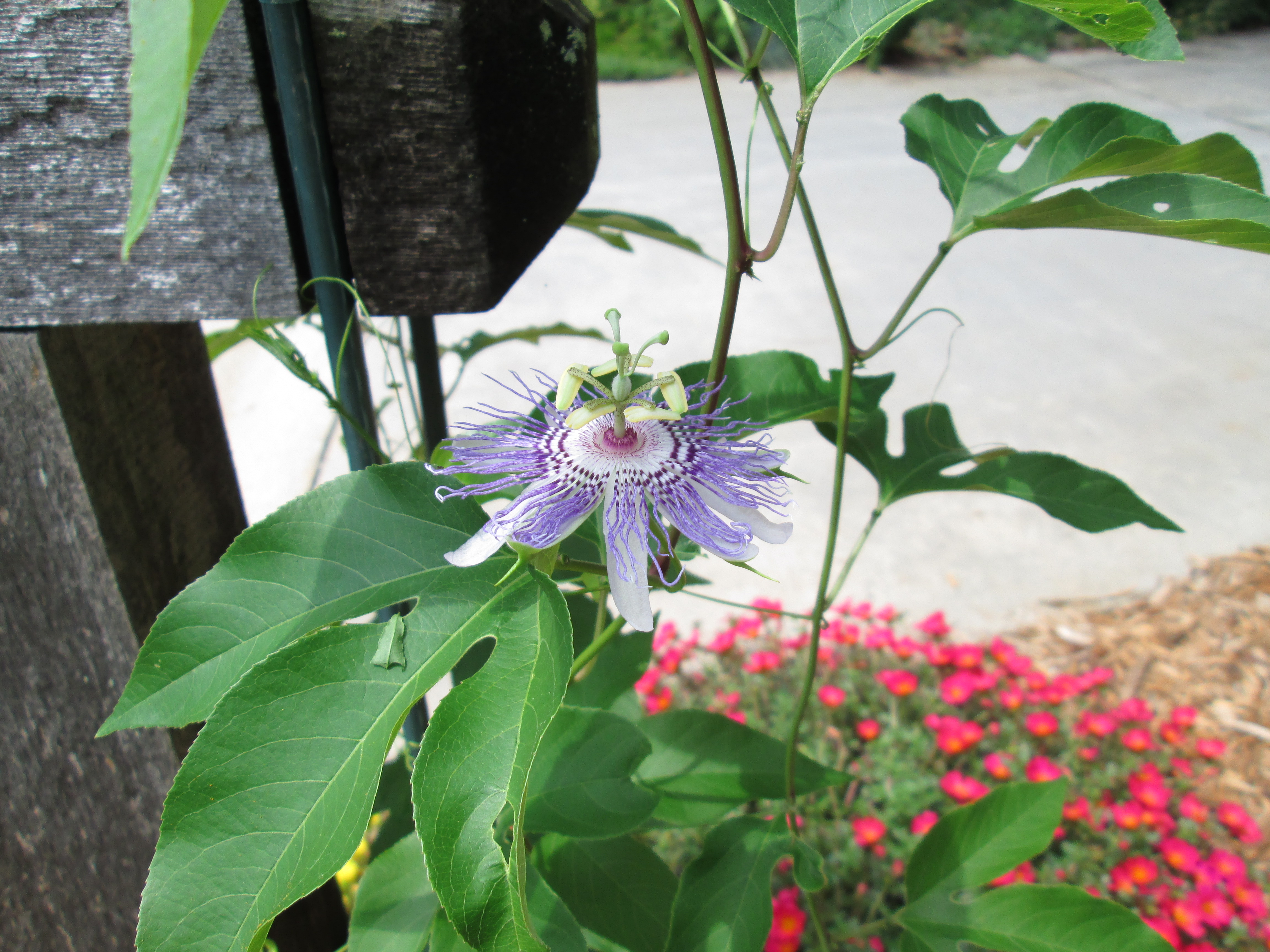
Getting to study horticulture the past three years has given me the opportunity to be introduced to lots of interesting new (to me) plants. Passiflora incarnata is one such plant. One of its common names, passion flower, alludes to the fact that some of the components of its wonderfully complex flowers have been likened to various aspects of the passion of Christ. According to the Floridata website, “The name, Passiflora or ‘passion flower’, was given by 16th century Spanish missionaries in South America who thought they saw a reference to the Crucifixion of Christ in the elaborate flower structures: the corona, sitting at the top of the flower, is the crown of thorns; the five anthers are the five wounds; the three styles are the three nails; and the five petals and five sepals are the apostles, less Judas and Peter.” (The two apostles who betrayed Jesus – Judas to the utmost and Peter only temporarily.)Passiflora incarnata


I decided the stunning flowers would make a lovely addition to my garden and planted a small vine next to my mailbox. I watched as the vine grew, wrapping tiny tendrils around support stakes as it went. I searched daily for buds, which finally appeared. Sadly, for some enigmatic reason, all but two failed to produce the much anticipated and hoped-for flowers. Instead, my Passiflora produced a bounty of a different kind . . .

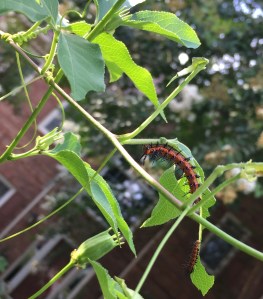
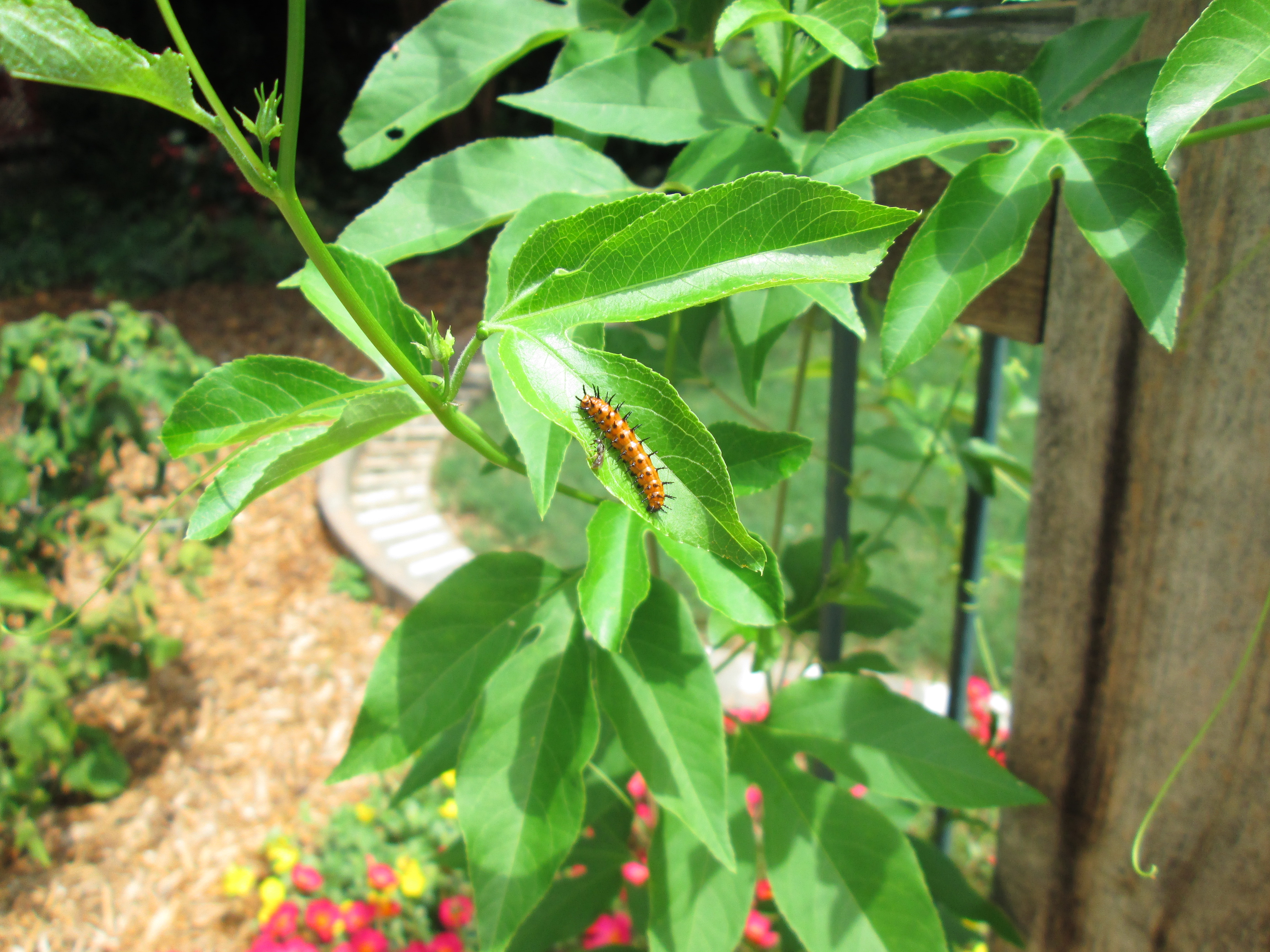
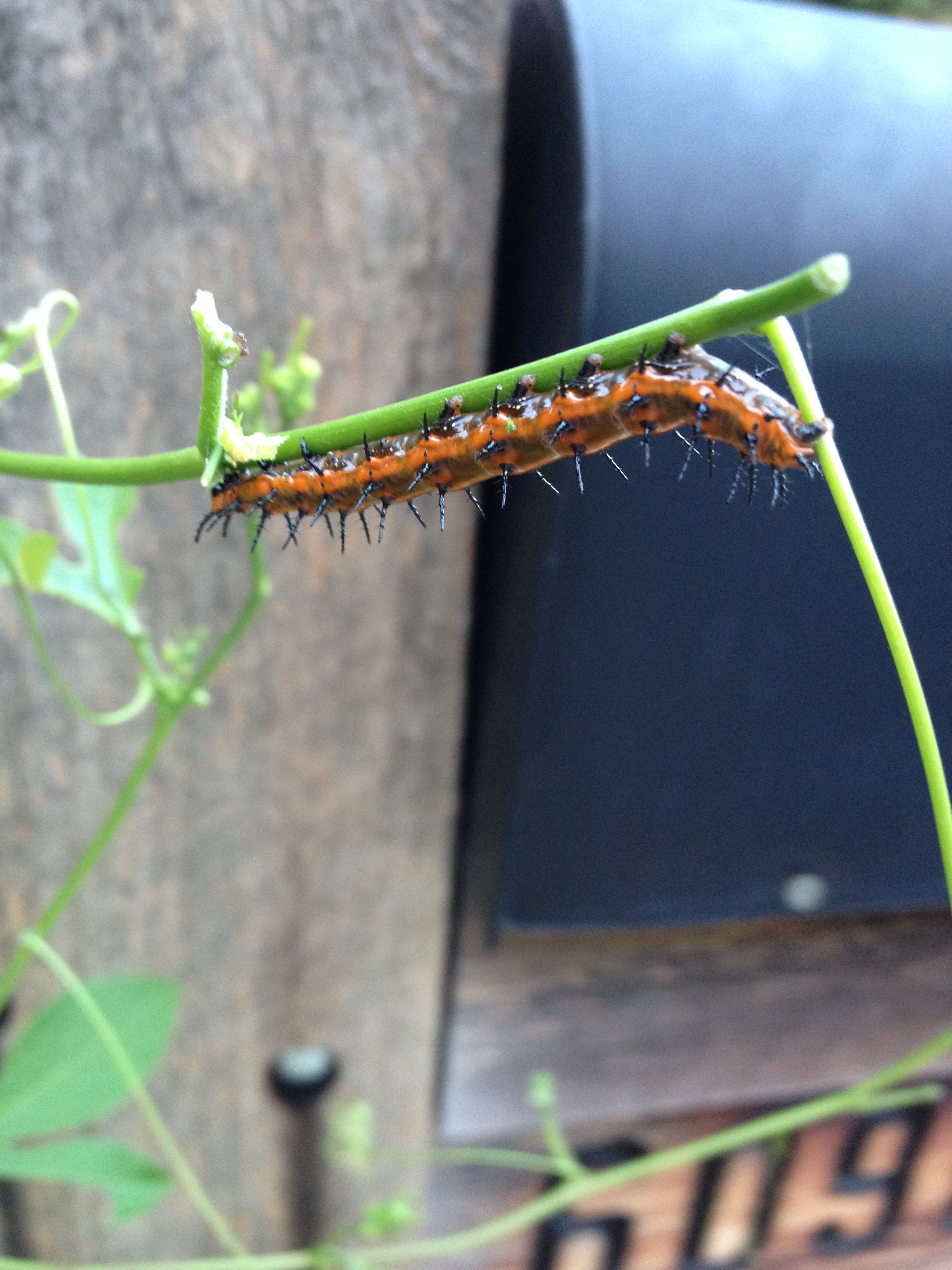
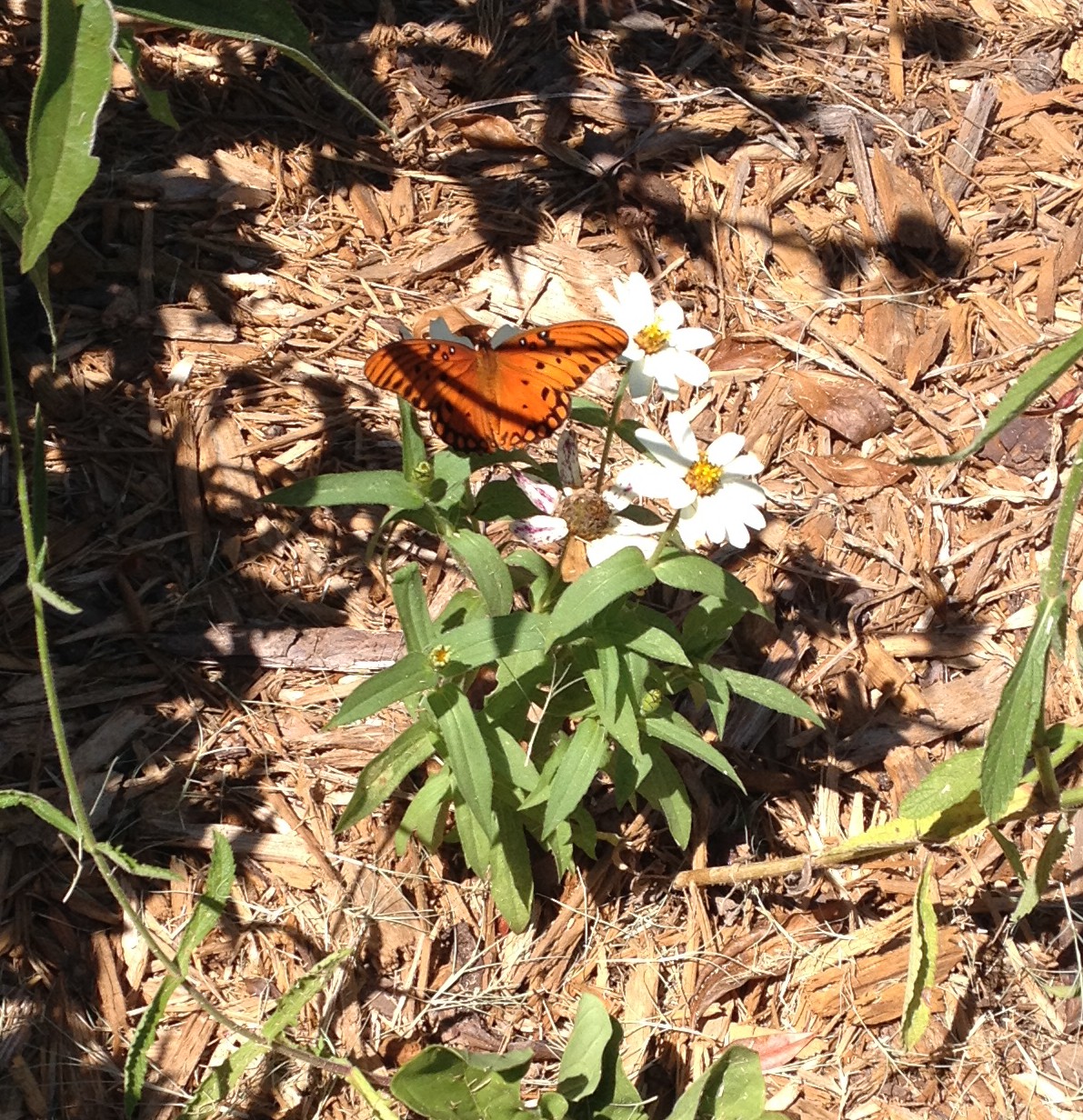
In addition to the beautiful flowers, I learned Passiflora serves as a host plant for the larva of the Gulf fritillary, a lovely bright orange butterfly with black markings. The Gulf fritillary is so-named because of its migration across the Gulf of Mexico. Sure enough, one morning when I went out to get my newspaper, I spied the first of what would be several waves of caterpillars to feast on my vine. Although the orange caterpillars don’t sting, they have rows of soft black spines. The black and orange stripes warn potential predators of their toxicity and so, even though my little crop of caterpillars was munching away in plain view, the birds left them alone to eat and grow. And eat and grow some more!An early caterpillar

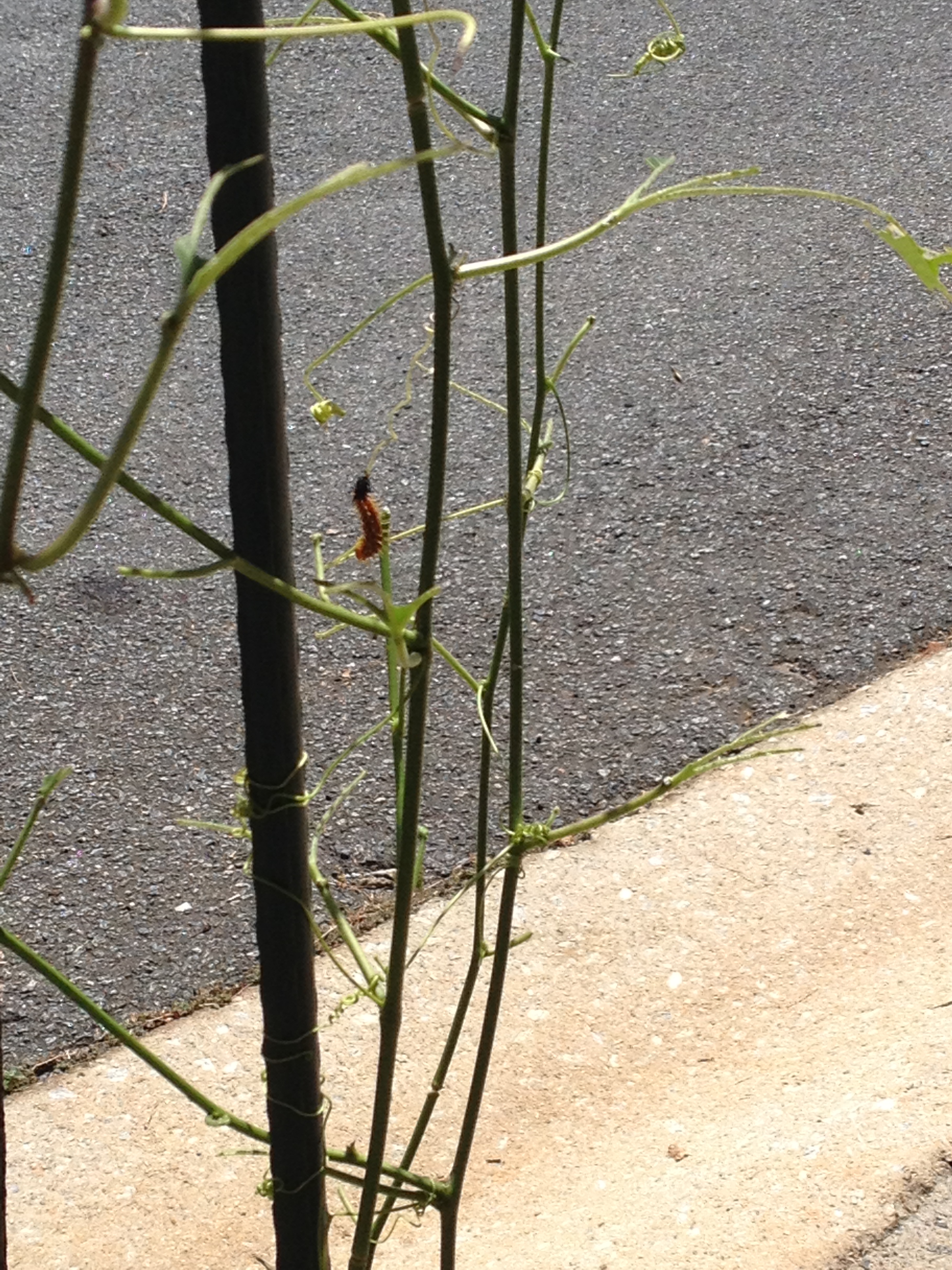
I delighted in watching the caterpillars, checking on them every morning when I went to retrieve my newspaper and every afternoon when I went to the mailbox. Then one afternoon they were all gone. The first group, in its entirety, had disappeared in the four hours or so between my two daily treks down the driveway. Search as I might over the next few days, I couldn’t find any of the chrysalises. Soon more tiny but ravenous caterpillars appeared and started munching their way through the remaining leaves.A late catepillar

Noticing the bedraggled appearance of my vine, a well-meaning friend asked what I was planning to use to “take care of” the voracious intruders. I explained that the caterpillars would turn into butterflies and I was willing to sacrifice my plant so they could complete their life cycle. As a matter of fact, I was rather in awe of the ability of the mother butterflies to find my vine in the first place. It was small (and getting smaller every day), the only Passiflora on my property and possibly the only one for miles around. Yet because of the innate capability God instilled in them, the fritillaries found, and deposited their eggs on, the only genus of plant their caterpillars feed on. After some more cycles of hatching and eating, there were no more leaves (or buds) left on the vine and the subsequent generations were left to eat the stem. As I watched them gnawing away, I could only imagine that the stem was much tougher than the tender leaves.

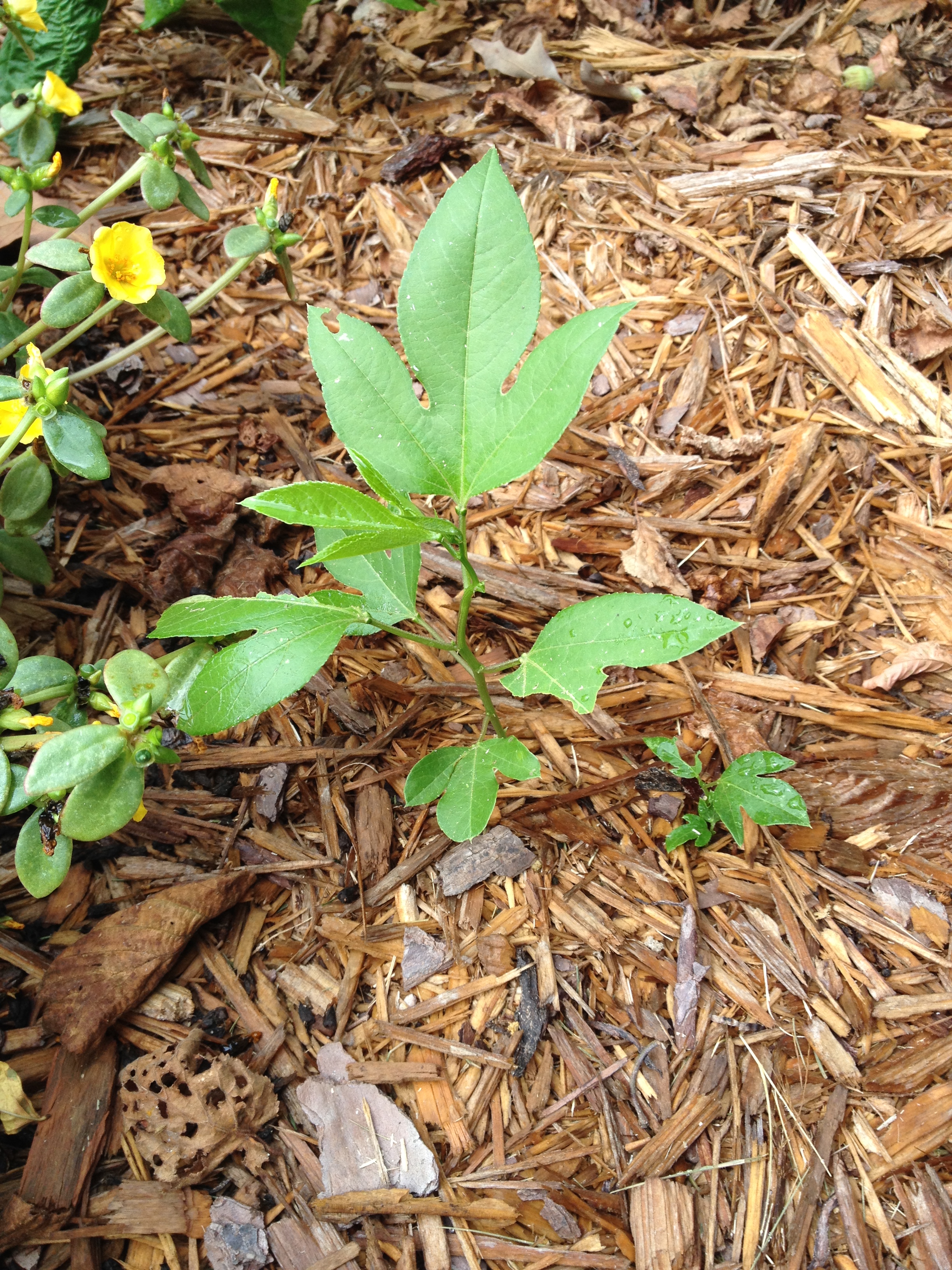
With each successive hatching, there were fewer and fewer caterpillars, probably due to the dwindling food supply. The last hatching yielded only one caterpillar. I checked on him from time to time as I worked in my garden last Saturday afternoon, watching as he valiantly stripped and then ate the outer, green layer of the vine. A couple of days before I noticed a Passiflora seedling had sprouted not too far from the mother plant. After some deliberation, I decided to gently remove the solitary caterpillar from the leafless vine and place him on the seedling, which already had several leaves. I held my breath as I watched him crawl down the short stem of the seedling, hoping I hadn’t confused him when I disrupted his resolute consumption of the tough vine. Fortunately, my fears were unfounded. After a few seconds of exploration he settled in at the base of one of the leaves and resumed eating. I continued to check on him throughout the afternoon, content to see him making headway on the tender leaf.

A tasty last mealThe next morning, when I looked at the seedling, there were two half-eaten leaves but no sign of the caterpillar. I smiled, hoping the leaves had provided a tasty last meal for him before he crawled off to spin his chrysalis.

Over the past month, I’ve seen a number of Gulf fritillaries fluttering about in my garden, no doubt the result of some of the caterpillars I took such joy in watching eat and grow. It was worth sacrificing my Passiflora although knowing how that particular vine can spread around and having already found several more seedlings, I’m hoping next year there will be enough to feed a passel of hungry caterpillars AND provide some exotic flowers for me to enjoy!

As I considered how the Gulf fritillaries faithfully laid their eggs on the right plant, thereby providing the proper food for their offspring, I was reminded that God has provided his Word, both written and in the flesh, to nourish us spiritually. Jesus quoted the Old Testament when he resisted Satan’s temptation to “turn stones into bread” so He could satisfy his hunger after forty days and nights in the wilderness, saying, “Man does not live by bread alone, but on every word that comes from the mouth of God”. (Matthew 4:4) Later in his ministry, He referred to himself as the “true bread from heaven”, saying, “I am the bread of life. He who comes to me will never go hungry, and he who believes in me will never be thirsty.” (John 6:35)

My thoughts also turned to the very hungry caterpillar in the beloved children’s book of the same name by Eric Carle. For the first six days of his existence, the storybook caterpillar ate everything that appealed to him, eventually giving himself a stomach ache. It wasn’t until day seven, when he “ate through one nice green leaf” that he felt better. Like the caterpillar in Carle’s book, we are tempted to feed on many things other than the spiritual nourishment God has provided and, similarly, we often find those things to be poor substitutes for the sustenance we need and crave. Instead, may we be as single-minded as the determined Gulf fritillary caterpillars to seek out and consume our designated food, being fully satisfied by the sufficiency of the Word. Gulf fritillary butterfly