Sunday before last, I had the privilege of attending two special services. That morning I watched as my 7-month old granddaughter, Emma, was baptized. Four generations were present as her parents vowed to bring her up in the nurture and admonition of the Lord.[1] As the congregation promised to come alongside Mary and Justin as they raise Emma, I prayed she won’t be able to remember a day when she doesn’t know God loves her. I made a similar supplication when my daughters and other grandchildren were baptized, for there is no greater assurance than knowing you’re a child of the King.[2]
Later that day, I attended the memorial service for the mother of my dear friend, Susan Hunt. Mrs. Mac, as most affectionately referred to her, was 99 years old when she was called Home. She was ready. Her health had been declining for some time and, knowing the end of her earthly life was drawing near, she had been planning her funeral. Susan related that at times it felt like they were planning a party, as she and her daughters helped Mrs. Mac select hymns and scripture passages for the service. There was certainly a celebration that afternoon, of a life well-lived by a godly woman whose death was precious in the sight of her Lord.[3]
Our pastor, who shared 1 Corinthians 15:50-58[4] with Mrs. Mac just minutes before she passed away, spoke on the Apostle Paul’s declaration in Philippians, “For to me, to live is Christ, and to die is gain.”[5] Indeed, for believers, death is the gateway to eternal life in the presence of God. Yet even at Emma’s tender age, as she gets bumps and bruises from toppling over while learning to crawl, this life presents challenges. Jesus didn’t downplay the difficulties and hardships we’d face. He told his disciples to expect them, but added the promise He’d overcome the world. [6] And while we’re here, we’re called to do all to his glory[7], keeping our eyes firmly fixed on him, not our circumstances.
Pastor Todd Allen had the closing prayer, a sermonette in its own right, at Mrs. Mac’s service. Now 92, he proclaimed the same truth he declared at Ray’s funeral over 19 years ago. Speaking words of hope and assurance, Pastor Allen reminded us that when the days allotted to us are over, we too will be welcomed Home. What an encouragement to see the consistent faith of this senior saint across the years, a faith and consistency shared by Mrs. Mac and others who’ve gone before us. May we, like them, be able to say with the Apostle Paul when our days here are coming to an end, “I have fought the good fight, I have finished the race, I have kept the faith.”[8] The One who is with us from beginning to end, the Alpha and the Omega[9], is worthy of all praise, glory and honor. [10]
[1] Ephesians 6:4, King James
[2] 1 John 3:1
[3] Psalm 116:15
[4] This passage includes the proclamation, “Death is swallowed up in victory.”
[5] Philippians 1:21
[6] John 16:33
[7] 1 Corinthians 10:31
[8] 2 Timothy 4:7
[9] Revelation 1:8, Revelation 22:13
[10] Revelation 5:12
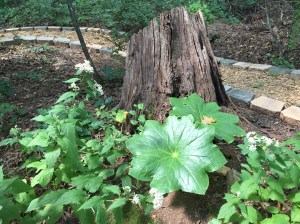 One recent day as I walked the property checking on plants and critters, my clothes soaked with perspiration from the afternoon’s exertion, I thought, “This is a happy garden.” And so it is. As I’ve alluded to before, there are certainly weeds and unsightly areas I need to attend to, but my Father has tucked all sorts of gifts and surprises onto the 1/3 acre He’s entrusted to me. A few current examples:


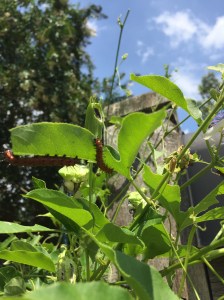 all things are made new. My finite mind can’t comprehend the splendor in store, but my heart rejoices in the assurance God will dwell among his people forevermore, our eternal source of light and life.
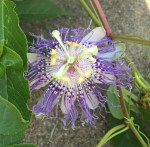 Not only are the flowers intricately beautiful, but Passiflora is the only host genus for the Gulf Fritillary butterfly’s caterpillars. (See “Very Hungry Caterpillars”, September 2014 for more info.)
 “Righteousness will be his belt and faithfulness the sash around his waist. The wolf will live with the lamb, the leopard will lie down with the goat, the calf and the lion and the yearling together; and a little child will lead them. The cow will feed with the bear, their young will lie down together, and the lion will eat straw like the ox. The infant will play near the cobra’s den, and the young child will put its hand into the viper’s nest. They will neither harm nor destroy on all my holy mountain, for the earth will be filled with the knowledge of the Lord as the waters cover the sea.”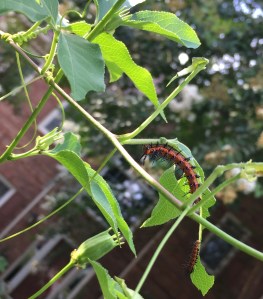
 She starts to fidget as soon as she feels my arms (and herself) move away from my body and works up to a full-on wail by the time I get her into her bed. I quickly cover her with a soft blanket and begin to rub her back and pat her bottom to ease the transition. Inevitably one tiny hand reaches for her mouth and extracts her pacifier. As of now this is a one-way maneuver – she hasn’t quite figured out how to put it back. The result: more fussing. In an attempt to keep her from dislodging her paci, I offer her one of my fingers to hold as she dozes back off.
 Siblings Joshua and Lyla will offer Emma one of theirs from time to time and then exalt, “Look! She’s holding my finger. She likes me!”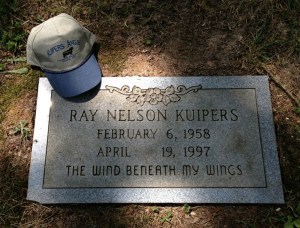
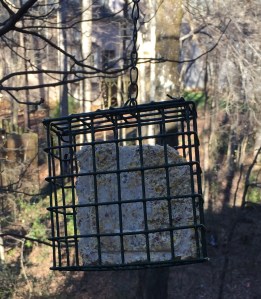 Brown thrashers are among those who want to partake of the high-calorie goodness. To say they have trouble steadying themselves on the suet basket would be a significant understatement. Inevitably, when one lands on the suet, it starts to wobble. This in turn causes the bird to flap frantically which results in the basket spinning around, bringing about another flurry of desperate flapping. It’s a rather comical sight, but also somewhat sad because the thrasher’s behavior keeps him from the nourishment he’s seeking .

 Back 2 the Garden